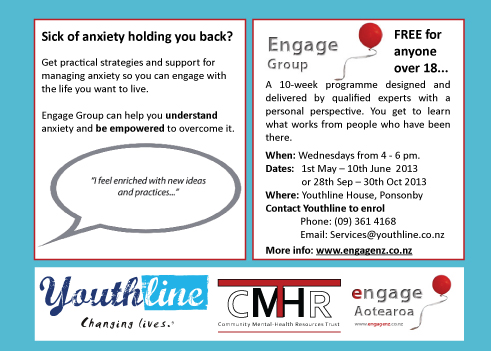
Click here to find out more about Engage Group and save a copy of the information sheet.

Here are the frequencies for The Nutters Club new home on radio Newstalk ZB – first show this Sunday 21st April from 11 pm-1:00 am…
“yes we know it’s late,” says host Mike King, “but look at the positive people…we are back!!!”
These are the Newstalk ZB Frequencies across NZ
Changing Minds is pleased to announce the public release of “Partnership and Tangata Whai Ora: Report from Changing Minds Community Forum.” The report contains feedback from a range of forum attendees and other interested tangata whai ora, and we hope that this information will be well received by mental health and addictions service providers. Our goal is to provide a space for tangata whai ora to speak, and this report holds a great deal of wisdom and insight into what services are currently doing and how things could be improved. It describes challenges that people have faced, and recommendations for improving the quality of services for everyone…Read More
EngageNZ needs two volunteers to help keep two of their most widely-used recovery resources happening, The Community Resources Directory and the Mental-Health News and Events Blog. These resources aim to inform the public about what recovery resources are available for them – information is power and sharing information is an empowering act. By volunteering for Engage Aotearoa you can help empower others to find what works for them.
If you answered yes to those three questions, you might be just the person EngageNZ is looking for. You can be based anywhere in the country, because you will be working mainly online.
You would be responsible for finding and adding information about recovery resources to The Community Resources Directory and sending in an updated directory at the start of each month. You will be as passionate as EngageNZ is about connecting people across the country with the resources they need to recover from mental-health problems. So much is available, but it so hard to find out about it. Your work will help solve that problem. Some information you will receive by email and other information you will need to find through your own research and detective-work.
Skills Needed:
You would be responsible for updating the Mental-Health News and Events Blog twice a week. There are so many events, groups and announcements happening in and around the mental-health sector. Your work will help make sure they can all be found easily, in one place. You will receive mental-health news and events notices by email and twice a week you will add them all to the Mental-Health News and Events Blog using WordPress and share the most interesting ones on the Engage Aotearoa Facebook Page.
Skills Needed:
To apply, please send a brief CV, photograph and cover letter to Engage Aotearoa.
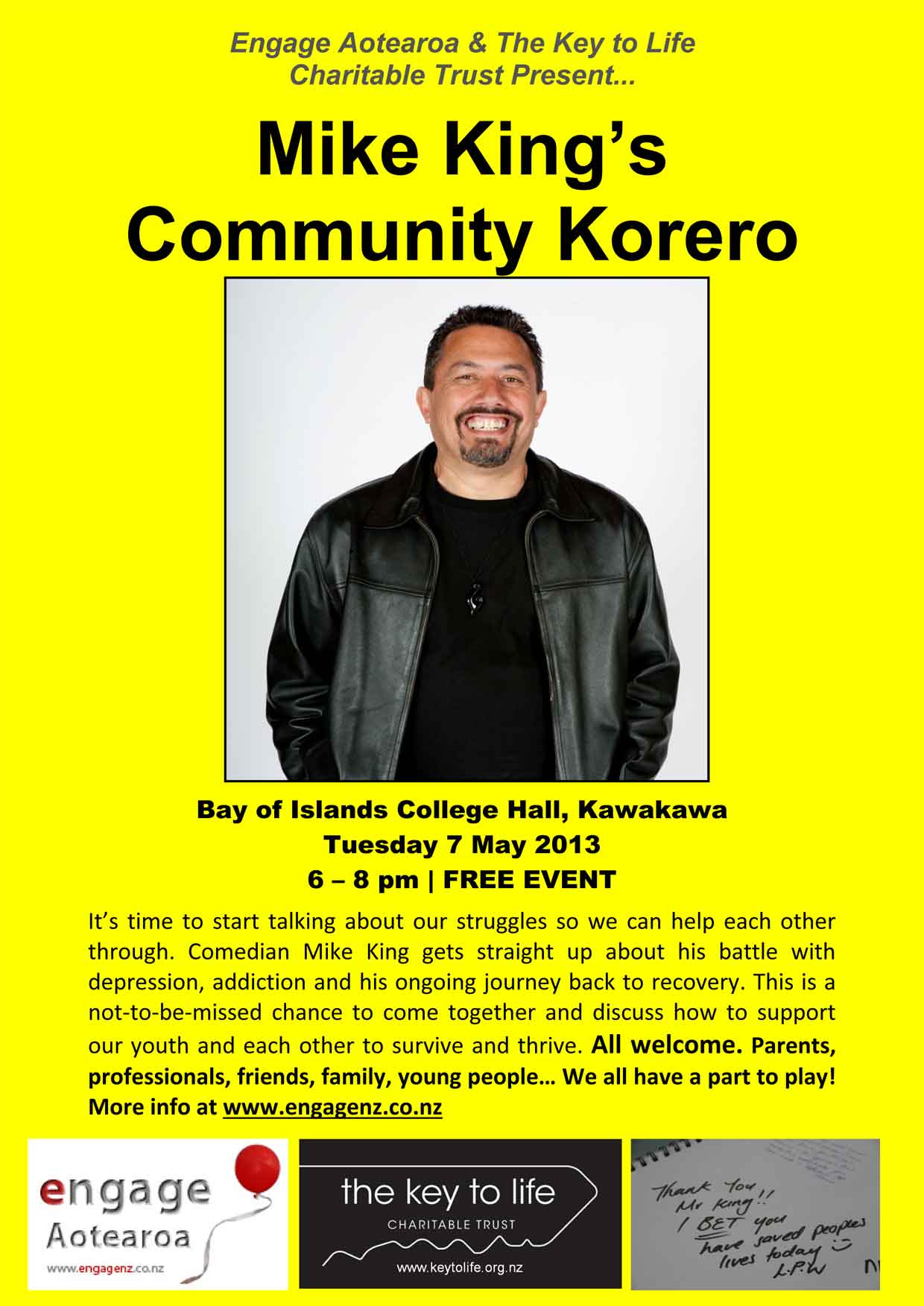
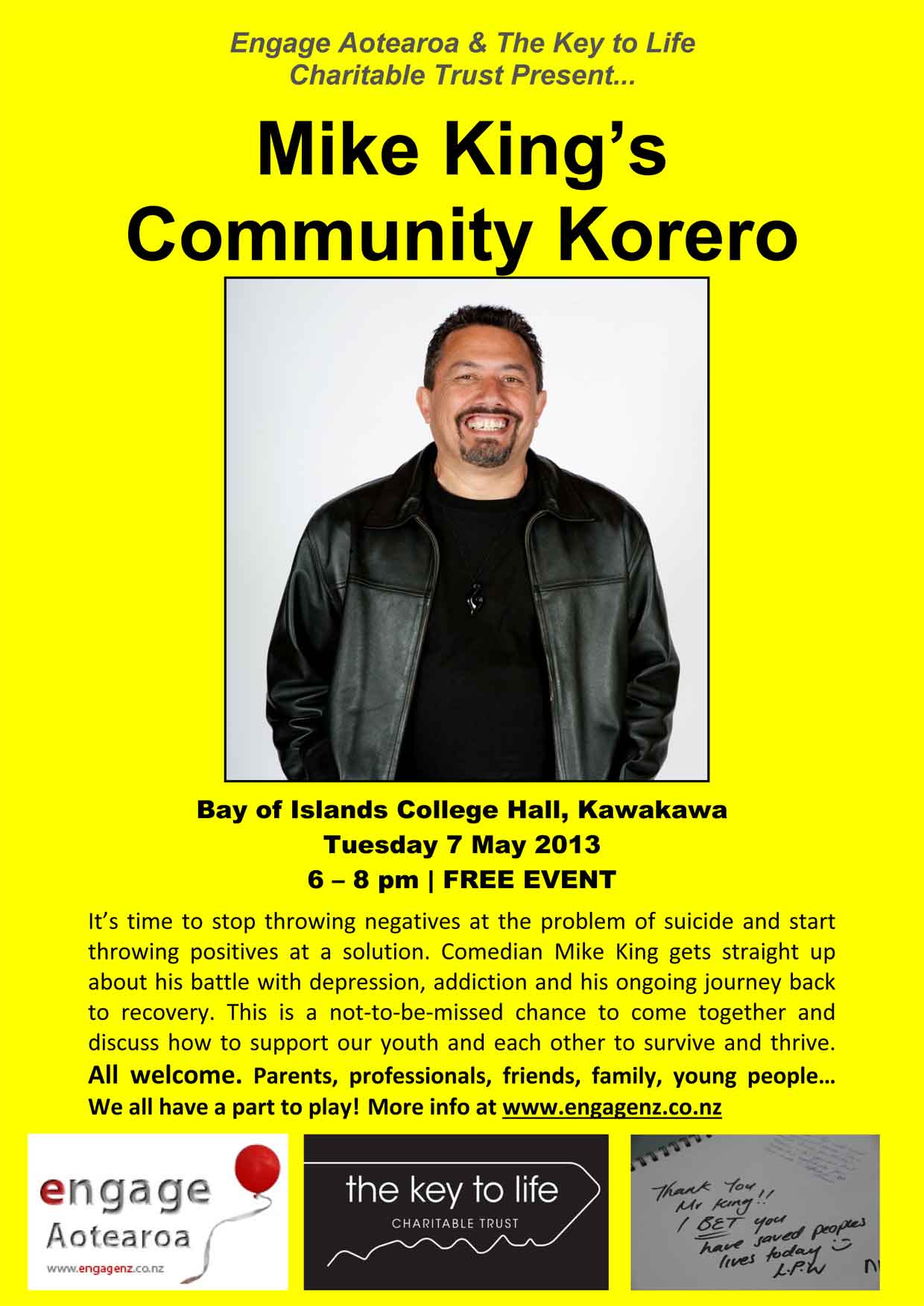
Engage Aotearoa and Key to Life Charitable Trust will be taking the Mike King Korero to Kawakawa on the 7th of May for two sessions at Bay of Islands College. In the morning, students at Bay of Islands College will get the chance to take part in the Cool to Korero seminar that aims to encourage students to talk about their problems with people they trust before things get on top of them. In the evening, community members will be able to take part in the Community Korero to discuss how to help prevent suicide in their town.
Click here to check out photos and feedback from the Whangarei Korero.
Annie Chapman is walking the length of the north island following the Te Araroa trail to raise awareness of the need for better mental-healthcare choices in NZ. She’s on a mission to take a petition to parliament seeking improved options for people using public mental health services across the country. Across April and May she’ll stop off at a range of different towns to touch base with locals and collect signatures.
Itinerary for April and May 2013
Times and venues for Community Hikoi Meetings coming soon.
If you are interested in organising a Hikoi Meeting for your group or community contact Annie Chapman’s new volunteer Hikoi coordinator, Miriam Larsen-Barr by emailing admin@engagenz.co.nz
Keep yourself in the loop at the official Facebook event.
And don’t forget to sign and share the petition!
If you’d like to know a bit more about what this Hikoi is all about, please click here to watch a short video taken of the Hikoi Meeting in Whangarei.
Media Release: Engage Aotearoa & The Key to Life Charitable Trust
For Immediate Release: 01/04/2013 | Updated 5/04/2013
_ _ _
Mike King’s Community Korero will hit Whangarei from the 8th to the 9th of April to throw solutions at the problem of suicide, with a series of public seminars. NZ has one of the highest suicide rates in the developed world, especially among older people and youth. Estimates suggest that 1 in 6 New Zealanders have suicidal thoughts every year. As Mike King puts it “The Korero encourages people to help fight suicide by talking and supporting each other rather than taking their own lives. Silence is not the solution.” Rather than simply telling people they need to talk, King leads by example; Through sharing his own story, he opens the way for community members to share theirs.
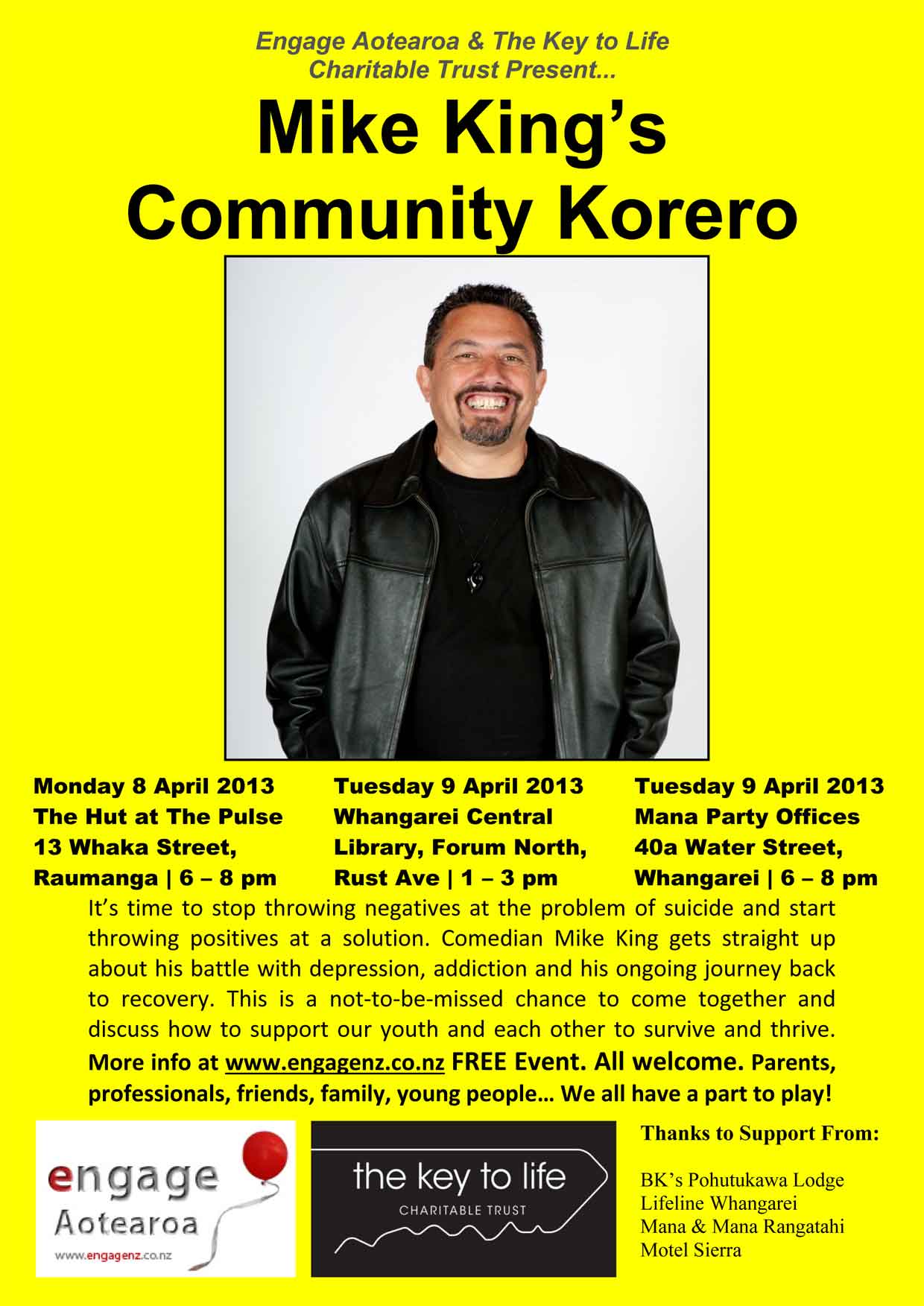
In the Community Korero, comedian Mike King gets straight up about his battle with depression, addiction and his ongoing journey back to recovery, including the mistakes he made along the way. This is a not-to-be-missed chance for communities to come together and explore how to support our youth and each other to survive and thrive. People can ask the questions they have always wanted to ask during a Q & A session at the end of the talk where Mike is joined by Engage Aotearoa service director Miriam Larsen-Barr, who also has a lived experience of recovery from being suicidal. Together they are an example of how the issue of suicide can affect anyone, Pakeha and Maori, men and women, young people and adults.
The Q & A is a chance for local professionals, parents, teachers and people with personal experience of these issues to discuss how we as individuals and communities can use our experiences to prevent suicide. Those with questions can ask them and those with knowledge can share it. Feedback from the Community Korero in Kaitaia included comments like “loved it”, “amazing evening, Mike opening his heart and bringing this community together” and “we should have another one I reckon.”
The initiative hopes to reach local schools in Whangarei in the future, through Cool to Korero, a special student-centred session that gives kids a chance to seek help and empowers youth to lead the way in creating supportive school and community environments. At least 20 students came forward to seek help for active suicidal thoughts after the Kaitaia and Taipa talks and were linked in with support.
Students commented “It was mint. I like how you approached the subject like not too serious and yeah, shot oi!”, “Thank you so much, words don’t suffice” and “you should come back mah gee!” Teachers commented “Thank you for giving our rangatahi options to stand up, speak up and seek help” and “I BET you have saved lives today.”
Community Korero is open to the public and a resource table provides plenty of take-home information about everything from suicidal thoughts and supporting someone who is suicidal to recovery and community services. Local services are welcome to bring information to share with the community too – people can simply bring their materials along and add them to the table.
Larsen-Barr comments “suicide is a really hard issue in our communities. There are so many people who are prepared to help and who are already helping. When our powers combine, I truly believe great things will happen. But first, we need to talk about it. Mike’s Korero creates a space to do that.”
For more information visit www.engagenz.co.nz and click on Mike King Talks.
___ ENDS ___
This week to attain, maintain, or regain my sense of wellbeing...

...I will practice being mindful of my breath as a way of changing my state of mind in the moment.

This week, I will try to pause at least once a day to spend a few minutes simply noticing my breathing, as I observe my thoughts and come back to being aware of my breaths.  Observing my thoughts means that as I notice my mind has wandered I describe what I am thinking to myself in my head. For example I might say to myself "Oh I am thinking xyz about work right now..."  and then I will turn my mind to noticing my breathing. Observing and describing my thoughts might help me express to myself what is really going on for me.

I won't try to change my breathing at all, I will simply sit still for a few minutes while I breathe and notice myself breathing. As I see thoughts come into my head, I will notice what I am thinking and then I will bring my thoughts back to my breathing. I will notice the sensation of the breaths as they come in and out, I will notice the temperature of the air, the sound of my breathing, the way the breath feels on the way in and the way it feels on the way out. While I notice my breathing and observe my thoughts, I will practice having compassion for myself  and not criticising myself for the thoughts I have. Even if I notice myself criticising myself, I will simply bring my thoughts back to my breathing without further judgement. After a few minutes, I will open up my eyes and come back to my day.

It might seem pointless at first, but giving ourselves a chance to be mindful of our breathing has been shown to help a lot of people feel calmer about things, even though it doesn't change the situation. Taking time to be mindful of our breath can help us  feed ourselves the air we need to have a clear head and give us the space we need for our thoughts to become clear to us.

Once I am used to spending some time being aware of my breathing while I observe my thoughts, I will add this exercise to my Personal Coping Kete as a way of dealing with stress and distress. When I notice myself becoming tense or upset, I will pause and spend some time focused on my breathing while I observe my thoughts without judgement and come back to my breath. No matter what happens, I am still here breathing. This can be an excellent way to give myself some space when things are tough. Sure, breathing doesn't change anything I am facing, but it gives me some time and room to clear my head and become aware of where I am at in the moment, so I can move forward through my day with awareness and a bit more clarity.

Acknowledgement: Mindfulness can be traced back to buddhist philosophy. Thich Naht Hanh is known for creating the Engaged Buddhism movement  and popularising mindfulness in the Western world. Jon Kabbat-Zinn is known for popularising mindfulness in the medical community with the Mindfulness-Based Stress-Reduction (MBSR) programme at the University of Massachusetts. Marsha Linehan is known for popularising mindfulness in the mental health community with Dialectical Behaviour Therapy (DBT).  The basic practice of mindfulness features in many strategies shared in The Coping Kete. Once you learn the basic skills, you can use mindfulness in any moment you find yourself in, in countless different ways. There is an awful lot behind each of the skills involved. Follow the links above to learn more.
Avatar therapy for persecutory auditory hallucinations: What is it and how does it work?
Julian Leff, Geoffrey Williams, Mark Huckvale, Maurice Arbuthnot & Alex P. Leff
Psychosis, 2013, DOI: 10.1080/17522439.2013.773457
From the abstract: “[Avatar Therapy is] a novel therapy based on a computer program, which enables the patient to create an avatar of the entity, human or non-human, which they believe is persecuting them. … The therapy was evaluated in a randomised controlled trial with a partial crossover design. … There was a significant reduction in the frequency and intensity of the voices and in their omnipotence and malevolence. Several individuals had a dramatic response, their voices ceasing completely after a few sessions of the therapy. …”