Engage Aotearoa

Report on Peer Support Worker Roles | England, 2014

New Ways of Working in Mental Health Services: A qualitative, comparative case study assessing and informing the emergence of new peer worker roles in mental health services in England
~ National Institute for Health Research, July 2014 

“Conclusions: Key barriers to, and facilitators of, peer worker role adoption were identified, including valuing the differential knowledge and practice that peer workers brought to the role (especially around maintaining personally, rather than professionally defined boundaries); maintaining peer identity in a role of work; changing organisational structures to support peer workers to remain well in their work; and challenging organisational cultures to empower peer workers to use their lived experience. Recommendations for future research include developing a theoretical framework articulating the change mechanisms underpinning ‘what peer workers do’, piloting and formally evaluating the effectiveness and cost-effectiveness of peer worker interventions, and mixed-method research to better understand the impact of working as a peer worker.”

Click here to read the full report

5 things I’ve learned about surviving my darkest struggles

RecoveryNotes_WebImage
Five things I’ve learned about surviving my darkest struggles

Recovery Note #3

~ Taimi Allan


1. De-claw the Bear

Talking about the most difficult stuff (the unwanted thoughts, the frightening images, fears, guilt and panic) takes their power away. These things are waking nightmares designed by my brain to purge the rubbish and if I don’t find a way to let them out and dispose of them they become a self-destruct mechanism. Speaking them aloud to someone empathetic and non-judgmental I can trust helps me to challenge their hold on me, come up with more balanced perspectives and talk through cause and solution.

2. Look for physical and environmental causes

Sure there are some moments where my distress/depression/mania/psychosis is an equal and opposite reaction to an external, significant, negative event; those moments are really tough and life feels very unfair. The upside of horrible things happening to me though is that it’s easy to see why my brain is in meltdown, and get support and empathy from others. Sometimes, however, it just hits me like a sledge hammer from seemingly out of the blue. In these times my experience tells me there is usually a physical cause, maybe my hormones have gone haywire, I’ve developed a food allergy, eaten unhealthily for too long (or not eaten at all) or typically, I’ve not had enough sleep. I know now that if I address the physical stuff, nurture my temple then my mental health follows.

3. Avoid the Sirens-song of Substances

We all know the myths of sailors lured by beautiful Siren song only to become shipwrecked on the rocks. It is very easy in my darkest moments to reach out for the easiest means of escape. “Self medication” for me nowadays is junk food and wine. In my darkest moments it is tempting to use them, or something more destructive as a quick way of blocking out, avoiding or putting off dealing with what’s really going on. I learned the hard way that even taking a single step in this direction when I’m unwell is bad, bad news. As difficult as it is, I need to remove the temptation completely from my home, my friendships and my life until the moment has passed and I feel in control enough to simply eat respectfully and drink in moderation.

4. Observe moments of choice

Mental distress is like a pot-bellied stove, it gets stronger by feeding on every little piece of negativity and fear and yet it is warm and inviting. It is easy to fall into the comfort of distress, it sounds contradictory but life IS unfair and horrible so sometimes the only thing I really want to do is escape under the bed-covers, take a respite from responsibility and shut out the world. In every single millisecond however I know I have a choice to turn that around. I forgive myself for needing a moment to wallow, then as soon as I notice the moment that don’t have to punish myself or anyone else, I make the conscious choice to do something different.

5. Take responsibility

Here’s the truth as I see it for me; it is not the rest of the world, the people around me, services, doctors or pharmaceuticals job to ‘cure’ or ‘fix’ me. They are helpful aides when I need support, but without my buy-in, they actually don’t have much effect. In fact, if I blame anyone or anything outside of myself I know the situation very quickly deteriorates. That doesn’t mean I need to blame myself, but adopting a radical acceptance of the situation I’ve found myself in and a willingness to do everything I can to improve it gives me back some semblance of control. It’s fair to say that when I’m at my worst, I feel completely out of control, so this step towards autonomy is imperative to becoming whole again.

~ Taimi Allan

_ _ _ _

About the author: Taimi Allan has worked as a mental health consultant since 2009. She is most well known in the field for innovative and engaging health promotion strategies that challenge attitudes, inspire creativity and entertain audiences.

Read more Recovery Notes here 

Recovery Notes is an Engage Aotearoa project that asks people to share the top five tips and insights they have learned from or about their personal experiences of mental-health recovery or being a supporter.

Write your own Recovery Note

_ _ _ _

Copyright (c) Engage Aotearoa, 2014

Highlights from Engage Aotearoa on Facebook

Some updates from our Facebook page (Like us!):

Issues requiring “urgent attention” in the mental health service at Palmerston North Hospital were identified in an audit.

Every day brings a chance for young poets to be heard
New Zealand Herald talks about how being young can often mean a lot of people will disregard what you have to say.

Big Brother Is Feeling You: The Global Impact Of AI-Driven Mental Health Care
An article about the automation of psychology and the first AI-psychologist.

HYPE – Helping Young People Evolve
Sharing love of hip-hop and getting experience in music.

17 Beliefs About Sexual Assault That Are Totally Wrong
Despite the high-profile cases in the news lately, Cosmopolitan writes about major misconceptions that persist.

The Coping Kete No. 156: Extend the Image
I will practice using extended imagery as a way of coping with unhelpful thoughts of the future that hold me back.

Engage Aotearoa: Update from the Service Director

It’s Mental Health Awareness Week from 6-12 October 2014 and World Mental Health Awareness Day on October 10th.  Seeing as every week is Mental-Health Awareness Week at Engage Aotearoa, now seems like a good time to give everyone an update about what’s on the horizons here.

RecoveryNotesPromo2014Recovery Notes: Recovery Notes is a new series of blog articles by people with lived experience of recovery highlighting the lessons they have learned about or from their experiences. The CMHRT board of trustees are in progress with writing contributions that share the lessons they have learned from their journeys and the first one is out today. If you would like to try your hand at writing a Recovery Notes blog article, submissions are welcome from anyone with lived experience of recovery or being a supporter. Click here to read the Recovery Notes Writing Guidelines first.

Upgrading The Community Resources Directory: Engage Aotearoa went to a LifeHack Weekend earlier this year and got some help to get started with upgrading The Community Resources Directory so you can create a customised directory filled with the services for your region. The web-app is still in development and the volunteer directory editor, Cath, is continuing to add new services to the directory as we work on creating a truly nation-wide resource. You might notice the downloadable document got shorter recently – the team made the font smaller, to fit more on each page, so there’s actually more information listed than there was before. Don’t forget to keep sending your directory additions to Cath by emailing directory@engagenz.co.nz

One Year Anniversary of The Butterfly Diaries Vol 1: It has been one year since the launch of The Butterfly Diaries and the team has distributed over 700 books from Kaitaia to Invercargill and everywhere in between. Copies have been ordered by teenagers for themselves and their friends, worried family members, schools, counsellors, psychologists, psychiatrists, GP doctors, corrections facilities and universities. With no promotional budget and no funding outside of community donations, the team at Engage Aotearoa are pleasantly surprised that so many copies have already found wings. You can help raise awareness of the books by printing and placing a poster somewhere public or sharing one of the book reviews on social media (find them here and here).

The Butterfly Diaries Vol. 2: Engage Aotearoa continues to work on The Butterfly Diaries Volume 2 and it’s very close to publication. Volume 2 shares the stories of Jane and Tess. Jane has a history of difficult family relationships and intense emotions. Tess has a history of childhood trauma, domestic violence and dissociative identity disorder (often known as multiple personalities). Written by  Genevieve McClean and Maureen Irvine,  Between the Sun and the Moon, and Rebuilding Camelot tell two true stories of surviving the hardest parts of humanity and finding a way to thrive despite it all. Engage Aotearoa needs your help to publish The Butterfly Diaries Volume 2 and keep Volume 1 in print. Make a tax-deductible donation for Mental Health Awareness Week.

The Coping Kit Smart Phone App: It’s still coming! Good things take time.

5 things I’ve learned about supporting friends in distress

RecoveryNotes_WebImage

Five things I’ve learned about supporting friends in distress

Recovery Note #2

by Sheree Veysey


As a person who has experienced my fair share of mental distress and who now works in the counselling field, I have learned a few things about how to be there for someone who is upset and how to ask others to be there for me.  I wish this list had been available for me to give my friends and supporters in times  past – I lost a few of them, at least partly because of the stress that supporting a friend who has longer term “stuff” going on put on our relationship.

1. You don’t need to fix: you don’t need to make someone feel better

We live in a fixing culture, and often when someone tells us what’s going on for them, we jump immediately to problem solving, or ideas for the person to do things differently to make them feel different. This is often not helpful as frequently the person can feel that they are not heard. This may also give the message that their less pleasant feelings are somehow ‘wrong’ and that if they tried harder to ‘fix’ them they would not have issues…

Instead of aiming to help someone feel better, if we concentrate on listening to their experience and validating it then often the person will walk away feeling heard, less alone, (and not surprisingly often feeling a touch better). Validating people’s feelings and experience is about just acknowledging where they are: “I can see how you would feel that…” “Wow, that’s a lot going on” “No wonder you feel overwhelmed.”

The opposite is invalidation (e.g. “I don’t see what the big deal is.” “There’s no reason to get so upset”) which can leave people feeling isolated and awful about themselves.

2. Friend and support versus therapist…

If someone is dealing with high levels of distress, then I would be strongly encouraging them to be engaged with health services (doctor, counselling, psychologist, mental health services) rather than just using friends for support. Counsellor’s and others who work with people in distress receive comprehensive training and regular supervision. Part of the reason they are able to offer such intensive listening and support to a person is because of this- and also because the time they give has boundaries around it and clear expectations.

When we try to be there for someone in a lot of distress outside of these professional relationships, often we start out with lots of energy and listening time and empathy. However, if the distress is not short lived, we often run into problems because we have not put boundaries around our time and availability. We  tell our friend to call us at any time of the day and night- and when they start doing this, the supporter can be left burnout, not wanting to hear from their friend, guilty about feeling this way and sometimes even experiencing what is called ‘vicarious trauma’ from listening to really difficult and traumatic experiences.

If you are aware of this pitfall, then you can set some boundaries with the person. Boundaries are our friends! Some of these may not need to be discussed and you can just hold them in your own head, others you might like to talk about. You need to be clear about where your lines in the sand are about what you can and cannot offer: Are there things you don’t feel able to talk about with the friend and you would prefer they saw a professional? How late is it okay to call? What about if they are intoxicated? What if they are feeling that they might harm themselves? What if they want to stay over?

3. Think long haul 

The boundary setting above is crucial if you intend to keep this person in your life long term.

I have had times in my life when a dear friend has let me know she isn’t available for any support at this time. While in the moment I would have preferred it to be different, I also understood that her letting me know this was about her wish to be a friend for the long haul and to do this, she needed to prioritise her wellbeing.

I would far rather have her in my life for years to come, than lose this friendship because she got exhausted. In return I have learned to set similar boundaries with friends in distress – letting them know I care very deeply but I don’t have the capacity for support right now. I would always encourage people to be developing a number of supports for themselves- I feel it leads to far healthier relationships.

Some people experiencing distress are hyper aware of asking for ‘too much’, and as a result often won’t ask for support they need because of their fear. Talking about this issue can really encourage them to reach out at the appropriate time, knowing you will be able to say “not today” if you need to.

4. Reciprocity

When I was a teenager I had a good friend who didn’t tell me until weeks afterward that she was living with another family for a while because her parents were fighting and might be splitting up. I asked her why she hadn’t told me, and she said that she didn’t want to put any other stress on me because I was having such a hard time. I heard her thoughtfulness, but at the same time I was dismayed, because I didn’t just want a friend- I wanted the chance to be a friend. I would have liked to take the opportunity to give back to her with some listening and support. Our friendships work best when there are vaguely equal amounts of give and take- so don’t be afraid to ask your friend who is distressed for things you might need. If they can’t give this at the time- well this is also a good chance for them to practice boundary setting and say no (remember- boundaries are our friends).

5. Look after yourself

You matter, and you need to keep an eye on your own well-being. Sometimes when someone we love is really struggling we can tell ourselves we should just keep giving and giving to them because they are having a harder time than us. In the long term, this really does not do ourselves or them any good.

Don’t underestimate the stress of having someone you care about really struggling. Good sleep, a wide variety of food, some sunshine and physical activity are all important! Turn to your supports, and even think about seeing a professional if you feel you need to. This is great modelling to our friends, families and children.

Arohanui

Sheree Veysey

_ _ _ _

Sheree Veysey is a counsellor from Auckland offering counselling and coaching via Skype and face to face at www.lifeinprogress.co.nz. Her own journey toward wellbeing inspired her to work with people and offer them the compassion that helped her healing. Sheree is also a writer, dog owner, auntie and part-time performer.

_ _ _ _

Read Recovery Note #1: Five things I’ve learned about food and my mood

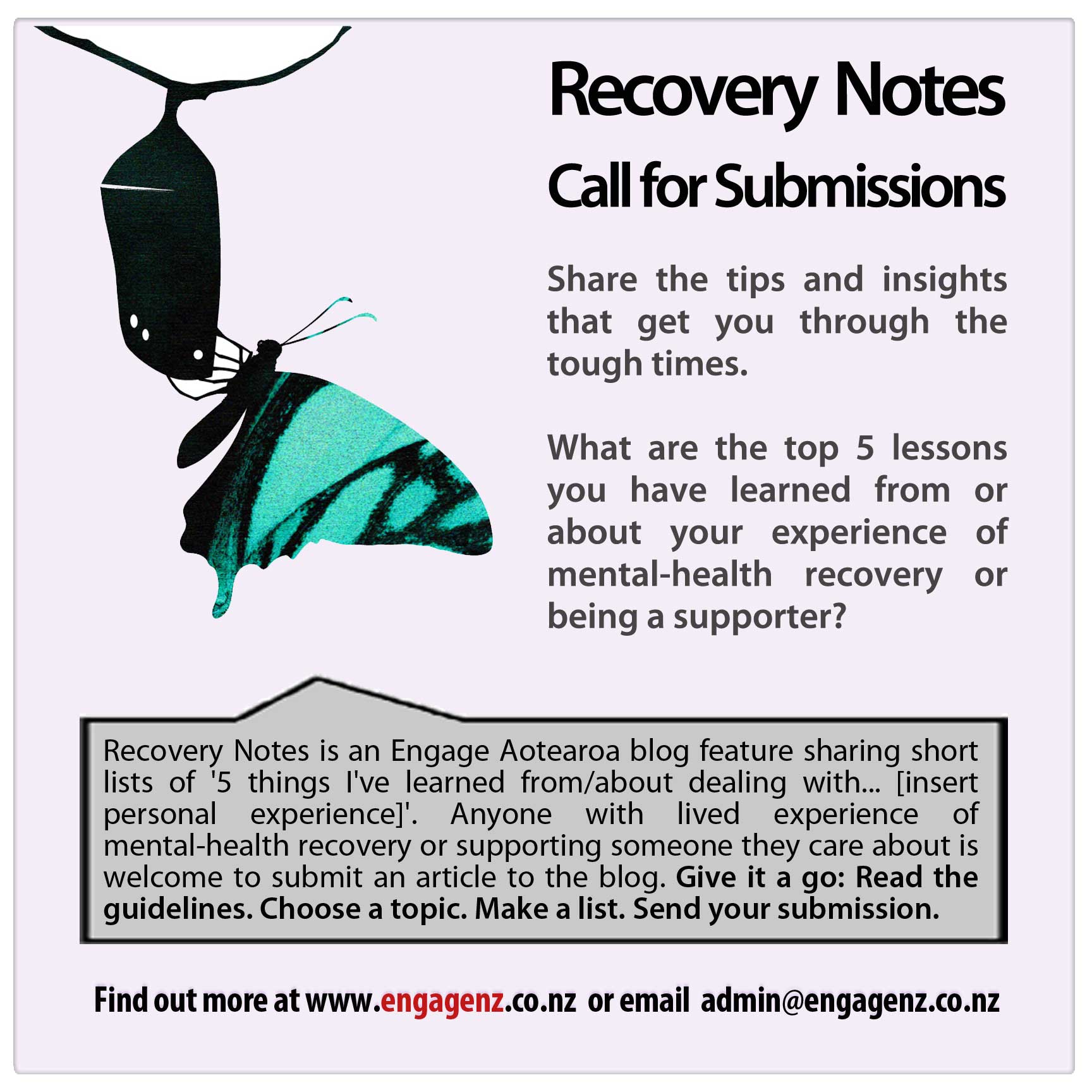
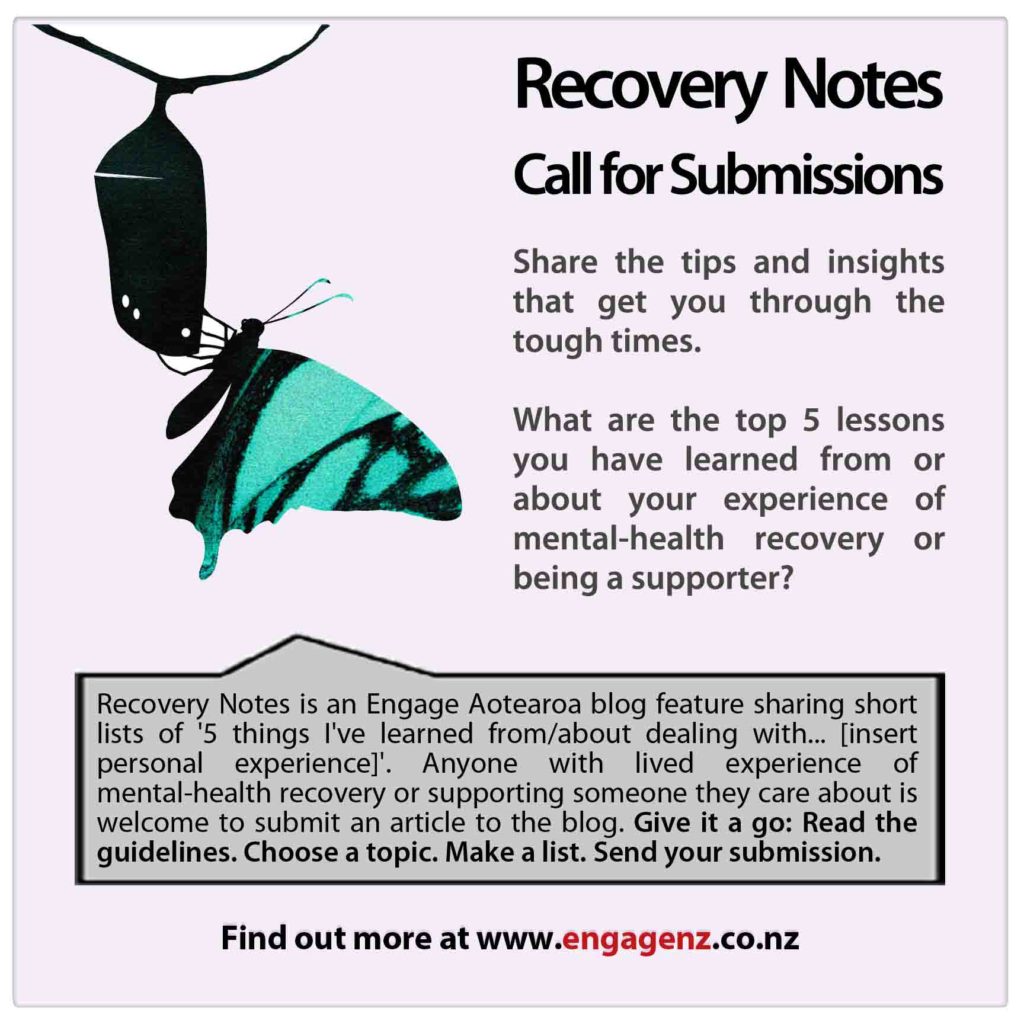
Recovery Notes Call for Submissions

Engage Aotearoa extends a standing invitation for submissions to the Recovery Notes feature on the Engage Aotearoa blog.

Anyone with personal experience of mental-health recovery or supporting someone they care about is welcome to contribute. The aim is make it easier for other people to find the things that might help them through. You can get involved whenever you are ready. Read the Recovery Notes Writing Guidelines to find out more. 

  • Choose a topic.
  • Make a list.
  • Send your submission.

Mindfulness champion on Take It From Us Radio | 30 Sep 2014

On Tuesday 30 September,  tune into Take it From Us to hear from to a young psychologist who is a champion of alternative natural therapies, especially mindfulness, to manage mental health. Special guest Vikki Baird has already done some hard yards in mental health and gained some insights as a result of working in intensive residential rehabilitation.

Listen live on 104.6FM at 12.30pm or online www.planetaudio.org.nz

OR if you missed the broadcast, listen for the next seven days: www.planetaudio.org.nz/takeitfromus

And don’t forget the Facebook page @ Facebook.com and type ‘take it from us’ in the search box; contact Sheldon.brown@framework.org.nz for any feedback and comment/suggestions for shows.

Engage Aotearoa Facebook Updates

Some updates from our Facebook page:
10 Depression Myths We Need To Stop Believing
In recent weeks, the global conversation surrounding death by suicide has taken center stage

Haka4Life
This is our Haka4Life which we dedicated to our girl Jessica Nakia lost at just 14, today’s date 24.08.2014 marks 3 years without her

Stigmatising headline: “Fears for mentally ill forced to streets.”
“More mentally ill people will be on the streets as a funding shake-up forces the closure of support services.”

It’s not all about you
A growing body of research shows, chances are, others aren’t judging you as harshly as you think, if at all.

Answers in letting kids talk
Mike King believes NZ’s biggest mistake about suicide is ignoring those who have the solution.

The Butterfly Diaries

The 10th of September was World Suicide Prevention Day. It’s common to have suicidal thoughts. Engage wants to get people talking about how to survive suicidal thoughts and safely support the people they care about. The Butterfly Diaries is part of a mission to make it okay to talk and easier to find help. Engage has a big box of books waiting to be posted out right now.

The Butterfly Diaries is a creative book project sharing stories of hope and transformation from people who have made it through the experience of being suicidal.

Visit the Butterfly Diaries Page.

Or if you want to support our work, click here to make a donation to Engage Aotearoa.

Taylor and Francis: New Research Article on First-episode Psychosis

A fascinating new article has been published in full on the Taylor and Francis website. The full title and abstract are below. One of their conclusions is that people can use some coping strategies which are “adaptive” and some which may not be so good for us. Also they decide “growth” is important.

Recovery and adaptation after first-episode psychosis: The relevance of posttraumatic growth
Jane E. Dunkley & Glen W. Bates

This research expanded the concept of recovery following first-episode psychosis (FEP) to include the possibility of posttraumatic growth (PTG), particularly in improved relationships and views of others. Accounts of recovery and adaptation from FEP in the context of a trauma model were examined. FEP is defined as the first treated episode in an individual’s lifetime. A longitudinal qualitative study was conducted utilising a thematic analysis derived from interpretative phenomenological analysis of interview data. Ten people were interviewed three to six months following their psychotic episode and again three months after their initial interview. Analysis of interview data revealed that people actively manage their experience of FEP and utilise adaptive and maladaptive coping strategies. Both restorative and constructive processes and outcomes were relevant, with growth integral to recovery. The identification of PTG after FEP has important clinical implications.

DOI: 10.1080/17522439.2014.936027