Engage Aotearoa

Author Archives: Admin

Posts by 'admin' on the Engage Mental-Health News and Events Blog are shared on behalf of third parties to help make information about mental-health news and events easier to find and do not necessarily reflect the views of Engage Aotearoa or Community Mental-Health Resources Trust. News and events posted with the tag 'Engage Updates' are written by and/or about Engage Aotearoa.

Support for Parents of Suicidal Teens Facebook Page Started

A new Facebook page was launched on the 7th of November 2013 to provide a non judgmental support group for parents supporting teens who struggle with suicidal thoughts. A place where parents can share ideas, vent or just get support. This page is about supporting those that are supporting suicidal teens…it is a very long, scary, frightening and lonely road and this group aims to ease that as much as possible.

Created by parents supporting NZ teens, for parents supporting NZ teens, Karen Prosser, one of the organisers says, “I have found that there are often people online during the night…and often that is the time I have felt so alone as well. When you are unable to sleep, the night is a very long time and that is where web based support can also fill a gap.

Visit Support for Parents of Suicidal Teens NZ on Facebook to get involved.

Since it launched on the 7th of November, Support for Parents of Suicidal Teens NZ has over 390 ‘likes’ and a host of useful resources and discussions.

There is also a closed group called Hope For Our Teens, which offers the opportunity for more private discussion that is only visible to other members of the group.


No. 147: One Thing at a Time

This week, to attain, maintain or regain my sense of wellbeing…
… I will practice doing just one thing at a time. I will pick one daily activity, like taking a shower or brushing my teeth, drinking a coffee or eating breakfast. Each time I find myself doing my chosen activity, I will do just that activity, with an awareness of what I am doing in that moment. For example, instead of drinking my coffee while I read emails – I will just drink my coffee and notice the experience in its fullness. I can anchor myself in each of my five senses as a way to practice being aware of what I am doing: sight, taste, hearing, smell and touch. While I notice the activity at hand, I will practice letting my thoughts come and go, without chasing them. My inner world is part of my current experience in any moment and I will allow it into my attention. By turning my attention to the one thing I am doing, I’ ll practice not being pulled into other thoughts and feelings, even though I know they are there. As other thoughts enter my mind, I will observe them and my responses to them with kindness, then bring my attention back to the one activity in front of me. Doing one thing at a time, frees our minds up to do that one thing more efficiently. Taking time to do one thing at a time also lets us experience the simple pleasures of everyday things more fully. Practicing doing one thing at a time and focusing my attention on the task during everyday activities, will help strengthen my ability to focus my attention on mindful distraction tasks during times of distress.
Once I’ m used to the art of doing one thing at a time, I will add it to my Personal Coping Kete as a way of coping when the going gets tough. When I am feeling overwhelmed by emotions or unwanted thoughts, I will choose any small activity I can find to do and I will focus my awareness on that for a while. I’ ll observe my thoughts as they float to the surface of my attention, notice my responses to them and then turn my mind back to doing the one activity before me and experiencing it fully. It could be anything from dusting an ornament to making dinner. Whatever I choose, I will do just that one thing and I will pay attention to every part of it.

Highlights from Engage Aotearoa’s Facebook Page

The Engage Aotearoa team is constantly stumbling across little bits of awesomeness on the internet to share on the Engage Aotearoa Facebook page.

Here are some of the top posts from last week. 

Children Coping with Stress

Watch the video: Almost half of British children have been kept awake by stress. Jahmene Douglas is supporting a programme that helps kids cope, after experiencing extreme stress earlier in his life.

Bedlam

Watch episodes: The world’s oldest psychiatric institution opens its doors in a documentary series challenging the myths, taboos and stigma around mental illness in Britain today

Don’t Get Defensive: Communication Tips for the Vigilant

Read the full article online: If the other person isn’t attacking you, why are you fighting them? This article outlines a great three-step strategy to deal with the desire to get defensive.

The Nutters Club, Series 4 Episode 9

Watch the video: 14 year-old McHayla and her mum Deb talk about making it through suicide on The Nutters Club show on Maori TV.

It’s Hard To Speak About These Things In Public. So He Drew This Instead.

View the Comic Strip Online: It takes a few seconds to look at. Much longer to forget.  Dean Trippe is on a mission to bust a few of society’s myths about victims of child sexual abuse.

And this…

Ten Rules for Being Human


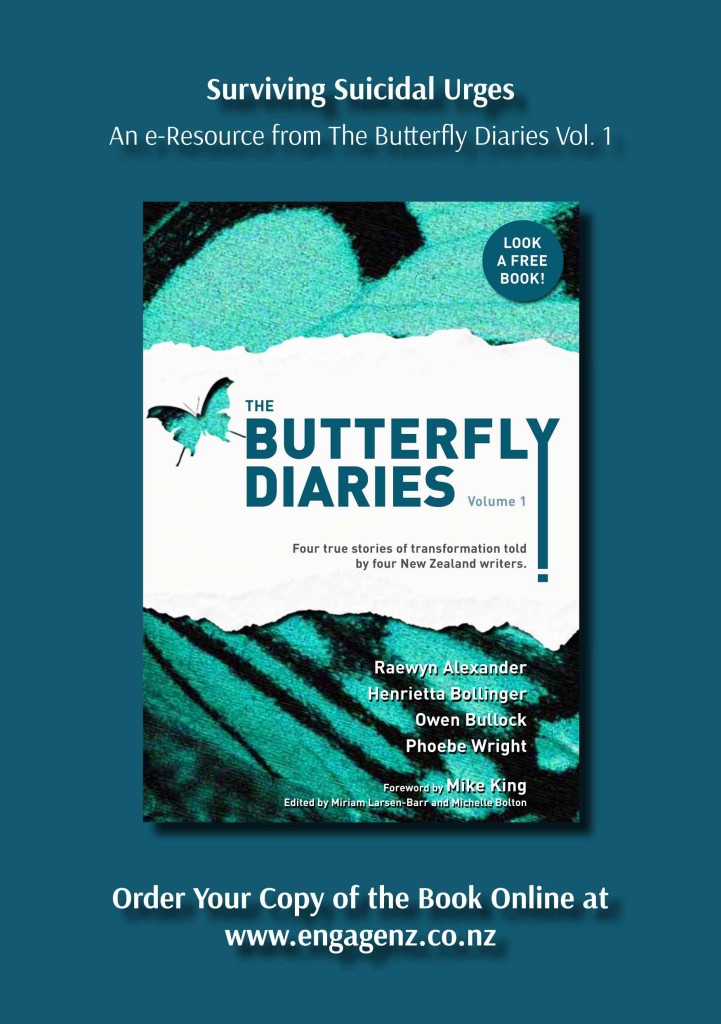
Surviving Suicidal Urges: e-Resource Now Available

Surviving Suicidal Urges is an e-Resource sharing tips for recovery from the storytellers in The Butterfly Diaries, Vol 1.

View, save and share Surviving Suicidal Urges.

BDETipsRecoveryCover


The Butterfly Diaries is a creative book project sharing true stories of hope and transformation from people who have made it through the experience of being suicidal.

Storytellers took part in an interview and writers used the interview notes to turn their stories into creative works of fiction. The interview notes were also used to summarise each of the storytellers’ recovery strategies. These have now been collected together in the e-Resource Surviving Suicidal Urges.

Order a copy of the free book online to get the full story behind each set of tips.

You can find permanent links to this e-Resource on the Information Resources and Butterfly Diaries sections of the Engage Aotearoa website at www.engagenz.co.nz.


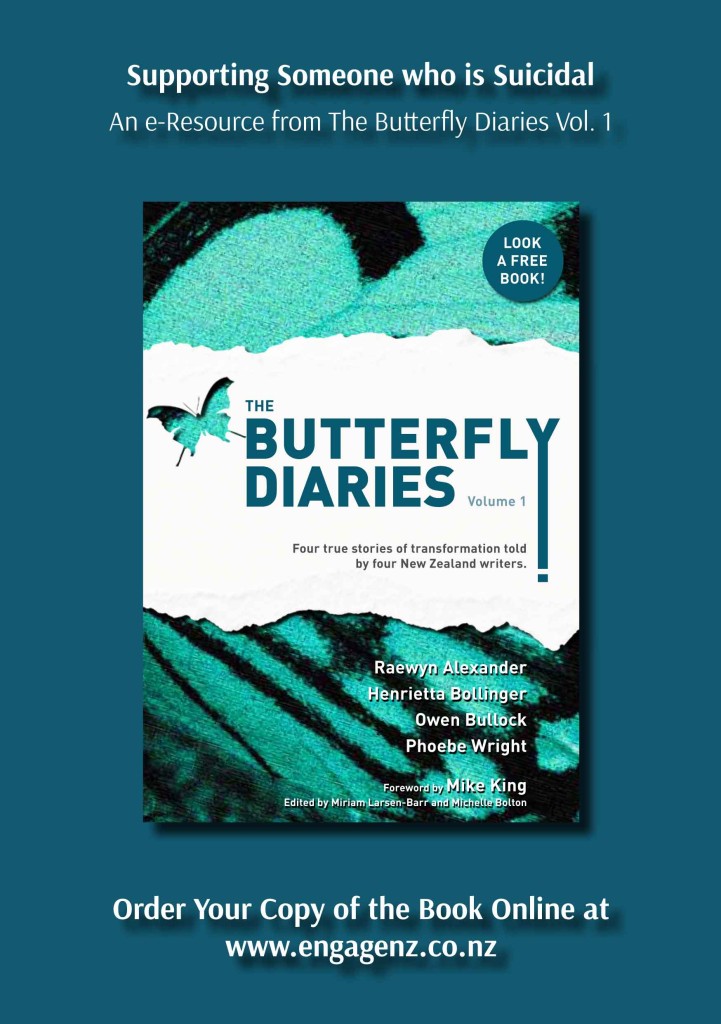
Supporting Someone Who Is Suicidal: An e-Resource from The Butterfly Diaries

Due to popular demand, the team at Engage Aotearoa has created an e-resource that shares the Storyteller Tips for Supporters from The Butterfly Diaries, Volume 1.

BDETipsSupportersCover

The Butterfly Diaries is a creative book project sharing stories of hope and transformation from people who have made it through the experience of being suicidal.

True, Kiwi stories of recovery are told by established writers in a variety of different forms. Storytellers were interviewed by the editors and writers used the interview notes to turn their stories into creative works of fiction. The editors used the interview notes to summarise the storytellers’ comments about what supporters did or could have done to help them. These have now been collected together in the e-Resource Supporting Someone Who Is Suicidal.

Visit The Butterfly Diaries to order a copy of the full book, learn more about the project or connect with other suicide prevention resources.

Click here to view, save and share Supporting Someone who is Suicidal.

You can find permanent links to this e-Resource on the Information Resources and Butterfly Diaries sections of the Engage Aotearoa website at www.engagenz.co.nz.

Free Access to Articles in Journal of Child Sexual Abuse for a Limited Time | Download Them While You Can

Journal of Child Sexual Abuse

FREE ACCESS ARTICLES

The following articles are available for FREE to read and download for a limited time. Click on the article titles below to access this content.

From Volume 22, Issue 7, 2013
Voices of Healing and Recovery from Childhood Sexual Abuse, Brittany J. Arias and Chad V. Johnson

From Volume 22, Issue 6, 2013
Sister – Sister Incest: Data from an Anonymous Computerized Survey, Sandra S. Stroebel, 
Stephen L. O’Keefe, Karen Griffee, Shih-Ya Kuo, Keith W. Beard, and Martin J. Kommor

Health Care and Female Survivors of Childhood Sexual Abuse: Health Professionals’ PerspectivesKim McGregor, Jeny Gautam, Marewa Glover, and Shirley Jülich

The Employment and Mental Health Option Grid

Employment tool for people who experience mental health problems

The Employment and Mental Health Option Grid (EmOG) has been published to help individuals and their health providers have conversations about the benefits and risks of returning to employment. Option Grids are shared decision support aids used internationally to help patients and health providers digest technical details together in relation to the evidence for different treatment options.

The EmOG is the first Option Grid to be developed in New Zealand and was led by the Wise Group in partnership with Te Pou, health professionals, consumer representatives and academics from New Zealand and around the world.

Find out more about the Grid or view the Grid online.


Care Kits for People Bereaved by Suicide | You Can Help Make it Happen

Earlier this year, Gemma Claire lost a friend to suicide. To cope, she did lots of reading about suicide and discovered that for every suicide, at least six people are affected by the death. As about ten people die by suicide per week in NZ, that is a minimum of 60 people bereaved through suicide (known as “suicide survivors”) per week. At least 3000 per year.

Gemma wants to create care kits to distribute to suicide survivors in NZ. She would do this through survivor support group, agencies and so on. She surveyed survivors in an online suicide survivor forum and collected ideas about what to include: Journal, pen, candle, matches, stress ball, drawing paper, felt tip pens, meditation CD, a book about suicide grief, a resource about supporting children through suicide grief, a list of places to go for support, information about dealing with the practicalities, a cosy blanket, tissues, energy drinks, and so on.

Gemma has a fundraising page called “Care Kits for People Bereaved by Suicide”
https://www.givealittle.co.nz/cause/carekits4suicidebereaved

Gemma will give updates via the Givealittle page through posts and photos about exactly how funds are used and how the care kits are assembled and distributed. Thank you for your generosity. Please spread the word about this project!

To contact Gemma, text / phone 021 0275 4738. 

No. 146: Be Still and Breathe

This week, to attain, maintain or regain my sense of wellbeing…
… I will practice being mindful of the wider moment by pausing as often as I can remember and simply being still. Throughout the day, wherever I am when I remember, I will stop what I am doing, be still and just breathe. Whatever is going through my head, I will notice and let pass, while I breathe and be still. I will take this time to notice the light and temperature and textures around me and the sensations in my body as I stop what I am doing and settle into the moment. When I notice thoughts I will practice noticing them kindly, without judging them. I will practice letting the thoughts I notice pass by looking at what else there is to notice in this moment. Moving my awareness on will help me make sure I don’ t get hooked into one particular train of thought. If I notice myself making judgements, I will observe the judgement and again move my awareness to what else I notice while I am breathing and being still. In this way, I will practice having little rest spots throughout my day, where I can slow down and notice what is happening inside and around me, without getting hooked into the stressful stuff. Taking moments to slow down and be still might help me be aware of what am dealing with, while I allow myself to be mindfully distracted by my surroundings. After a little while of being still and breathing, I will carry on with what I was doing.
When I am comfortable stopping to be still and breathe in everyday moments, I will add it to my Personal Coping Kete as a strategy for times of stress and distress. When I notice I am getting wound up, I will be able to stop what I am doing, be still, breathe and look around me to get a bit of soothing space between feeling and responding. _ _ _ _ _ This week’s Coping Kete strategy is inspired by a strategy from a member of the public who attended The Butterfly Diaries launch during Mental Health Awareness Week.

5 things I’ve learned about food and my mood

RecoveryNotes_WebImage

Five things I’ve learned about food and my mood

Recovery Notes #1

by Claire Sexton


It is generally accepted that our diets play a huge part in our overall physical fitness and health. But have you ever considered the possibility that the food you eat can also affect your mental health and mood? Although experts believe that clinical depression and other mood disorders cannot be cured by diet alone, they do advise certain food types, nutrients and eating habits in general can act as a natural aid alongside medication to help ease symptoms of depression and anxiety. After all you are what you eat, so getting a healthy, well balanced diet will make you feel healthy and happy too. Here are some of the nutrients that can make up a happy diet and help aid recovery for depression or simply just boost your mood.

1. Antioxidants

Free radical cells are responsible for a number of health issues, some of which can lead to serious diseases such as cancer and heart disease occurring. Free radicals can be caused by inhaling the harmful compounds from pollution or simply unexplained malfunctions in the body. They can also have a very detrimental effect on the brain’s functioning and contribute to causing mental-health problems such as depression to occur. Antioxidants found in types of vitamins can help fend off these free radical cells and protect your mind and body from their harmful effects. They can also help boost the immune system keeping you fighting fit from other bugs and infections too. Antioxidants can be found in a number of foods but they are most powerful in brightly coloured fruit and vegetables with high Vitamin C content such as broccoli, orange, peppers and berries. They are particularly potent in strawberries and blueberries which are being hailed as new ‘super foods’ due to the sheer amount of goodness in such small berries.

2. Happy carbs

One of the key reasons for irregular mood is irregular energy levels caused by irregular blood sugar. When you are running on caffeine or sugary highs you will find yourself feeling pumped up and full of energy one minute and lethargic and irritable the next. This rapid change isn’t good for your general health or your mood. Certain food types have simple molecular make ups which means the body breaks them down quickly and uses up the energy they provide quickly too. Try and adapt complex carbohydrates into your diet as these have a much more intricate make up which takes the body a lot longer to metabolize, thus leaving you with more regular and long lasting energy. With fatigue being one of the key symptoms in depression and low mood, feeling energized and ready to go is a great way to improve mood. Complex carbohydrates can be found in wholegrains such as brown rice, pasta, cereals and bread and also in a variety of vegetables.

Fact: Complex carbohydrates are generally less fattening than their simple counterparts and leave you feeling fuller for longer due to their high fibre content. This means that a diet rich in complex carbs can also help you maintain a healthy weight as well as improving your mood.

3. Protein

Foods high in protein contain a substance called tryptophan. When absorbed by the body this substance is transformed into serotonin – otherwise known as the happy hormone. This will make you feel more alert, calm and focused as well as providing you with more energy. It is also great for boosting the immune system and helping the body to fight off any ailments which may also bring your mood down. Protein can be found in a range of food types including dairy, fish, beans and poultry. It is also particularly high in bananas.

Fact: Whey protein is very potent in the tryptophan compound. Although you should try and get protein from your diet, you can buy whey protein in powder form and incorporate it into your meals either by stirring it into a stew, adding it to smoothies or even mixing it into a cake or bread mix.

4. Vitamin D

Although research is ongoing, experts believe that there is a clear link between Vitamin D and depression and those deficient in the vitamin are more susceptible to suffering from mental disorders. The reason for this isn’t fully understood but it is known that Vitamin D is vital in brain development. For this reason you should try and keep your levels of Vitamin D high through consuming full fat dairy products, red meat and some fish. It is worth noting that many foods rich in Vitamin D are generally quite fattening and for this reason experts are unsure just how much to recommend in dietary form. You can also add Vitamin D to your diet through supplements (although always speak to a healthcare provider first) or through a stroll in a sun. That’s right, the key source of Vitamin D is through natural sunlight.

Fact: A brisk walk in the sunlight can really be the ultimate mood enhancer. Not only are you elevating your levels of Vitamin D but you are also pumping blood around the body, improving oxygen levels and getting feel-good hormones circulating.

5. Eating habits

Getting the key nutrients is important in elevating mood but so are your eating habits in general. You need to ensure that you eat regularly to avoid blood sugar levels dropping and also ensure that you drink a lot of water throughout the day. Becoming dehydrated is a sure fire way to lead to fatigue and irritability and it can be very dangerous. Try to ensure that the food you eat means you can maintain a healthy weight. Being overweight can put extra pressure on vital organs and make you feel sluggish and tired. Combat this through regular exercise and healthy eating.

Fact: When it comes to drinking a lot, don’t assume that anything in liquid form will keep you hydrated. High caffeine drinks such as coffee, alcohol and some fizzy drinks actually act as a diuretic meaning that it makes your urinate more and this leads to dehydration occurring. They also tend to produce anxiety-like symptoms such as a rapid heart rate, followed by depression-like symptoms such as low energy dips.

_ _ _ _
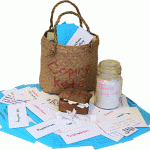
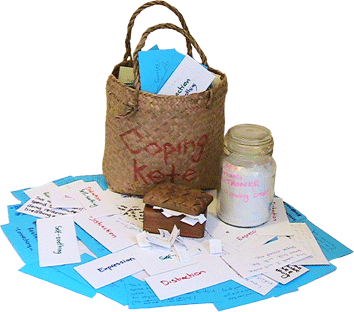
CopingKeteWithCardsTest3Recolour

Practice Point: Check out Strategy 18 in The Coping Kete for ideas to help turn the Good Mood Food information into part of your daily practice.

About the Author:  Claire Sexton is a freelance writer and full-time mom with experience of supporting people she cares about through the experience of depression. This gave Sexton an interest in mental health in general.  After graduating college, she put a lot of effort into her career as a nutritionist, but when motherhood came along, she decided it was time to pull back and take up her other passion, writing. Now she writes about health and finds her work-life balance far more enjoyable. When not working and caring for her children, she likes to go for long walks and find ways to make family meals more exciting.

Read more Recovery Notes here

Recovery Notes is an Engage Aotearoa project that asks people to share the top five tips and insights they have learned from or about their personal experiences of mental-health recovery or being a supporter.

Write your own Recovery Note

_ _ _ _

Copyright (c) 2013, Engage Aotearoa 


_ _ _ _