Engage Aotearoa

Tag Archives: Coping

Teacher Uses Coping Kete to Theme Static Image Lessons

Engage Aotearoa went to the Far North LifeHack Weekend in mid-2014 and met Ilana Hill, a Year 9 teacher at Taipa Area School with a passion for suicide prevention. She had the idea to use the content in The Coping Kete to get her students talking about coping and at the same time engage them meaningfully in the Static Image component of the Year 9 English curriculum.

Ilana says “I have a year 9 class that is full of energy and disparate personalities. I was very worried about engagement in English and I was seeking ways to make learning relevant and meaningful.” She adds, “I was really excited about helping make useful information about how to cope with depression visually accessible. I got the idea that perhaps … it could even be a subtle vehicle to teach them some of their own coping techniques for when times get tough.”

I hoped students would develop compassion and tools to become resilient as they progress through their teenage years in a very low decile area where they have to face a lot of negativity in their lives.”

Students were motivated by the knowledge that the top two posters would actually be shared on the Engage Aotearoa website to help more people find what they need. In this way, the project gave students an opportunity to make a real difference to their communities. Mindful of the sensitivity of mental-health related topics in school, Ilana worked with Engage Aotearoa and her school principal to set safe guidelines for the project and incorporated these into her existing lesson plans for the Year 9 static image curriculum.

Engage Aotearoa and the CMHRT board of trustees would like to thank Ilana for leading this partnership and giving permission for her material to be turned into a resource for others (this will be available on the Engage Aotearoa website shortly). The team also sends out a massive thanks to the students at Taipa Area School for their amazing work in creating graphic designs that share ideas that matter. You all did a fantastic job and in the words of the service director “we wish we had space for all of them!”

Check out the top two designs below and help us share these young Kiwis’ work as far and wide as it can go.

First Place

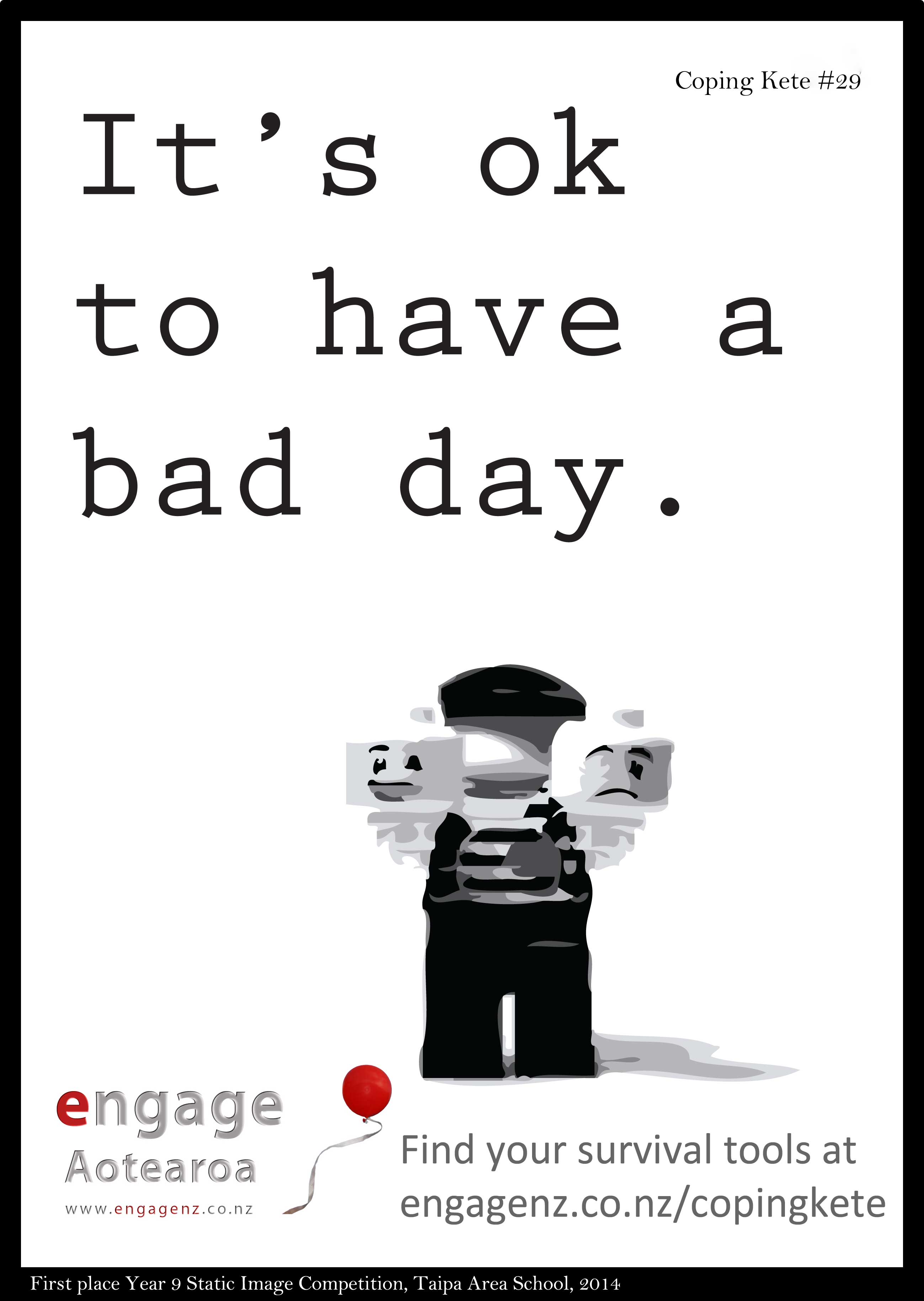
Aaliyah for It’s Ok to Have a Bad Day

Judges notes: “This poster design stood out for its simplicity and the importance of the message that Aaliyah chose to highlight from The Coping Kete. One of the most important things for surviving the tough times, is being allowed to have tough times. So much of our suffering comes from not being allowed to feel what we feel. Strategy 29 in The Coping Kete is all about telling ourselves that it is okay/acceptable to feel the whole spectrum of emotions, instead of trying to stay in the ‘positive’ ones all the time and judging ourselves for the ‘negative’ ones like anger, anxiety, sadness, jealousy or disgust.”
Taipa-Area-School-Static-imageComp-1stPlace-EngageAotearoa

 Second Place

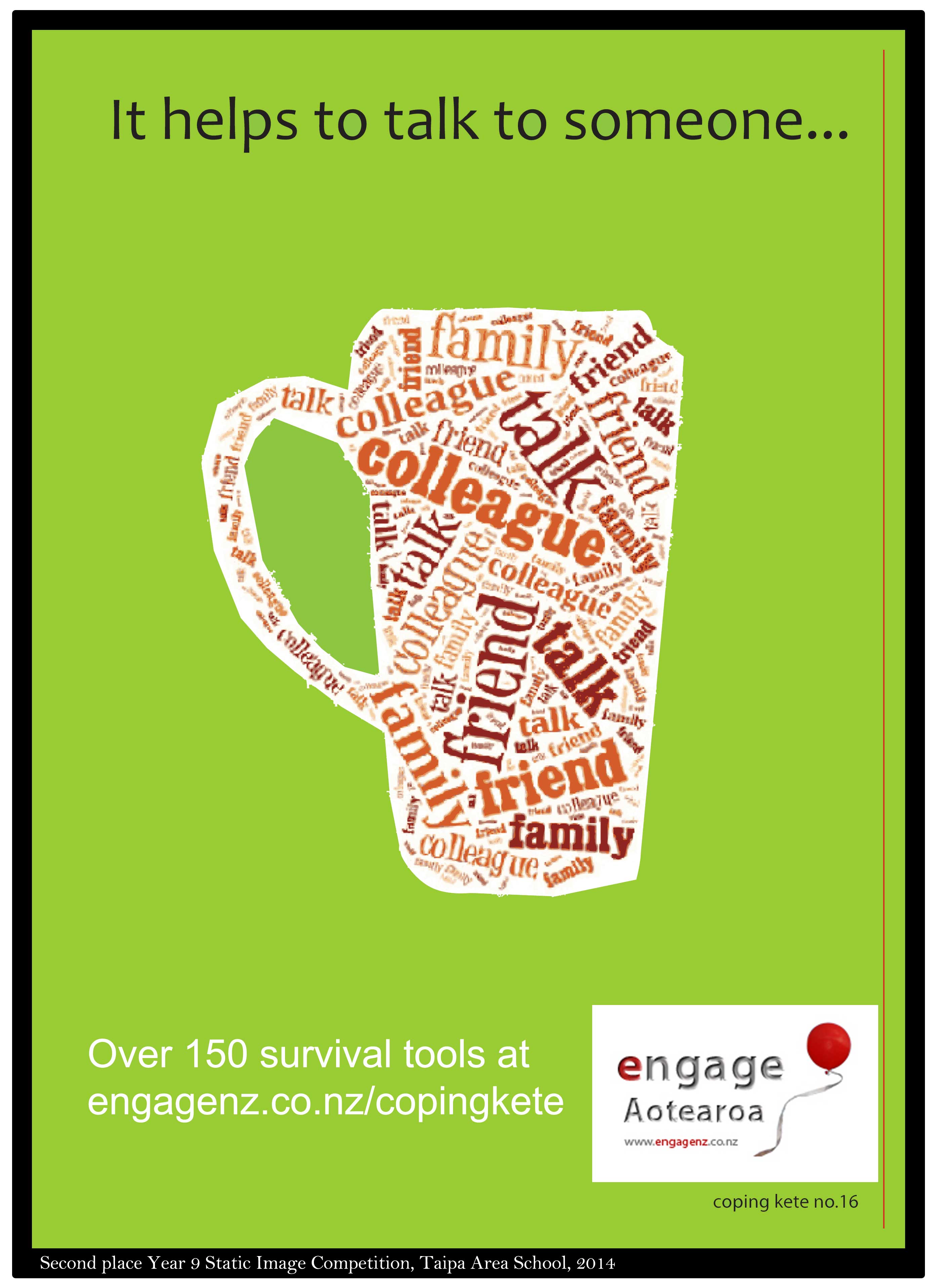
Destiny for It Helps to Talk

Judges Notes: “Destiny chose to highlight a message that is central to most effective suicide prevention and mental-health promotion strategies. We liked the idea that a young person chose to share this particular message with other young people. In the words of a young person we met at KiwiFoo Camp in May, “kids are sick of adults telling them what to do”. Here we have a 14 year-old sharing the message that talking helps. We liked how the cup shape suggests sitting down to a cup of tea with someone and the words Destiny chose to fill the cup with might give people a few ideas of who to reach out to. It also says something about the range of people we need to get involved in creating truly supportive communities.”
Taipa-Area-School-Static-ImageComp-2ndPlace-EngageAotearoa


5 things I learned about coping with depression in my teens

RecoveryNotes_WebImage

Five things I learned about coping with depression as a teenager

Recovery Note #4

~ Emma Edwards


1. It’s okay to not be okay

It is not a weakness to experience depression, anxiety, and other forms of distress as a teenager. It is quite common! Society tells us that we should look and behave in certain ways, and that we have to fit a certain stereotype in order to simply be accepted. I didn’t think it was okay to be struggling with depression when I was a teenager. I thought it meant I was weak and worthless. But admitting that I was not okay and that I did not know who I was took me on a journey of incredible discovery. I came out the other end of the dark tunnel with strength, purpose, and value for my life. I wouldn’t change a thing.

2. Connection is the key

It is incredibly lonely when experiencing depression – and I almost think it is more lonely when you experience depression as a teenager, during the life-stage in which you are trying to figure out how and where you fit in the world. At a time in your life when you are trying to fit in, you fall into a dark hole that isolates you – giving you no opportunity to find your place in the world. I isolated myself and was anxious to interact with anyone. However, the most useful thing for me was the one thing I did not want to do – it was to spend time with friends, family, and people who understood what I was going through.

“When you are at the bottom of the dark hole, it feels like every movement causes you to fall deeper. It is extremely difficult to see that each step actually takes you closer to the light of day.”

3. Asking for help actually helps!

Looking back, I had friends around me going through similar struggles, and I wanted them to be honest, ask for help, and let me support them. I saw them as courageous when they confronted their fears, darkness, and failures head-on. I learned that it takes more courage to be vulnerable, ask for help, and accept others’ support than it does to wrestle alone in the dark. I learned that friends, family, and professionals actually wanted to help me. Each time that I reached outside of myself and asked for help, my burden was lightened a little bit because it was shared with another. Even if the problem was not solved by the other person, at least I felt more understood, more loved, and less alone.

4. Balance between trust and supervision

I am sure my adolescent self would not admit this, but I’ve learned from looking back at my experience that it was helpful to have a balance of trust and supervision from my parents. I think this balance is largely determined by what is safe for us. As I built up trust with my parents, the amount of supervision I needed decreased. I found that, as my parents trusted me more, I learned to trust myself more – giving me confidence in myself. From my view, the helpful parent provides love, encouragement, support, practical help, and compassionate supervision.Blaming, minimising, or not being taken seriously are not helpful. Being listened to, provided with appropriate help, and shown compassion are essential.

5. It is never the end

There is always hope. I know clichés like “there’s a light at the end of the tunnel” often don’t provide much reassurance at the time, but it turns out they are actually true. When you are at the bottom of the dark hole, it feels like every movement causes you to fall deeper. It is extremely difficult to see that each step actually takes you closer to the light of day. But others can see it. Others can see the bigger picture because they are not in the dark hole with you. In these times, when all hope seems to have escaped you – I learned that I could rely on at least one person around me to hold the hope for me. When I could not see it, they could. When I could not believe, they believed. They held my hope, and gave it back to me when I could hold it again. It is never the end. There is always hope.

Emma Edwards

_ _ _ _

About the author: Emma Edwards is currently completing her doctorate degree. She was previously a registered mental-health professional, working in youth and adult mental-health settings. Her own service-user and family experience with mental-health struggles sparked her passion to support others and make a difference to those struggling to cope with difficult times.

Read more Recovery Notes here

Recovery Notes is an Engage Aotearoa project that asks people to share the top five tips and insights they have learned from or about their personal experiences of mental-health recovery or being a supporter.

Write your own Recovery Note

_ _ _ _

Copyright (c) Engage Aotearoa, 2014

No. 154: Supportive Self-Talk

This week, to attain, maintain or regain your sense of wellbeing…
…practice catching your inner critic when it’ s up to its tricks and responding to your self-talk with kindness. This is about learning to label your unhelpful self-talk for what it is and deliberately talk to yourself in a way that builds you up instead of cutting yourself down. Self-talk is automatic but we can bring it into our awareness and use it to support ourselves through moments of stress and distress. That last bit is key here. It is important to choose self-talk that feels supportive to you and that you can believe to be true. Sometimes we take ‘ supportive’ to mean that we are supposed to try to cheer ourselves up with lots of positive phrases that oppose what we have been thinking and that can often make people feel worse, especially if they really do not believe the positive statement at all. It doesn’ t usually work when we try to do this with others, and it doesn’ t usually work when we try to do this to ourselves either.
Supportive means to hold up, so try to experiment with finding a way of talking back to harsh self-talk that can hold you up in the struggles you find yourself in. This can be really hard to do, so practice in the ordinary moments first, maybe with your morning cuppa or something like that. Just sit and observe what you notice in your mind as it arises for a few minutes a day. If it’ s empty, observe and describe that. If it’ s focused on the cuppa, observe and describe that. Practice noticing the detail. Eventually your mind will start to wander and chatter like minds are designed to do. When you notice, observe and describe that too. Keep a look out for how your mind talks to you. When you notice critical, judgemental or harsh self-talk, describe what you observe, put words to it, name it for what it is.
Then take a deep breath and deliberately respond with self-talk that is supportive towards yourself, in a way that has your back, as if to hold yourself up in this moment, not to deny your reality, but to hold you steady there. Our minds are kind of messy in real life and so observing them can be too. It might go something a bit like this inside in your mind as you do this: “I am sitting here with my cup of coffee I notice my mind is blank. [cue distracting chatter] I can never do these things. How does this even work as a thing. I’ m not even thinking anything important. I want to have chicken for dinner. Dammit I’ m not paying attention… [good noticing, and you’ re back. Describe where you went just then and try your supportive self-talk again]….I notice I am judging the way I am confused about doing this. I notice I am kind of hungry… [take a deep breath and meet this with some supportive self-talk]… This is a kind of hard thing to learn really. At least I am trying. Did I have breakfast? Dammit again! [Good noticing again, and you’ re back. Describe where you went just then and try your supportive self-talk again]...I notice hunger distracting me. I notice harsh words about that. No one can focus properly when they are hungry…” Stay with it for a couple of minutes if you can, and then continue on with your day.
As you move through each day, pause when you notice your mood change and take a moment to observe what you are telling yourself about the situation and your experience of it, and see what happens if you meet it with some of the supportive self-talk you’ ve been practicing each morning.
When you are comfortable noticing, labeling and responding to your self-talk with support, add ‘ Supportive Self-Talk’ to your Personal Coping Kete for moments of stress and distress. When times are tough, you’ ll be able to catch your harsh inner critic and feed yourself supportive self-talk that helps hold you up. Self-judgement adds another layer of distress to already difficult situations. Giving ‘ voice’ to your inner supporter can make distress less intense and easier to cope with.

No. 148: Practice Compassion

This week, to attain, maintain or regain my sense of wellbeing… Coping Kete…I will practice being compassionate towards myself. When I notice critical thoughts or judgments about myself or things I have done or not done, I will practice responding in my mind with kind words, that share sensitivity for my suffering and respect for my humanity. I will practice choosing compassionate and accepting words to talk to myself about my mistakes, weaknesses, flaws and limitations. Other people can criticise me if they wish, but I will give myself compassion. As I move through my week, I will keep an eye out for self-talk that is harsh, critical and judgmental. For example, I will watch out for self-talk where I label myself stupid or useless when I make a mistake. When I notice I am labeling myself harshly for my mistakes and limitations, I will give myself compassion by pausing to remind myself it is human to struggle. I will appreciate my strengths by remembering them to myself and recalling that my flaws and limitations are simply part of a whole, not all that I am. By responding to myself with compassion throughout the week, I will practice accepting my whole self, warts and all. I do not need to be perfect, nor would I want to be. When I am used to talking to myself with compassion and acceptance on an ordinary day, I will add ‘ talk to myself with compassion’ to my Personal Coping Kete as a way of coping with stress and distress. When I find myself in distress, I will be mindful of how I am talking to myself and be careful to use compassionate words. In times of stress and distress, I will be better able to give myself messages of kindness, instead of giving myself messages of shame or judgement that make me feel worse.

No. 144: Be Aware of My Choices

This week, to attain, maintain or regain my sense of wellbeing… ""… I will practice noticing all the different ways I can control my outcomes by paying attention to the choices I make each day and purposefully choosing the option that moves me towards more of what I want. This week, as I move through each day, I will practice being aware of each of the small choices I make. When I notice that I am making a choice, I will practice pausing to observe what options I am choosing between and what the possible outcomes of each of the options might be. I will then deliberately choose the option that will bring me closer to what I want for my future – whether that is how I want to feel later in the day or what I want to be doing next year. I’ ll start out doing this with the small choices I make, such as what I eat and drink, what I watch on TV, what I work on next, where I sit and everyday things like that. Noticing how my small choices change the way I experience my daily life, might help me to be make more mindful decisions, that effect me in more positive ways. Slowing down and thinking about our choices is especially hard when we are distressed, which is why we so often do and say things we regret when we feel angry or upset. If I practice slowing down and being aware of my choices in everyday moments, it might be easier to slow myself down and think about my choices when I’ m distressed. In this way, I will learn how to hold my own responses and act based on what I want and need, not just on what I feel. This week, as I notice myself making a choice, I will pause, ask myself what the other options are, think about the possible consequences and what consequences I want, then choose the option that brings me closer the outcome I desire. When I am comfortable pausing myself and observing my options before I make everyday kinds of choices, I will add ‘ Be Aware of my Choices’ to my Personal Coping Kete as a way of coping during times of stress and distress. By being aware of the choices I am making and choosing the option that brings me closer to what I want for my future, I will be able to guide myself through the tough moments in a way that has a positive effect on me, rather than getting caught up in my distress and making coping decisions that make things harder in the long-run. The simple act of stopping to think through the options and make myself aware of what I want and need will help me practice giving myself a delay between feeling and acting, a mini time-out to have a little think. Doing this could be a form of mindful distraction, moving my mind away from how I feel in the moment to what I want in the future and what my choices are.

No. 143: Finding Excuses to Get Outside

This week, to attain, maintain or regain my sense of wellbeing…
…I will find excuses to spend small amounts of time outside and work them into my day to give myself little moments of mindfulness in nature. To start with, I will make a list of all the things I can do outside around my house or around my work or anywhere in between.
For example:
Weed the garden
Check the mail
Water the garden
Hang out washing
Bring in washing
Read the newspaper in the sun
Have lunch at the local park
Eat breakfast on the lawn
Drink my coffee under a tree
Walk to the dairy for milk
etc… etc…. etc…
Then, as I move through my week, I will practice giving myself time outside to do these things. I might schedule them in to my diary to help me remember to do them or I might be able to remember whenever the opportunity presents itself. When I find myself outside I will mindfully observe the environment around me and how it feels to be in it doing what I am doing. I will describe each part of my experience to myself and fully focus on participating in the experience of being outside. If I notice my thoughts distracting me from my moment outdoors, I will observe them for what they are and bring my mind back to the present moment. This will allow me to practice engaging with environments that are soothing and enjoyable as part of my everyday life. It might also help me get all the Vitamin D I need. Vitamin D comes from the sun.
Once I am used to enjoying outside as part of daily life, I will add it to my Personal Coping Kete as a way to self-soothe or distract myself during times of stress and distress. Taking myself outside and mindfully doing something else when I am distressed might give me the space I need to feel more calm before I respond to my distressing feelings, while still allowing them to be there.

No. 140: Observe the Facts of the Moment

This week, to attain, maintain or regain my sense of wellbeing… Coping Kete once a day, I will practice distracting myself from unhelpful thoughts by mindfully interrupting myself in the middle of an ordinary daily task and spending a few seconds observing and describing the current moment to myself without using any emotional words. While I am observing and describing the current moment to myself I will practice belly breathing to help me relax. Once I have observed and described each element of my current moment to myself, I will go back to my task. I could use an alarm to help me remember to interrupt myself each day. I will pass my mind over the space I am in, the people present, what they are doing, what the air feels and smells like, the weather, the sounds around me, the scene out the window, the position of my body in the room, the sensations within my body – all of the physical facts of the moment. If I notice my mind making judgements about anything I observe, I will watch the judgement pass by me like a train and turn my mind back to describing the moment around me. Everything but these observable facts is my perception. I can choose which perceptions to attach myself to and which perceptions to let pass me by. I will remember this as I move back into my task. Once I am comfortable with interrupting an ordinary experience to mindfully connect with the physical moment, I will add the strategy to my Personal Coping Kete as a way to interrupt distressing thoughts and get some space from my emotions. When I notice I am getting distressed, I will give myself permission to let go of my worry for a little while and turn my attention to my breath and the physical facts of the moment around me. I will keep observing and describing the physical facts of the situation until I have calmed down and am able to think a bit more clearly about how to cope. As distressing thoughts come into my mind I will observe them as they pass by, without chasing after them and turn my mind back to noticing the physical facts of the situation and continue with my breathing until I am feeling calmer.

No. 132: Affirming Breaths

This week, to attain, maintain or regain my sense of wellbeing… Coping Kete…I will spend a moment every morning taking some calm, slow breaths while I repeat a couple of positive self-affirmations in my head. For just two minutes, I will sit still, with my eyes closed, as I breathe deep into my belly and gently repeat my affirmations in my mind. As I notice my mind drifting away from my affirmations into doubtful, critical or negative chains of thought, I will bring myself back to my slow breathing and once more begin repeating my affirmation to myself. After a couple of minutes I will open my eyes and carry on with my day. Before I try this, I will need to prepare some statements that I might find validating, hopeful, strengthening or soothing in some way. A positive self-affirmation is just a statement about something positive that I think is true about myself or my place in the world. It is important that it is something I can believe to be true. What is a useful, comforting affirmation for one person, might not be any help to another person. So this exercise involves doing some exploration of what fits for me. Some people use inspiring quotes they have read somewhere, others use simple self-statements like “I am okay, whatever happens, I can survive it.” Others like to acknowledge their values and intentions. Others like to remember things like “I am connected to the wider universe and the ancestors that came before me.” Really, an affirmation can be anything at all. Over the week, I will pay attention to the kinds of statements that I find useful and figure out what kinds of self-affirming statements work for me. This week, each morning, I will have a chance to get used to hearing myself being kind and encouraging to myself. Once I am comfortable with doing a breathing exercise while I think some self-encouraging statements, I will add the Breathing Affirmations to my Personal Coping Kete as a way of coping during times of stress and distress. When I notice myself feeling upset or troubled in some way, I will take a moment to breathe and feed my mind some soothing, strengthening thoughts.

No. 120: Reserve Judgement

This week, to attain, maintain or regain my sense of wellbeing… Coping Kete…I will practice reserving judgement about what the future might bring. Each day, when I find myself moving into a new task or situation, I will take a couple of seconds to say to myself “Lets just see what happens, whatever happens, I’ ll handle it. For now I reserve judgement.” Then I will move on to the next part of my day with an open mind. When I am comfortable saying this to myself in ordinary, everyday situations and moving forward with an open mind, I will add this strategy to my Personal Coping Kete as a way of improving my mood during times of stress and distress. When I find myself stressed or distressed about what I think might happen in the future, I will take a moment to reserve judgement and trust myself to handle whatever comes my way. This might help me balance out my fears and worries, when they seem overwhelming.

No. 119: Talk About Solutions

This week, to attain, maintain or regain my sense of wellbeing… Coping Kete…I will practice positive communication as a way of expressing myself. This week, I will practice talking to people about solutions, rather than identifying things I am unhappy about. Whenever I feel like complaining or raising an issue with someone, I will practice flipping it on its head and talking about what I want to see instead. For example, instead of saying “I don’ t like it when you spill food on the carpet,” this week I would say “I’ d really like you to have a plate.” First off, I will need to take a moment to think about what I would like to see in the situation so I can express it to those around me. I’ ll use simple, positive language to let the people around me know what I want to happen. In this way, throughout the week I will get used to identifying solutions to problems and negative feelings and expressing them to the people around me. Once I am comfortable talking about solutions to everyday problems to the people around me, I will add the strategy to my Personal Coping Kete as a way of dealing with distressing situations with other people. If I find myself upset or stressed about something, I will be able to think about the possible solutions to the problems and talk to the person about those solutions and how we could put them into action together.