Engage Aotearoa

Pilot Study Puts Mindfulness in NZ Schools

A November 16th article from Stuff.co.nz highlights the results of a pilot study by the Mental Health Foundation of New Zealand showing a mindfulness in primary schools programme may have “improved students’ self-control, attentiveness, respect for other classmates and enhanced the school’s mood.”

The eight-week programme includes:

  • “Week One: Coming Home: Introduction to mindful breathing – and mindful movements like ‘opening the curtains’, ‘the penguin’ and ‘seaweed’.
  • Two: Happiness Here and Now: Exploring the difference in happiness – how material things offer a temporary boost, whereas actions create a sustainable sense of wellbeing. Encouraging children to foster friendships and be kind.
  • Three: Everything for the First Time: Experiencing things freshly in each moment, helping students appreciate newness and things they often take for granted rather than getting stuck in unhelpful habits.
  • Four: All things Rising and Falling: Exploring physical sensations in the body. By now, children are aware their breathing is always rising and falling. Now that’s extended to emotions and how emotional states are ‘triggered’.
  • Five: Moving Still: Using a mind-jar (a glass jar filled with water and glitter) and engaging in the ‘neuron dance’, students learn about the brain and how mindfulness can settle a scattered mind.
  • Six: Kind Heart, Happy Heart: Mindful breathing, sending kind thoughts and practising gratitude.
  • Seven: Everything is Connected to Everything Else: Seeing the different connections between things and how being isolated and alone can be harmful.
  • Eight: Touching Base, Touching stillness: Kids bring in an object that reminds them to practice mindfulness.”

Click here to read the full article.

Compulsory Treatment in NZ Mental Health | Take it From Us radio 18 Nov 2014

Tomorrow Take It From Us again takes a look at the frequency of compulsory treatment orders issued within our mental health system, and reviews the most recent report on our mental health from the director of mental health in his annual report. Hear the thoughts of consumers James King and Reina Harris about these issues, and how discriminatory such legislation can be.

Take It From Us, PlanetFM104.6 @ 12.30pm Tuesday 17 November 2014 

Listen live on 104.6FM at 12.30pm or online www.planetaudio.org.nz

OR if you missed the broadcast, listen for the next seven days @: www.planetaudio.org.nz/takeitfromus

Email Sheldon.brown@framework.org.nz for any feedback and comment/suggestions for shows. 

Engage Aotearoa on Twitter

Twitter.com/EngageAotearoa

Twitter.com/EngageAotearoa

Follow us on Twitter

Engage Aotearoa has at long last joined the Twitter revolution. There is now one more way to find and share recovery information.

Follow us at www.twitter.com/EngageAotearoa and tag us in your recovery-relevant posts using the Twitter handle @EngageAotearoa

Teacher Uses Coping Kete to Theme Static Image Lessons

Engage Aotearoa went to the Far North LifeHack Weekend in mid-2014 and met Ilana Hill, a Year 9 teacher at Taipa Area School with a passion for suicide prevention. She had the idea to use the content in The Coping Kete to get her students talking about coping and at the same time engage them meaningfully in the Static Image component of the Year 9 English curriculum.

Ilana says “I have a year 9 class that is full of energy and disparate personalities. I was very worried about engagement in English and I was seeking ways to make learning relevant and meaningful.” She adds, “I was really excited about helping make useful information about how to cope with depression visually accessible. I got the idea that perhaps … it could even be a subtle vehicle to teach them some of their own coping techniques for when times get tough.”

I hoped students would develop compassion and tools to become resilient as they progress through their teenage years in a very low decile area where they have to face a lot of negativity in their lives.”

Students were motivated by the knowledge that the top two posters would actually be shared on the Engage Aotearoa website to help more people find what they need. In this way, the project gave students an opportunity to make a real difference to their communities. Mindful of the sensitivity of mental-health related topics in school, Ilana worked with Engage Aotearoa and her school principal to set safe guidelines for the project and incorporated these into her existing lesson plans for the Year 9 static image curriculum.

Engage Aotearoa and the CMHRT board of trustees would like to thank Ilana for leading this partnership and giving permission for her material to be turned into a resource for others (this will be available on the Engage Aotearoa website shortly). The team also sends out a massive thanks to the students at Taipa Area School for their amazing work in creating graphic designs that share ideas that matter. You all did a fantastic job and in the words of the service director “we wish we had space for all of them!”

Check out the top two designs below and help us share these young Kiwis’ work as far and wide as it can go.

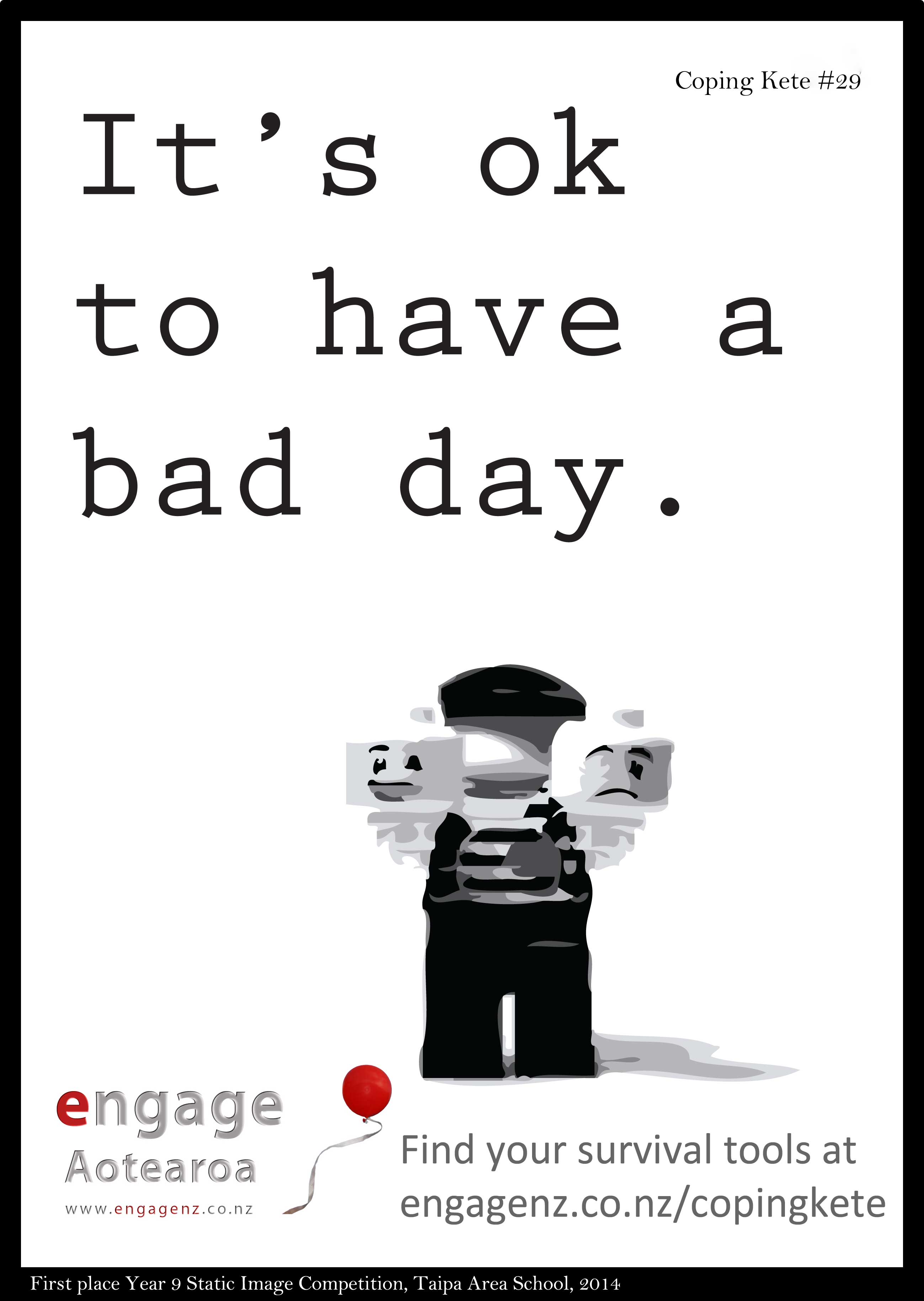
First Place

Aaliyah for It’s Ok to Have a Bad Day

Judges notes: “This poster design stood out for its simplicity and the importance of the message that Aaliyah chose to highlight from The Coping Kete. One of the most important things for surviving the tough times, is being allowed to have tough times. So much of our suffering comes from not being allowed to feel what we feel. Strategy 29 in The Coping Kete is all about telling ourselves that it is okay/acceptable to feel the whole spectrum of emotions, instead of trying to stay in the ‘positive’ ones all the time and judging ourselves for the ‘negative’ ones like anger, anxiety, sadness, jealousy or disgust.”
Taipa-Area-School-Static-imageComp-1stPlace-EngageAotearoa

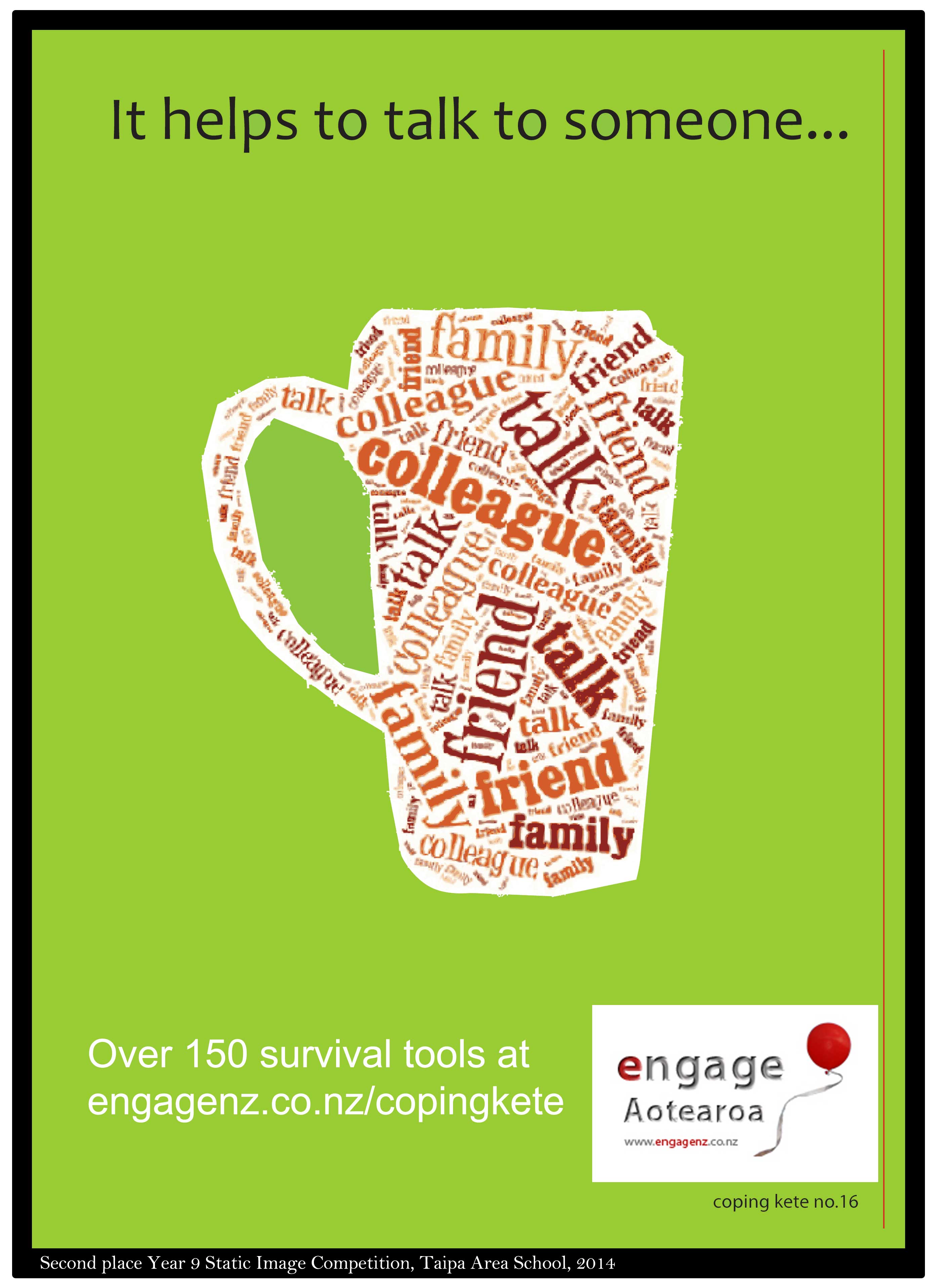
 Second Place

Destiny for It Helps to Talk

Judges Notes: “Destiny chose to highlight a message that is central to most effective suicide prevention and mental-health promotion strategies. We liked the idea that a young person chose to share this particular message with other young people. In the words of a young person we met at KiwiFoo Camp in May, “kids are sick of adults telling them what to do”. Here we have a 14 year-old sharing the message that talking helps. We liked how the cup shape suggests sitting down to a cup of tea with someone and the words Destiny chose to fill the cup with might give people a few ideas of who to reach out to. It also says something about the range of people we need to get involved in creating truly supportive communities.”

Taipa-Area-School-Static-ImageComp-2ndPlace-EngageAotearoa


Four Articles from the APA Monitor

The following content is from the Monitor digital newsletter. The Monitor is the magazine of the American Psychological Association, which they describe as “a must-read for psychology educators, scientists and practitioners.”

Born Bashful

Psychologists have new insights into the causes and effects of childhood shyness.

Unlocking the Emotions of Cancer

A new mandate requires cancer centers to screen oncology patients for distress.

Double Whammy Discrimination

Health-care providers’ biases and misunderstandings are keeping some older LGBT patients from getting the care they need. Psychologists are working to change that.

Suicide and Intimate Partner Violence

A US federal initiative aims to bring experts from the two fields closer together in an effort to save lives.

_

SAMHSA: Trauma and “Trauma-Informed” Care

The following is a deatiled release on ‘Trauma and “Trauma-Informed” Care’ from  SAMHSA (Substance Abuse and Mental Health Services Association of the USA).

The recently released Treatment Improvement Protocol (TIP) 57, Trauma-Informed Care in Behavioral Health Services (Trauma TIP), offers behavioral health service providers and program administrators information and practices to assist people who have experienced repeated, chronic, or multiple traumas. People who experience trauma are more likely to exhibit pronounced symptoms and consequences, including substance misuse, mental illness, and other health problems. For this reason, addressing trauma is a public health priority under the SAMHSA Trauma and Justice Strategic Initiative.

Trauma results from an event or a series of events that subsequently causes intense physical and psychological stress reactions. The individual’s functioning and emotional, physical, social, and spiritual health can be affected. Some of the most common traumatic experiences include violence, abuse, neglect, disaster, terrorism, and war. People of all ages, ethnic backgrounds, sexual orientations, and economic conditions may experience trauma. Trauma can affect a person’s functional ability – including interacting with others, performing at work, and sleeping – and contribute to responses – including isolation, anxiety, substance misuse, and overeating or under eating – that can increase health risks. Behavioral health service providers can benefit greatly from understanding the nature and impact of trauma and the benefits of a trauma-informed approach.

Adopting trauma-informed policies may require a fundamental cultural shift within organizations intended to promote a greater sense of equality and safety. This may lead to changes in governance and leadership; organizational policy; engagement and involvement of people in recovery, trauma survivors, consumers, and family members; cross-sector collaboration; services and interventions; training and workforce development; protocols and procedures; quality assurance; budgeting and financing; evaluation; and the physical environment of the organization.

Mental Health and Happiness Summit Videos Online

The videos of all interviews broadcast for the Mental Health and Happiness Summit on World Mental Health Awareness Day are now online here.

You can also check out the Mental Health & Happiness Daily Challenges here.

5 things I learned about coping with depression in my teens

RecoveryNotes_WebImage

Five things I learned about coping with depression as a teenager

Recovery Note #4

~ Emma Edwards


1. It’s okay to not be okay

It is not a weakness to experience depression, anxiety, and other forms of distress as a teenager. It is quite common! Society tells us that we should look and behave in certain ways, and that we have to fit a certain stereotype in order to simply be accepted. I didn’t think it was okay to be struggling with depression when I was a teenager. I thought it meant I was weak and worthless. But admitting that I was not okay and that I did not know who I was took me on a journey of incredible discovery. I came out the other end of the dark tunnel with strength, purpose, and value for my life. I wouldn’t change a thing.

2. Connection is the key

It is incredibly lonely when experiencing depression – and I almost think it is more lonely when you experience depression as a teenager, during the life-stage in which you are trying to figure out how and where you fit in the world. At a time in your life when you are trying to fit in, you fall into a dark hole that isolates you – giving you no opportunity to find your place in the world. I isolated myself and was anxious to interact with anyone. However, the most useful thing for me was the one thing I did not want to do – it was to spend time with friends, family, and people who understood what I was going through.

“When you are at the bottom of the dark hole, it feels like every movement causes you to fall deeper. It is extremely difficult to see that each step actually takes you closer to the light of day.”

3. Asking for help actually helps!

Looking back, I had friends around me going through similar struggles, and I wanted them to be honest, ask for help, and let me support them. I saw them as courageous when they confronted their fears, darkness, and failures head-on. I learned that it takes more courage to be vulnerable, ask for help, and accept others’ support than it does to wrestle alone in the dark. I learned that friends, family, and professionals actually wanted to help me. Each time that I reached outside of myself and asked for help, my burden was lightened a little bit because it was shared with another. Even if the problem was not solved by the other person, at least I felt more understood, more loved, and less alone.

4. Balance between trust and supervision

I am sure my adolescent self would not admit this, but I’ve learned from looking back at my experience that it was helpful to have a balance of trust and supervision from my parents. I think this balance is largely determined by what is safe for us. As I built up trust with my parents, the amount of supervision I needed decreased. I found that, as my parents trusted me more, I learned to trust myself more – giving me confidence in myself. From my view, the helpful parent provides love, encouragement, support, practical help, and compassionate supervision.Blaming, minimising, or not being taken seriously are not helpful. Being listened to, provided with appropriate help, and shown compassion are essential.

5. It is never the end

There is always hope. I know clichés like “there’s a light at the end of the tunnel” often don’t provide much reassurance at the time, but it turns out they are actually true. When you are at the bottom of the dark hole, it feels like every movement causes you to fall deeper. It is extremely difficult to see that each step actually takes you closer to the light of day. But others can see it. Others can see the bigger picture because they are not in the dark hole with you. In these times, when all hope seems to have escaped you – I learned that I could rely on at least one person around me to hold the hope for me. When I could not see it, they could. When I could not believe, they believed. They held my hope, and gave it back to me when I could hold it again. It is never the end. There is always hope.

Emma Edwards

_ _ _ _

About the author: Emma Edwards is currently completing her doctorate degree. She was previously a registered mental-health professional, working in youth and adult mental-health settings. Her own service-user and family experience with mental-health struggles sparked her passion to support others and make a difference to those struggling to cope with difficult times.

Read more Recovery Notes here

Recovery Notes is an Engage Aotearoa project that asks people to share the top five tips and insights they have learned from or about their personal experiences of mental-health recovery or being a supporter.

Write your own Recovery Note

_ _ _ _

Copyright (c) Engage Aotearoa, 2014

Keep Learning with the Updated Online Resources Pack

mhaw-image-2014
In support of this year’s Mental-Health Awareness week theme, ‘Keep Learning’, the team at Engage Aotearoa have added two new pages of links to the Online Resources Pack for you to explore. Find new online sources of distraction/entertainment, self-help tools, information, support and recovery stories – and keep learning for Mental-Health Awareness Week and beyond.

Click here to browse and save a copy of the updated file

New links include…

  • All Right Canterbury
  • Beyond Meds
  • Coming Off
  • Conversations that Matter
  • Depression is Not Your Destiny
  • Everybody
  • Guide to Psychology and its Practice
  • Intervoice
  • Like Minds, Like Mine
  • Male Survivors of Sexual Abuse NZ
  • Mental Health News Hub
  • Mind Share
  • Open Culture
  • Reasons to Go on Living
  • Recovery Notes
  • SPARX CBT Computer Game
  • Support for Parents of Suicidal Teens
  • Support Page for Anxiety Depression and Mental Illness
  • The Depression Center 4.0
  • The Peaceful Parent
  • Worry Wise Kids

Find more Recovery Information Packs on the Engage Aotearoa website.


Dominion Post reports NZ police handling 12,000 suicide calls a year

“Police are receiving 12,000 attempted or threatened suicide calls a year, increasing the strain on their resources.

The national figure of 11,939 calls last year amounts to an average of nearly 33 a day – and the figures have been rising steadily in the past five years.

But police say they have little expertise in the area of mental health, and the increasing time spent on callouts takes officers away from other duties.

They are now working with the Ministry of Health in an effort to understand why people in distress – or their friends and family – appear to be ringing police rather than mental health crisis services.

One possibility they are looking at is that people may feel the police are now more likely to respond quickly to calls than clinical services…”

Read the rest of this article from The Dominion Post (30 Sep 2014) online here.