Engage Aotearoa

Inspiring Story of Independence and Connection

Martine Abel at the Auckland Council sent a copy of this Herald Article around in a group email last week. Engage Aotearoa service director says “this story makes me wish I had an ‘Awesome’ tag for our blog posts!

“Disabled find their place

By Boris Jancic | 5:30 AM Friday Jun 28, 2013

Journey to independent living was difficult, but the results are astonishing, says mother

Like most young people, Travers Brown wants his independence.

But Mr Brown, 33, has Down syndrome, which means he is unable to do everyday things like read, write or drive.

Despite that, he now flats happily with three other adults with disabilities in Howick, and the journey he took to get there is behind a new resource aimed at helping families in similar situations.

His family set out on an ambitious project to engage a variety of charities, government bodies and private companies to create a shared, independent living space for their children.”

Read the rest of the article on the NZ Herald website here.

A 1970s Teacher Gives Her Class a Lesson They Won’t Forget

If you have an interest in issues like self-worth, stigma, discrimination and equality, you might like this video of one teacher’s experiment with her 3rd Grade classroom for National Brotherhood Week in the 1970s (might be earlier – it’s hard to tell). This is one of those old experiments that would never get through a modern-day ethics committee, but that nonetheless teach us a lot about what it is to be a human being in the world.

Upworthy writes:

“1:30: This teacher begins a study that will be talked about for 40 years.
3:00: She re-creates segregation and racism in her classroom.
7:45: Mrs. Elliott flips the entire class on their heads.
10:00 Jane Elliot makes the most profound discovery about us all
11:43: The students learn something that the world is still struggling to. 
There are too many great moments to point out. Just watch.”

Revisiting a Personal Account of Surviving Suicide on Psychiatry Online

In 2011, Dr Sarah Gordon, a New Zealand service-user academic at the Department of Psychological Medicine, University of Otago, Wellington wrote a personal account of surviving her own suicide attempts. The Engage Aotearoa team came across it again on Facebook this week. In the article, Gordon writes of her experiences partially in the third person and notes

The psychiatrist refused to entertain any notion of immediate discharge, however, reasoning that the patient seemed to have no relationship with anyone or anything. You see, the psychiatrist argued, relating to people is absolutely fundamental to living well. So that is what the woman did with the remainder of her time with the unit, which was a further five months: she worked on relearning and practicing relationships with herself, her family, her friends, and her community. And this is what she is doing now: actively engaging in her roles as a mother and wife, working, dancing, writing, celebrating holidays, and shopping (something she particularly enjoys).

Read the rest of the article online here.

No. 138: Visualising My Intentions

This week, to attain, maintain or regain my sense of wellbeing… Coping KeteI will practice telling the difference between my expectations and my good intentions and get in the habit of letting my intentions guide me instead of my fears. While my expectations are useful, they can get in my way at times, but my good intentions bring me back to what it is important to me, back to my values. This week, I will take a moment every morning to practice slow, belly breathing while I focus my attention on visualising my positive intentions for the day. Before I get out of bed in the morning, I will lie back and do a few minutes of belly breathing. As I breathe slowly down into my belly and let each breath float back out, I will think about my good intentions for the day by saying to myself “today I would like to ….” and then picturing it happening in my mind. If my self-critic or inner future-predictor interferes and I start thinking about barriers to my good intentions or reasons why it won’ t work out, I will notice the thoughts then come back to my breath and my intentions for the day. After a few minutes, I will open my eyes if I had them closed and move on into my day, carrying my values and positive intentions with me. In this way, I will get used to setting aside my expectations to get a clear sense of what I value and what I want to happen, so I can carry these things throughout my day and come back to them when I find myself in a tough moment. I’ ll also get to start my day off with a bit of calm breathing which might help set me up for a more relaxed day too. Once I am comfortable with spending a few moments breathing and connecting with my values and wishes rather than my fears and expectations, I will add this to my Personal Coping Kete as a strategy for self-soothing during times of stress and upset.When I notice I am distressed, I will be able to take a moment to breathe, come back to my own values and intentions as a way of soothing my unhelpful thoughts and problem-solving how I will deal with the situation I am facing.

New Research Burst: Lots of Great New Articles Out Online

New Research from Psychosis Online

Psychosis has just published a bunch of new research articles online, one of which has the Engage team buzzing because it backs up our transdiagnostic approach by providing another piece of proof that people with psychosis have some of the same underlying traits that people with anxiety and depression have. Maybe when we see beyond what the experiences look like from the outside, different mental-health problems are not so different underneath it all.

Developmental pathway to paranoia is mediated by negative self-concept and experiential avoidance
Alisa Udachina & Richard P. Bentall
DOI: 10.1080/17522439.2013.810301
Psychosis: Psychological, Social and Integrative Approaches

Madness contested: power and practice
Sami Timimi
DOI: 10.1080/17522439.2013.806572
Psychosis: Psychological, Social and Integrative Approaches

Family intervention for psychosis: impact of training on clinicians’ attitudes, knowledge and behaviour
Jacqueline Sin, Steven Livingstone, Maria Griffiths & Catherine Gamble
DOI: 10.1080/17522439.2013.806569
Psychosis: Psychological, Social and Integrative Approaches

Psychosis and poverty coping with poverty and severe mental illness in everyday life
Alain Topor, Gunnel Andersson, Anne Denhov, Miss Sara Holmqvist, Maria Mattsson, Claes-Göran Stefansson & Per Bülow
DOI: 10.1080/17522439.2013.790070
Psychosis: Psychological, Social and Integrative Approaches

Positive effects of a novel cognitive remediation computer game (X-Cog) in first episode psychosis: a pilot study
Majid M. Saleem, Michael K. Harte, Kay M. Marshall, Andy Scally, Anita Brewin & Jo C. Neill
DOI: 10.1080/17522439.2013.791876
Psychosis: Psychological, Social and Integrative Approaches

Book Review: Hearing voices – the histories, causes and meanings of auditory verbal hallucinations, by Dr. Simon McCarthy-Jones
Adèle de Jager
DOI: 10.1080/17522439.2013.806571
Psychosis: Psychological, Social and Integrative Approaches

New Research from BMC Psychiatry Online

Research article    
Understanding psychiatric institutionalization: a conceptual review
Chow W, Priebe S
BMC Psychiatry 2013, 13:169 (18 June 2013)
[Provisional PDF]

Research article    
Frequency and relevance of psychoeducation in psychiatric diagnoses: Results of two surveys five years apart in German-speaking European countries
Rummel-Kluge C, Kluge M, Kissling W
BMC Psychiatry 2013, 13:170 (18 June 2013)
[Provisional PDF]

Research article    
Trauma-focused treatment for posttraumatic stress disorder combined with CBT for severe substance use disorder: a randomized controlled trial
van Dam D, Ehring T, Vedel E, Emmelkamp PM
BMC Psychiatry 2013, 13:172 (19 June 2013)
[Provisional PDF]

Research article    
Promoting recovery-oriented practice in mental health services: a quasi-experimental mixed-methods study
Gilburt H, Slade M, Bird V, Oduola S, Craig TK
BMC Psychiatry 2013, 13:167 (13 June 2013)
[Provisional PDF]

Research article    
Prevalence and sociodemographic associations of common mental disorders in a nationally representative sample of the general population of Greece
Skapinakis P, Bellos S, Koupidis S, Grammatikopoulos I, Theodorakis PN, Mavreas V
BMC Psychiatry 2013, 13:163 (4 June 2013)
[Provisional PDF]

Research article    
Association between psychiatric disorders and iron deficiency anemia among children and adolescents: a nationwide population-based study
Chen M, Su T, Chen Y, Hsu J, Huang K, Chang W, Chen T, Bai Y
BMC Psychiatry 2013, 13:161 (4 June 2013)
[Provisional PDF]

 

Mike King Korero Heads to Rotorua 2-3 July 2013

Mike King of The Nutters Club and Key to Life Charitable Trust is joined by Tai Tupou next week as they stop off in Rotorua on their way to Tokoroa as part of Key to Life and Engage Aotearoa’s Korero project.

In the Community Korero, comedian Mike King gets straight up about his battle with depression, addiction and his ongoing journey back to recovery, including the mistakes he made along the way. Hear about the things he learnt from the hard times and how all those mistakes were blessings in disguise. This is a not-to-be-missed chance for communities to come together and explore how to support our youth and each other to survive and thrive.

  • Tues 2 July 2013 |Venue: Sunset Primary School, Rotorua | Time: 6 – 8 pm

In Cool to Korero, school students get to spend some quality time with Mike and Tai as they talk about how they survived growing up. Mike’s is the story of a kid who wanted to fit in. It is about wanting to be part of the cool group but being 4’11 with buck teeth and big ears and needing a miracle to make it happen. Then one day he discovered he had a gift to make people laugh and he went from being bullied, to being liked and then many years later becoming a bully himself. Mike shares tips on how to deal with bullies and also why bullies do what they do. The main point is that struggles and hardship are part of life but if we make it cool to korero, seek support and hold on to an attitude of hope, we can get through anything and go on to thrive.

  • 2 July 2013
    • Session 1 Venue: Rotorua Girls High, 11:30 am
    • Session 2 Venue: Sunset Heights Primary School, Rotorua
    • Session 3 Venue: Western Heights School, Rotorua
  • 3 July 2013 
    • Session 1 Venue: Rotorua Boys High School
    • Session 2 Venue: Rotorua Intermediate, 1:00 pm

Posters for Upcoming and Past Korero Events

[slideshow_deploy id=’4793′]


Eleanor Longden Shares Experience of Learning to Live Well with Voices at TED2013

Eleanor Longden has come a long way since she was a university student and first started hearing a voice that narrated everything she did back to her in the third person.

She recently gave a talk at a TED conference, which has been shared all over Facebook this week. Eleanor is now working with InterVoice to raise awareness of voice hearing as a meaningful experience to be understood rather than something to be feared.

In one of the online threads afterwards, a Twitter user asks: Did you hear voices during your talk?

Eleanor Longden replies: Yes, they reminded me of parts of the talk I forgot.

Watch the Youtube Video Here – Eleanor Longden: Learning from the Voices in My Head.

Can’t watch the video for some reason? Read a great summary in this blog.

Study Explores Guided Mindfulness Meditation and Physical Activity on Mood and Brain Functioning

Invitation to Participate

Exploring Guided Mindfulness Meditation and Physical Activity on Mood and Brain Functioning

Information:

Researchers from the University of Auckland’s psychology department would like to invite you to participate in a study exploring the connections between guided mindfulness meditation and physical activity. This information may be useful in developing materials and aids that will help individuals achieve a more balanced lifestyle. This research is being undertaken by Tamasin Taylor, as fulfilment of the requirements of a Ph.D (Health Psychology) degree at the University of Auckland.

The researchers are inviting people who have had zero or minimal experience of mindfulness meditation experience. There are three activities in this study that will involve your participation. The total amount of time required by you will be 5.5 hours over three weeks plus travelling time. Entry into a prize draw of $100 will be offered to participants who complete the study as a token of our appreciation for the time and effort contributed to this project.The involvement includes three activities:

1)     You will be asked to attend a five day course of 20-minutes of either guided mindfulness meditation or physical activity sessions (condition allocated to you by the researcher). The sessions will be held at the University of Auckland city campus, times to be allocated.

2)     You will be asked to complete two simple computer tasks at the University of Auckland city campus hsb building on two days (1- week apart).

3)     You will be asked to complete two general psychological wellbeing questionnaires via an internet link over the three-week study period. These will take approximately 15 minutes each to complete.

If you are interested in participating or finding out more about the study, please email t.taylor@auckland.ac.nz, or phone/text: 027 2435 198.

APPROVED BY THE UNIVERSITY OF AUCKLAND HUMAN PARTICIPANTS ETHICS COMMITTEE ON 29 April for (3) years, Reference Number 2011/7187

Petition for Better Mental-Healthcare Choices Presented to Parliament: What Next?

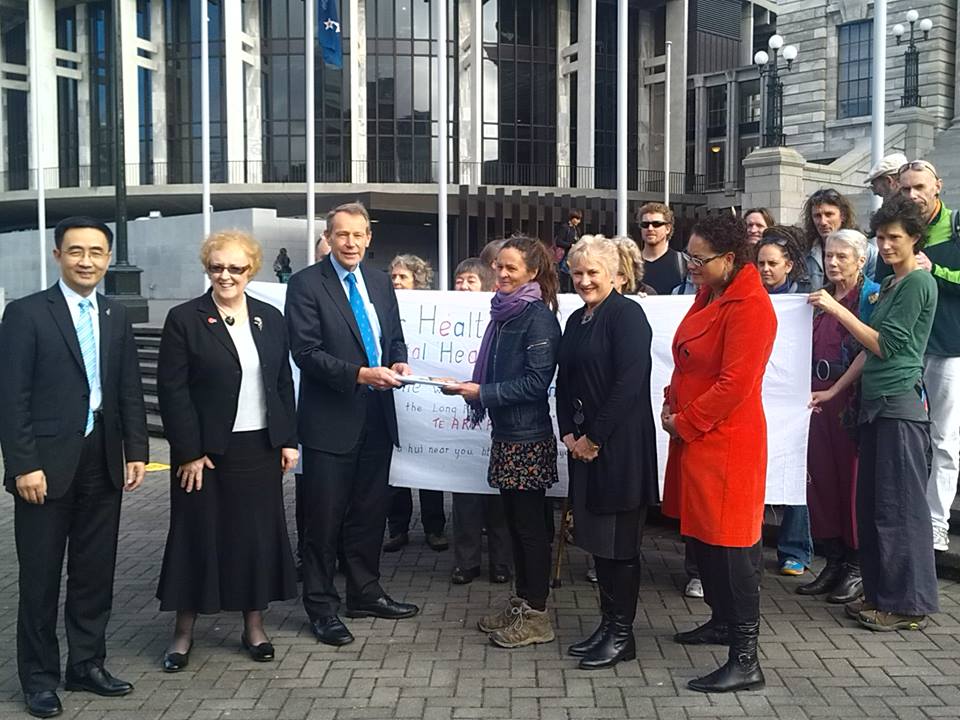
PetitionPresentationPhoto

Annie Chapman completed her Hikoi for Better Mental-Healthcare Choices on Tuesday the 11th of July and presented the final Petition for Better Mental-Healthcare Choices to members of parliament on the steps of the Beehive.

Chapman writes, “Well, the deed is done!! Six months after setting off from Cape Reinga, I handed over the paper petition with 1053 signatures to Paul Hutchison, who presented it to Parliament today. I will hear back from the Health Select Committee, probably in just over a week, of when the petition will be considered by the Committee and will be invited to make a submission at that time.

The petition presentation began with the final leg of the Hikoi as Annie made her way from the Botanic Rose Gardens to the Beehive with a collection of supporters. The procession reached parliament at midday where they were joined by a crowd of about 20 and at 12.30 the politicians arrived: Dr Paul Hutchison (National MP and chair of the Health Select Committee); Annette King (Labour Spokesperson for Health and member of the H.S.C.) Barbara Stewart (NZ First M.P. and member of H.S.C.); Dr Jian Yang (National M.P. and deputy chair of H.S.C.) and Louisa Wall (Labour M.P for Manurewa).

You can still help the Hikoi get results by making a submission to the health select committee about the Petition for Better Mental-Healthcare Choices.

Contact Annie Chapman for more information on hikoiforhealth@gmail.com

Email chairperson of Health Select Committee Paul Hutchison paul.hutchison@parliament.govt.nz

Consultation on Proposal to Change Home-Based Support Services in WDHB Area

C O N S U L T A T I O N ON PROPOSAL TO CHANGE HOME-BASED SUPPORT SERVICES

Waitemata District Health Board are proposing to change the current model of care for the provision of Home and Community Support Services funded within the Waitemata District Health Board area.

Waitemata District Health Board is consulting with its communities and stakeholders on a proposal that may change the model of care for home-based support services within the district. The aim of the proposed model is to ensure clients receive services based on the level of need and that they are empowered to achieve optimal functioning and independence.

Waitemata DHB encourage you to provide feedback.

PROPOSAL

The proposal and other relevant documents are available on the Waitemata District Health Board website.

View Online – Visit: www.waitematadhb.govt.nz to view the proposal and other relevant documents.

Request a hard copy – contact Imelda Quilty-King, Community Engagement Coordinator, Waitemata DHB on mobile: 0212236099 or by email: hbssconsultation@waitematadhb.govt.nz if you wish to request a hard copy or if you have any other query on this proposal.

FEEDBACK

Online – Visit www.waitematadhb.govt.nz to complete a survey using survey monkey.

By post – Request a hard copy or print off the feedback form from the

website and post it the Waitemata District Health Board.

Request a Face to Face meeting – The Waitemata DHB is not holding public meetings however your organisation/group is welcome to request a face-to-face meeting with us by contacting Imelda Quilty-King, Community Engagement Coordinator, Waitemata DHB on mobile: 0212236099 or by email: hbssconsultation@waitematadhb.govt.nz


Feedback closes at 5pm, Monday 24 June 2013.