Engage Aotearoa

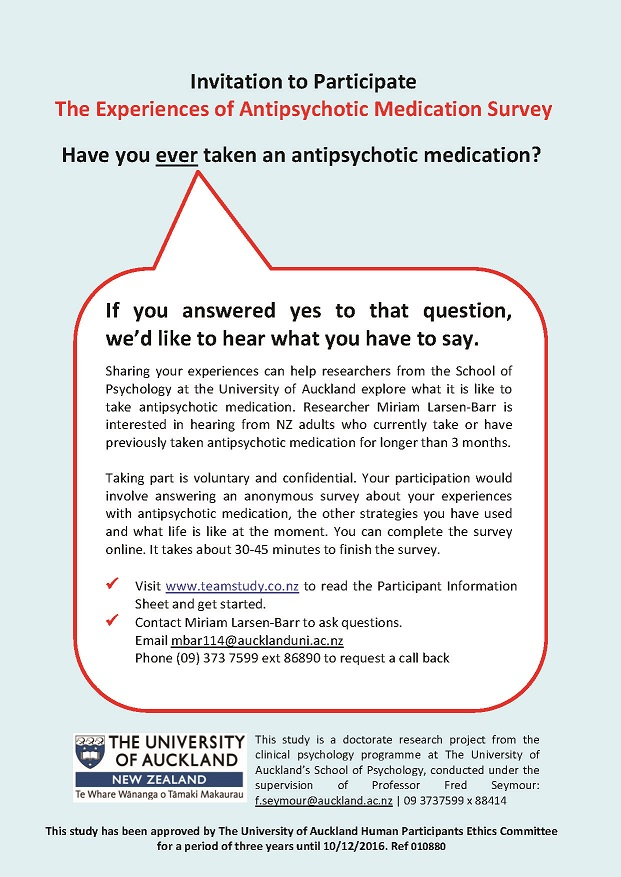
Update to The Experiences of Antipsychotic Medication Survey

The Experiences of Antipsychotic Medication Survey is now open to all NZ adults over 18 who are living in the community, including people with Compulsory Treatment Orders.
Find out more at http://www.teamstudy.co.nz
Everything you need to take part is available on the website.

Please share this invitation to take part with your networks.

Contact:
Miriam Larsen-Barr
Ph: 09 373 7599 ext 86890
Email: mbar114@aucklanduni.ac.nz

TEAMS

No. 153: Label Thoughts As Thoughts

This week, to attain, maintain or regain your sense of wellbeing… Coping Kete… practice noticing your thoughts and seeing them for what they are – thoughts. This week, whenever you notice yourself look at a clock, take a brief moment to be still, take five deep breaths, register what is in your mind and name what you notice in this time. As you notice a thought running through your head, say to yourself “I notice the thought that…“. For example, if I look at the clock, breathe and think “I am going to be late”, I will say to myself “I notice the thought that I am going to be late”. Sometimes we have second thoughts about our first thoughts. Thoughts often come in chains of ‘ this’ and ‘ then that’ and then… etc. If you notice a second thought attached to the first, describe that too. Try to be an impartial observer, not a bullying or critical observer and use neutral words to describe what you notice. If you notice yourself judging or labeling your thoughts as ‘ good’ or ‘ bad’ in some way, describe that to yourself self too, “I notice the thought that…”. If your mind goes blank or you feel distressed, label your thoughts about that and come back to your breathing. After you have taken five good breaths in and out, move your attention outwards again by describing what is around you right now, “Right now I see…Right now I hear… “. Then turn back to whatever you were about to do before. As thoughts pop up to distract you from your task, label them as thoughts and return your focus to what is around you and what you are doing now. Usually our thoughts are constantly running through our minds without us noticing them and we just go along reacting to them on auto-pilot. By doing this exercise, I will get used to taking a step back to observe my thoughts and recognise them as ideas happening in my mind. Labeling my thoughts as thoughts will highlight the distinction between what is coming in through my senses and what is the meaning attached to it by my mind. Often these two things we will be an obvious match. However, just as often things are a bit more ambiguous and unclear. Often there are multiple potential meanings and labeling thoughts can help me keep sight of that. This can help the body know it is safe to calm down any stress responses it has been automatically firing off. It is harder to step back and label our thoughts as thoughts when our emotions are high. This is why practicing for just a moment at regular intervals when emotions aren’ t high is helpful while we get the hang of it. You might find that looking at a clock isn’ t the most useful reminder to practice for you. If that’ s the case, pick another thing you do everyday to use as a reminder to practice. When you are comfortable with stopping to label thoughts as thoughts during everyday moments, add it to your Personal Coping Kete as a way of coping in times of stress and distress. When you notice emotions getting high or your mind starting to race, take a moment to breathe into your belly and observe your thoughts one by one. As you notice a thought, describe it to yourself “I notice the thought that…” . Then turn your mind to your senses and the world around you. “Right now I see… Right now I hear…”. When you are ready to move on to the next task in your day. Think to yourself, “Right now I could…” . This might be a self-soothing or distraction exercise or some form of expression, support or engagement. Labeling distressing thoughts as thoughts might help to soothe their sting if they are overwhelming, slow them down if they are racing or make them clear if they are clouded. If we can notice thoughts as events that happen inside us, we can choose which ones we want to act on and which ones are just the chatter of our minds on autopilot.

Updates from the Engage Facebook Page

Here are some highlights from Engage Aotearoa’s Facebook page:

Advice From Our Tribe: What positives/lessons can you draw from your mental health experiences? 

Helplines to merge into single service – National – NZ Herald News

Anti-gambling body to get chop – National – NZ Herald News

Welcome to the Engage Blog

VoiceBoxMEgaphone


The Engage Blog is my space for sharing updates, news, useful or interesting ideas, research updates and resources for people who experience mental-health challenges and their supporters. Browse from the top to find the latest posts. Use the search bar on your right to find something specific or explore the categories in the drop-down menu below. If you have something useful you’d like to see added, feel free to get in touch.

Subscribe for email updates

You’ll receive a Monday-morning email with the latest updates, whenever new content has been added.

Follow this link to the subscription form

Browse by category

.

Feed the Kids Bill Aims for Government-Funded Food-in-Schools Programme

The following is a press release from Hone Harawira, MANA Leader and MP for Te Tai Tokerau

Wednesday 12 March 2014

“Kids have a knack of saying things plain and simple” said Hone Harawira, MANA Leader and Tai Tokerau MP, following the lunch he hosted at Parliament today for 50 students from Naenae College who help run the school’s KickStart breakfast club.

“When asked why they support MANA’s Feed the Kids Bill they said they hate seeing kids having to scab food off other kids, and they’re embarrassed to have to hide their own lunches from their class mates.”

“And then they asked “Why can’t John Key make a smart decision and just Feed the Kids?”

“I was glad I was able to personally acknowledge the Naenae College seniors for fronting their breakfast club” said Harawira, “but the school’s guidance counsellor tells me it’s a real struggle organising volunteers, raising funds, and getting businesses to sponsor the extra kai.”

In question time today, which the College students observed, Mr Harawira pointed out that the government-assisted KickStart and KidsCan programmes feed about 20,000 students a day “which means that 80,000 are still going hungry … every day.”

“Even the kids are telling us that more needs to be done” said Harawira, “but government just point-blank refuses to step in.”

“In fact, Bill English thinks that hungry kids can learn just fine!”

“Honestly, it’s bloody frustrating when those who lead the country can be so dumb.”

MANA’s Feed the Kids Bill, which aims to introduce government-funded breakfast and lunch programmes for all students in decile 1-2 schools, is expected to be up for first reading in the coming months.

For further information from MANA, please contact Jevan Goulter, (022) 088-5646.

Good Practice Guidelines for the Assessment and Treatment of Adults with Gender Dysphoria

An online resource from the Royal College of Psychiatrists in London aims to improve treatment for people who identify as non-cis or gender-queer. “Gender variance is not uncommon…A survey of 10,000 people undertaken in 2012 by the Equality and Human Rights Commission found that 1% of the population was gender variant to some extent – though this figure cannot be assumed to be representative of the whole population…People often find it difficult to confide their feelings … to their GP because they fear ridicule, guilt or shame, or are concerned about delays in getting treatment… It is estimated that up to 40% of people with gender dysphoria may not be receiving appropriate help.”

The best practice guidelines are endorsed by 13 separate organisations and have been drawn up by a working group that included representatives from psychiatry, endocrinology, gynaecology, urology, general practice, nursing, psychology, psychotherapy and speech and language therapy, as well as representation from patient groups. It is the first time that so many different groups have come together to agree a common set of guidelines.

Click Here to Download the Full Resource

Thanks to the International Initiative for Mental Health Leadership for sharing this information.

United Nations World Happiness Report Calls on Policy Makers to Prioritise Happiness

The United Nations World Happiness Report 2013 was released in September last year. The report calls on global policy makers to prioritise happiness as a key measure and target of development.

In Chapter 3, Mental Illness and Unhappiness, authors Richard Layard, Dan Chisholm, Vikram Patel and Shekhar Saxena, write: “For policy makers, the key issue is what affects happiness. Some studies show mental health to be the single most important determinant of whether a person is happy or not. Yet, even in rich countries, less than a third of mentally ill people are in treatment. Good, cost-effective treatments exist for depression, anxiety disorders and psychosis, and the happiness of the world would be greatly increased if they were more widely available.”

The Report shows the major beneficial side-effects of happiness. Happy people live longer, are more productive, earn more, and are also better citizens. Well-being should be developed both for its own sake and for its side-effects.

Read the full report here: http://www.globalmentalhealth.org/sites/default/files/WorldHappinessReport2013_online.pdf
Thanks to the International Initiative for Mental Health Leadership for sharing this information.

A practical guide to implementation of Peer Support Services

In late 2013, the Centre for Mental Health in London released a briefing report on how to implement peer support services. The authors write: “Our experience has led us to the conclusion that the widespread introduction of people with lived experience of mental health problems into the mental health workforce is probably the single most important factor contributing to changes towards more recovery-oriented services.” Gilfoyle, S., Gillard, S., Perkins, R., & Rennison, J. (2013, October 29). London: Centre for Mental Health.

The report outlines four phases in the implementation of peer support services: 1. Preparation of the organisation as a whole, 2. Recruitment, 3. Safe and effective employment of peer workers in mental health organisations, and 4. Ongoing development.

Read the full report online here:

http://www.nhsconfed.org/Documents/7%20-%20Peer%20Support%20Workers%20-%20a%20practical%20guide%20to%20implementation%20[web].pdf

Thanks to the International Initiative for Mental Health Leadership for sharing this information.


Everyone’s Been Bullied. Not Everyone Responds Like This 15-Year-Old Girl.

Having experienced bullying a lot herself, as well as seeing how it affects other young people, Nakita wanted to do something to make a difference. Nakita is an incredible singer (as you can see here) and so at 13 decided to write a song. However, this songwriting process was different than most. Nakita went into six schools and interviewed 180 young people of all ages about their experiences of bullying. Then, with mentorship from the band Dukes, she collated these experiences into a song.

The result can be found here: http://onevoice.net.nz/#sthash.PJd6EjhC.cjBo9j7i.dpbs

or here: Nakita Turner – One Voice

No. 152: Do Something for My Future Self

This week, to attain, maintain or regain your sense of wellbeing… Coping Kete… practice choosing the course of action that will make you feel better later by doing something for your future self each day. We so often spend our time caught up in surviving the day-to-day things that lie in front of us, that we forget to spend time setting up our future selves to thrive. This week, practice nurturing my future self. Think about you in a week from now and imagine you find yourself in a good frame of mind; what does that person wish they had experienced or done? What are they proud of? What do they treasure? What brought vitality to their week? Then fast forward past next week, to next month, next year, and decades from now. Make a list as you go of small things you could do in a day to help your future self have these experiences they need to build the kind of life they want. Each day, choose one thing from your list to do and plan in a time to do it. For example, going to bed 30 minutes earlier might make your mornings easier; eating breakfast might make your afternoons easier; chatting with a friend might have given you a laugh; doing a job you’ ve been putting off might make you feel less stressed tomorrow; going for a walk might give you a mood lift and help you sleep better later; setting some goals might help you feel like you have a bit of direction later etc… As you get used to the practice of doing small things for your future self in a planned way, practice pausing as you make decisions in your daily life to ask yourself what course of action would help build a thriving life for your future self. When you are used to making choices for your future self, add ‘ Do Something for My Future Self‘ to your Personal Coping Kete as a way of coping during times of stress and distress. When you find yourself feeling upset, you can use this strategy to value yourself in the presence of that distress and keep moving towards the kind of life you want. How does your future self want to see you managing this?