Engage Aotearoa

Author Archives: Admin

Posts by 'admin' on the Engage Mental-Health News and Events Blog are shared on behalf of third parties to help make information about mental-health news and events easier to find and do not necessarily reflect the views of Engage Aotearoa or Community Mental-Health Resources Trust. News and events posted with the tag 'Engage Updates' are written by and/or about Engage Aotearoa.

Update on Cuts to Community Law Centres

Less than two weeks to go!

The Ministry of Justice has said that it will stop consulting with Community Law Centres by 1 August.  That makes the next two weeks a really important time to explain to the Ministry exactly why we need direct specialist legal services.

Here’s what you can do to help:

Come to the “Save Disability Law” public meeting

  • 1pm – 3pm on Monday 30th July 2012
  • Western Springs Community Garden Hall, 956 Great North Road

RSVP by phone 09 257 5140 or email info@adl.org.nz

Venue is wheelchair accessible and NZ Sign Language interpreters have been booked.  Please tell us if you have any other access or dietary requirements.

Please tell your whanau, friends and workmates to come along too.

Check out the media coverage

It’s not too late to sign the open letter to Justice Minister Judith Collins

How to sign:

Email your name to info@adl.org.nz and they will add you as an email signatory to our list.  If your organisation has not yet signed, ask them to support ADL.

If you are signing on behalf of an organisation, please include your logo.

Post it to Auckland Disability Law, PO Box 43 201, Mangere, Auckland

Fax it back to ADL on 09 275 4693 or scan it and email to info@adl.org.nz

Finally, you can print it out and post it directly to Minister of Justice, Judith Collins http://www.beehive.govt.nz/minister/judith-collins

What else you can do

You can write your own letter to Minister of Justice Judith Collins or to the Minister for Disability Issues, Hon Tariana Turia.

Lobby your local MP, Councillor or Local Board


Write to the newspapers, or put out your own press release

Contact ADL for further information

Follow on Facebook

Search and click the ‘like’ button on the Auckland Disability Law Facebook page

Huge thanks to the more than one hundred individuals and all these groups and organisations that have signed so far:

  • Altus Enterprises
  • Auckland Action Against Poverty
  • Auckland Branch of the Association of Blind Citizens of New Zealand
  • Auckland Disability Providers network
  • CCS Disability Action
  • Chair, Homeworks Trust
  • Citizens Against Privatisation
  • Community Law Canterbury
  • DPA Dunedin
  • DSAG Disability Strategic Advisory Group – Auckland Council
  • Employment Dispute Solutions
  • Engage Aotearoa
  • Green Party of New Zealand
  • Justice Action Group
  • Kaitaia Community House
  • Mana Tangata Turi O Aotearoa
  • Mangere Community Law Centre
  • National Secretary behal of New Zealand Public Serrvices Association
  • Niu Ola Trust
  • People First
  • PHAB Pasifika
  • PSA Deaf and Disabled Members
  • Pukenga Consultancy
  • Rotorua District Community Law Centre
  • Service and Food Workers Union
  • Socialist Aotearoa
  • Tamaki Ngati Kapo inc
  • Taranaki Community Law
  • Te Roopu Waiora Trust
  • The Asian Network Inc.
  • The Auckland Deaf Christian Fellowship
  • Unite Union
  • Youthlaw

Previous media coverage:


Further Information

If you require any further information or you are able to help the campaign in any way, please contact us:

Nicola Owen

Development Manager

Auckland Disability Law


Changes to Auckland Public Transport

Auckland City Council wants to make people aware that there will be physical changes to their local station when using public transport in Auckland.

As part of the changes currently being carried out by Auckland Transport, there will be new ticket and top up machines and electronic gates appearing at rail stations, bus way stations and ferry wharves across the city.

The Auckland Integrated Fares System will be going live towards the beginning of next year, so the machine and gates which are currently being installed, are not yet in operation.

Electronic gates

The work to install electronic gates has already begun the Newmarket station and will soon begin at the Britomart station. Gates will also be installed on Downtown Ferry Terminal Pier 1 from 2013 and there are plans for more rail stations to have these gates in the future.

At Newmarket Station, there are two sets of gates, one row of five as you enter from Remuera Road and a set of three as you access the platforms from Station Square. At Britomart station, the gates will be on the platform level at the East and West entrances.

Please note these gates are not currently in operation, and will remain in an `open’ position until they are activated in 2013.

When these gates are activated, HOP customers will tag their valid HOP card enabling the gates to open and allowing the customer to travel through. Passengers using paper tickets will need to use the manual gates situated at the end of the electronic gates, which will be manned by a train station staff member e the staff member by the manual gates. There will be audio and visual cues to indicate a successful or unsuccessful HOP card tag-on or tag-off. The machine will beep and flash a green light for a successful tag-on or tag-off. An unsuccessful tag or error will be presented with a different beep and a red light. Cards loaded with a concession will have a double beep and an amber line to indicate the concession.

The dimensions of these gates are as follows: 1020 mm height and each individual gate will be 1200 mm wide and 1900 mm deep.

Ticket and top up machines

Large self-service machines used to top up HOP cards or buy single fare paper tickets are currently being installed on all railway platforms, however these machines are not yet in operation. They will also appear at bus stations at a later date.

The dimensions of the self-serve machine are 1800 mm height, 900 mm width and 570 mm depth. In most stations they will be placed as near to shelters or existing structures as possible.

The ticket and top-up machines will become active later in 2012 and into 2013. They will have a vision impaired mode that has been developed in close consultation with RNZFB and ABC. Further information on the use of the vision impaired mode will follow closer to the installation date.

Hop Card Reader

Medium sized pillars for customers to tag-on and tag-off at the start and end of their journey are being installed at rail stations and ferry wharfs, but are not yet in operation.

The dimensions of the machine are as follows: Height 1070 mm, width 230 mm, depth 120 mm. In most stations they will be placed as near to shelters or existing structures as possible.

When these readers are active, passengers must `tag-on and tag-off’ to avoid a penalty fare. There will be audio and visual cues to indicate a successful or unsuccessful tag-on or tag-off. The machine will beep and flash a green light for a successful tag-on or tag-off. An unsuccessful tag or error will be presented with a different beep and a red light. Cards loaded with a concession will have a double beep and an amber light to indicate the concession.

Acclaim Otago Launches Independent ACC survey

As a support group for injured people, Acclaim Otago is concerned that there is very little in the way of current and independent data available that accurately describes aspects of an injured person’s experience with ACC.

Acclaim Otago’s president, Dr Denise Powell says, “This is especially obvious when talking about rehabilitation and Vocational Independence. We are hearing anecdotally, that people are being exited from ACC without first receiving meaningful rehabilitation”.

ACC has recently said that “rehabilitation always comes first” but Dr Powell says “We have no simple way of finding out if this is correct or not. ACC does not currently keep data that identifies what happens once a person exits the scheme and we believe that is a huge gap. This survey aims to find out what happens to people who are clients of ACC.”

“We hope to use the survey results to make recommendations that will substantially improve the experience of injured people in New Zealand. We believe any improvements we can identify to the scheme will benefit not just the ACC and their clients, but potentially generations of New Zealanders to come” Dr Powell states.

The survey can be found at

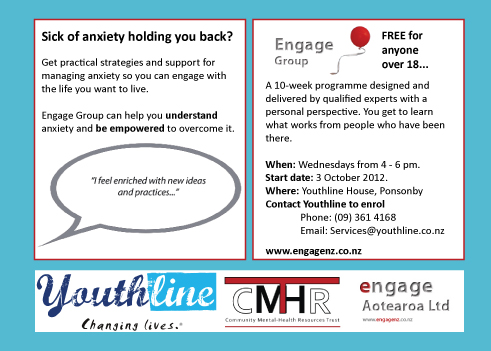
Engage Group Now FREE!!! Starts 3 October 2012

Youthline and Community Mental-Health Resources Trust are pleased to announce enrolments for Engage Group are now open for 2012 and participation is entirely free.

Spaces are limited to 8 participants – first in, first served.

Find the full information pack and eligibility criteria online here or phone Youthline for further information.

New Quality Rights Tool Kit from WHO

The World Health Organisation has launched a Quality Rights Tool Kit that aims to ensure that quality of care and human rights standards are put in place in mental health and social care facilities around the world.

Read more at: http://www.who.int/mediacentre/news/notes/2012/mental_health_20120615/en/index.html


Free access to building accessibility standards

The best advice on how to make buildings accessible for disabled people is now available online for free. As the result of advocacy by the Barrier Free Trust, CCS Disability Action and DPA, eleven organisations have joined together to fund public access to New Zealand Standard 4121: Design for access and mobility: Buildings and associated facilities (NZS4121) over the next two years.

NZS4121 covers public buildings such as government offices, commercial buildings, police stations, hospitals, schools, theatres, shops, petrol stations and public toilets. It provides detailed technical guidance for design and building industry professionals on how to achieve the minimum level of accessibility in the built environment, as required under the Building Act 2004.

The Department of Building and Housing (now part of the Ministry of Business, Innovation and Employment) has agreed to fund fifty percent of the cost, with the remaining fifty percent being met by:

  • Wellington City Council
  • Auckland Council
  • Christchurch City Council
  • Selwyn District Council
  • Building Officials Institute of New Zealand
  • Barrier Free New Zealand Trust
  • CCS Disability Action
  • Be. Institute
  • Royal New Zealand Foundation of the Blind (RNZFB)
  • National Foundation for the Deaf (NFD)
  • Deaf Aotearoa.

This is a great achievement. It will promote greater knowledge of practical changes that can be made to improve access for all.

The Barrier Free Trust and the Ministry of Business, Innovation and Employment are planning a series of seminars to inform the disability and construction sectors on the importance of NZS4121 in the design and building process. These seminars will help to spread the news about the free availability of NZS4121.

You can access NZS4121 at: http://www.standards.co.nz/4121+access+mobility+design


No. 106: Lean on Someone

This week, to attain, maintain or regain my sense of wellbeing… Coping Kete…I will practice leaning on the people around me when things start to feel a little stressful. Leaning on the people around me means that this week, I will share what I am going through with the people around me and accept their offers of help. If people ask me how they can help, I will practice letting them know. So often, we turn down help because we think we ‘ should’ be able to take care of everything on our own. This week, I will practice turning to the people around me for help, even with smaller stressors. As I move through the week, I will note who seems to respond to well to my sharing and who responds less well. This will allow me to figure out the best people to go to for help later. If I notice there aren’ t many people in my life who respond well, I might turn my attention to an engagement strategy for building some connections with some more supportive people. When I am familiar with letting people know I am finding something hard and accepting their help with everyday kinds of things, I will add ‘ Lean on Someone’ to my Personal Coping Kete as a strategy for getting through times of intense distress. I might keep a list of good people to contact in my Kete too.

No. 105: Sharing the Little Positives

This week, to attain, maintain or regain my sense of wellbeing… Coping Kete… I will practice sharing my successes, achievements and moments of enjoyment with other people. At the end of every day this week, I will contact someone I know to talk about one positive moment from my day. If I find it hard to notice positive things I might carry a notebook in my pocket so I can write them down when they happen or simply jot them down at the end of the day in preparation of my call or conversation. If I find it hard to talk to people about positive things I have experienced, it might help to make a list of people I can call. It may also help to think of some things I can ask the people I talk to so my sharing does not come out of the blue and the conversation doesn’ t become one-sided. This week, I will practice celebrating my achievements and sharing my good moments, however small they may be, with the people in my life. In doing so, I will practice making the small positives of life stand out from the mix of more difficult daily experiences. As a regular practice, this may help me to have balanced attention that takes both the good and the bad information on board. In regularly talking to the people I know about my positive experiences, I will create relationships in my life that give me the chance to also talk about the difficult things I go through as well. Once I have gotten used to sharing my achievements and positive moments, I will add ‘ Connect to Share the Little Positives’ to my Personal Coping Kete. In moments when the negatives seem overwhelming, I will contact someone to share some of the positives in my life. When I feel bad about myself and am finding it hard to feel better, I can get in touch with one of my people for some support to remember my positives. Sometimes it really helps to get a reminder about those things from someone other than ourselves!

Script: A Newsletter for Young Dads

The latest Issue of the Script is out – a newsletter from the Young Dads Group (Supported by The Glen Innes Family Centre – Te Waipuna Puawai – Thrive Teen Parent Support Trust)

Auckland Disability Law Still Needs YOU

Public Launch of Open Letter

The Public Launch of Auckland Disability Law’s open letter to Minister Judith Collins held on Thursday 5th July 2012 at Trades Hall was a positive success.

A crowd of over 30 people attended.  Many of them signed as individuals and on behalf of their organisations.

As a result of this hui, the Herald featured a story about disability law, featuring Steering Group Chair Person, Martine Abel,

Click link below for the article

http://www.nzherald.co.nz/nz/news/article.cfm?c_id=1&objectid=10817730

You can also listen to Nicola being interviewed on Checkpoint last week: http://www.radionz.co.nz/national/programmes/checkpoint/audio/2524294/auckland-disability-law-fights-against-closure

A week ago, Auckland Disability Law released and launched their campaign, Save Disability Law.

Since the launch, over 100 individuals have signed up to support Disability Law, and we have received support from these organisations (in alphabetical order):

  • Auckland Action Against Poverty
  • CCS Disability Action
  • DPA Dunedin
  • Green Party of New Zealand
  • Homeworks Trust
  • Kaitaia Community House
  • National Secretary on behalf of New Zealand Public Services Association (PSA)
  • People First
  • PSA Deaf and Disabled Members Network
  • Pukenga Consultancy
  • Service and Food Workers Union SFWU
  • Tamaki Ngati Kapo Inc
  • Te Roopu Waiora Trust
  • The Asian Network Inc.
  • Unite union
  • Youthlaw

It’s not too late to sign!

How to sign

Email your name to info@adl.org.nz and they will add you as an email signatory to our list.

If you are signing on behalf of an organisation, be sure to include your logo.

If your organisation has not yet signed, ask them if they would like to support the cause.

You can also save and print a copy of the Open Letter yourself and send it directly to Minister of Justice Judith Collins http://www.beehive.govt.nz/minister/judith-collins

What else you can do

You can write your own letter to Minister of Justice Judith Collins.

You can lobby, write to or talk to your Local MP.  Click link for list of MPs http://www.parliament.nz/en-NZ/MPP/MPs/MPs/ Don’t forget to let Auckland Disability Law know how your communications with them were received.

Write to the newspapers, or put out your own press release

Contact Auckland Disability Law for further information

Follow on Facebook

Search and click the ‘like’ button on the Auckland Disability Law Facebook page

Come to the “Save Disability Law” public meeting

  • Monday 30th July 2012
  • Time 1pm – 3pm
  • Western Springs Community Garden Hall, 956 Great North Road, Western Springs, Auckland

Further Information

If you require any further information or you are able to help the campaign in any way, please contact us:

Nicola Owen, Development Manager, Auckland Disability Law