This week to attain, maintain, or regain my sense of wellbeing...

...make a commitment to play everyday. It's true that all work and no play makes for a pretty dull time - it also means that we don't get a chance to properly wind down after something stressful. Life can't be all serious, sometimes we need a bit of silly. This week, spend some time everyday playing. You might spend five minutes seeing if you can still do knuckle-bones or an hour with a friend and a board-game or twenty minutes outside with a basketball or half an hour in the park on the swings. You might need to do a bit of prioritising and planning to make sure it actually happens. If you find it hard to think of something to play, make a list of things that you did to entertain yourself as a child and work your way through each of them. It could be tricky to fit a play in everyday, but you can do it if you have lots of different kinds of play, some that you can do in the space  of five minutes and fit in at a busy time. Try to have times of play with another person, and other times it can be solitary play. The key is that there is a time of light-heartedness in your day. This week, no matter how you feel each day, make sure you get at least five minutes of play. Try to notice what things make you laugh or lift your mood even just for a moment and what things don't make any difference, so you can repeat the things that work for you.

Once you are comfortable with playing everyday, add 'Play Time' and a list of the things that worked for you to my Personal Coping Kete as a strategy for times of stress and distress. When you notice yourself having a low mood or starting to get stressed on a regular basis, engage with some play to inject some balance in your life and shift your mood for a little while. Playing won't change the bad things in your life, but it will give you a break from them so they don't dominate, and insert some lighthearted variation into your daily life that might make it easier to cope with and recover from the tough stuff. When things are stressful, we all need a bit of time to recover, and you can use play as a way to recover your energy levels when things are hard.
Author Archives: Admin
No. 133: Play Time
New Ministry of Education Evidence-Base For Suicide Prevention in Schools Released
In case you missed it, on the 21st of March 2013, the Ministry of Education launched a new document to support suicide prevention work in schools called Updated evidence and guidance supporting suicide prevention activity in New Zealand Schools. This accompanies the Preventing and responding to suicide: Resource kit for schools (Ministry of Education, 2013) which is now ready to be distributed across NZ schools. The creation of the evidence-base update document was undertaken by Professor Sunny Collings to inform the revision of the school guidelines, as part of the suicide prevention research programme managed by Te Pou for the Ministry of Health.
 Click here to open and save a copy of Updated Evidence and Guidance Supporting Suicide Prevention Activity in New Zealand Schools 2003-2012
Just a Few Weeks Left to Enrol in Engage Group!
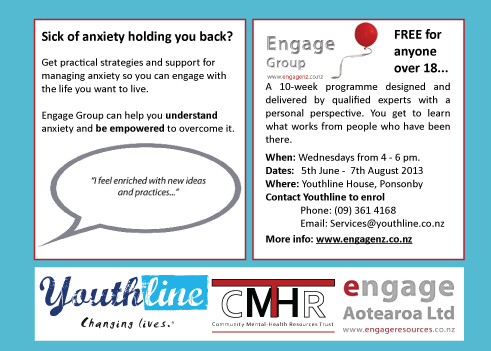
Engage Group’s start date has been moved to the 5th of June to allow the last few spaces to be filled before getting underway. Click here for more information.
Haka for Suicide Awareness and the Tu Kotahi Project
Students at Taipa Area School took part in the Cool to Korero seminar with Mike King at the beginning of March this year. Last week, Mike King of Key to Life Charitable Trust and Tai Tupou of Ripped Training returned to Taipa for their Kapahaka festival and were treated to the world premier performance of a haka for suicide awareness that the students created following the presentation.
Thanks to Tai Tupou, Engage Aotearoa is now able to share some footage of the haka here for everyone to see. The link below will take you through to a publicly available video shared on Facebook.
Click here to watch Taipa Area School’s Haka for Suicide Awareness.
Trigger alert: This is a powerfully expressive piece, created and performed by youth at Taipa Area School and they bravely take you on a journey through the full spectrum of emotion with this piece. If you have lost someone to suicide, we suggest watching this video with a friend, these kids don’t hold back for a second and there are a few explicit actions involved.
Newspaper Stories Keep Messages Alive and Well in Whangarei!
The Northern Advocate has published two amazing stories that take the Community Korero messages out to the wider community. Sharing these articles with friends and whanau might help someone you know to help themselves or help their loved ones. Please forward them around as widely as you can.
More Talk Needed on Suicide, Not Less – 22 April 2013
King: Learn to Like Yourself – 10 April 2013
Tu Kotahi Gets Up and Running
Since Engage Aotearoa and Key to Life first visited the Far North, Key to Life has created a student-led suicide prevention initiative called Tu Kotahi and linked in with youth ambassadors from Kaitaia College and Taipa Area School to make sure that it’s the youth themselves who are leading the charge to prevent suicide in NZ. Ezekial from Taipa Area School and Aleisha from Kaitaia College are on board and want to hear from other youth who have suggestions or want to get involved.
Visit the Key to Life Facebook Page to link in with Zeek and Leesh!

MindNet Issue 31 Out
| Issue 31 – part one |
mindnet.org.nz |
||||||||||||||||||
| In this issue of MindNet Michelle Hull discusses how lack of sleep affects wellbeing and how you can get a better night’s ‘kip’.
Sitting Fit is one way older people can become engaged in exercise. Find out how septuagenarian fitness instructor Shirley Waterfield inspires her classes. Sophia Graham shares the special meaning ‘neighbourliness’ has for her in light of our recent 3rd annual Neighbours Day (23-24 March). Vaea Hutchens tells us about a special Christchurch project to empower Māori families who have family members with experience of mental illness. And, we have a unique opportunity for MindNet readers to view NZ Mental Health Media Grant fellow Guy Frederick’s photojournalism exhibition The Space Between Words. The exhibition is now available online especially for people who have not been able to see it in Christchurch or Wellington. Guy has the chance to win an Australasian award for this project and would really appreciate your feedback on the exhibition and the inspiring stories that 14 Cantabrians have shared. Once you have viewed the exhibition (or if you have already done so) please share your thoughts by taking the survey. Finally, the reading list for this issue is about creating a balanced life. If you can recommend a wellness or mental health promotion service, project or programme that we could feature in MindNet – or would like to contribute an article yourself – please email mindnet@mentalhealth.org.nz From the MindNet team |
|||||||||||||||||||
Subscription detailsSubscribe to MindNet. |
|||||||||||||||||||
New Rainbow Community Human Rights Resource: Born Free and Equal
If you haven’t yet seen it, the Human Rights Commission recently released a new human rights, sexual orientation, sex and gender identity resource – Born Free and Equal.
Copies can be ordered from the Commission by emailing resources@hrc.co.nz or can be downloaded from the HRC website here: www.hrc.co.nz/wp-content/uploads/2013/02/BornFreeEqual_for_Web.pdf
Auckland Council Report on Aucklanders 50 and Over
A 17 page summary analysis of the life experiences of older Aucklanders has been released by Auckland Council’s Research Investigations and Monitoring Unit: Charles Waldegrave and Peter King of the Family Centre Social Policy Research Unit and Elizabeth Rowe of Elizabeth Rowe Consulting.
Please take the time to review at least the summary as the information contained within is very relevant to us all who are working with older people in the community in the Auckland region.
Follow this link to the Executive Summary of the research Aucklanders 50 and Over Executive Summary
The full report (140 pages) is available on the website below for those who wish to read more detail and graphs.
Hikoi for Better Mental-Healthcare Choices in Feilding 13 May 2013
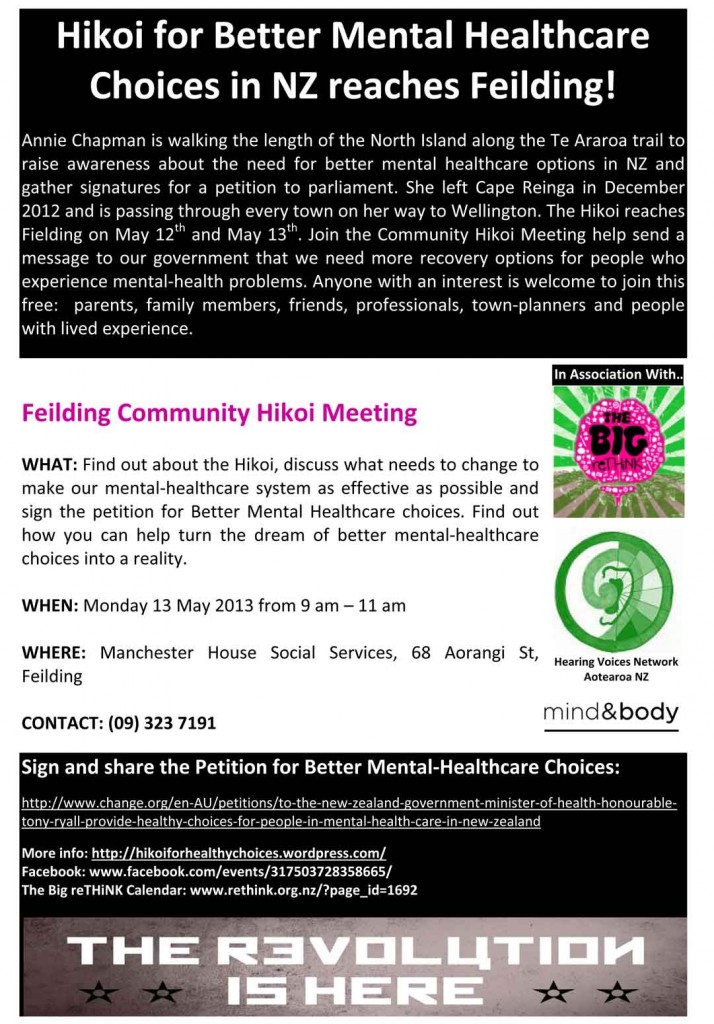
Want to help gather signatures? You can download, print and share a Paper copy of the petition here: http://hikoiforhealthychoices.
Update from the International Initiative for Mental Health Leadership
From the IIMHL and IIDL Update List
IMHL AND IIDL UPDATE – 15 APRIL 2013 – Shared with permission here: Read on…
IIMHL Features
Technique Is Not Enough (TINE) Framework
A Report from the British Psychological Society on Socially Inclusive Parenting Programmes and Child Mental Health
The BPS’s “Technique Is Not Enough (TINE) Framework” is designed to ensure known to be effective parenting programmes engage those parents most likely to benefit: those on low incomes who are marginalised and socially excluded. If all local programmes adopted this framework participation rates could increase dramatically.
Parenting programmes enhance parent-child bonding, reduce parental mental ill-health and lessen the chances of children growing up with behavioural problems or worse. Although the UN endorses 23 parenting programmes on the basis of RCTs their impact is limited by who they reach. In practice programmes recruitment and retention rates vary from a low 20% to a high of 80% in those programmes specifically adapted to reach and work with socially excluded families. The report recommends that parenting programmes should adopt psychosocial approaches to increase inclusion by involving culturally congruent parent “graduates” in the recruitment and retention of parents. When parents who have already benefited from the programme are involved in delivering the programme to others, it really helps. Parents should also be involved in adapting programmes’ content and learning styles to sensitively match participating parents’ cultural backgrounds as well as in quality control and evaluation.
The TINE framework describes how programme developers can invest in local parents and practitioners so their parenting programme can become an integral part of education and social care. Genuine co-production between programme developers and local parents, working alongside teachers, health and social care practitioners, can drive effective inclusion. TINE challenges developers to identify the essential ingredients from their current parenting programmes and to clarify what can be adapted to meet local parents’ socio-cultural needs, whilst avoiding adaptations that dilute effectiveness.
The report evolved from joint work with families and teachers from an existing programme in an alliance including community health, psychologists, family therapists, social workers and children’s rights professionals. The framework is illustrated with examples from 11 UN recommended programmes.
Following is the link to view this paper in full:
http://www.bps.org.uk/system/files/images/tine.pdf
IIDL Feature
High Aspirations. An Interview with Rob Greig, Principal Author of Valuing People
This is an interesting interview canvassing Rob Greig’s opinions on the current issues facing people living with an intellectual disability
http://www.ndti.org.uk/uploads/files/Untitled009.pdf
2013 Leadership Exchange
In due course, copies of video interviews with delegates attending the Network Meeting and copies of keynote speakers’ presentations will be available on the IIMHL website, and they will forward further information to you in the 15 April Update.
You can now view the whiteboard narratives which are loaded onto the IIMHL website along with notes from the various workshops: www.iimhl.com
IIMHL will also update you all on the formal evaluation in due course.
2014 Leadership Exchange
The 2014 Leadership Exchange will be in England in June. IIMHL will confirm the city and date soon.
Please note: IIMHL try to find articles, new policies, research that has been released or opinion pieces we think are interesting to reflect on. Sometimes those who receive these may feel is not accurate either for its use of data or not aligned with their views. IIMHL does not endorse any article it sends out as we try to rapidly share information.
General enquiries about this update or for other IIMHL information please contact Erin Geaney at erin@iimhl.com.
No. 132: Affirming Breaths
This week, to attain, maintain or regain my sense of wellbeing…  …I will spend a moment every morning taking some calm, slow breaths while I repeat a couple of positive self-affirmations in my head. For just two minutes, I will sit still, with my eyes closed, as I breathe deep into my belly and gently repeat my affirmations in my mind. As I notice my mind drifting away from my affirmations into doubtful, critical or negative chains of thought, I will bring myself back to my slow breathing and once more begin repeating my affirmation to myself. After a couple of minutes I will open my eyes and carry on with my day. Before I try this, I will need to prepare some statements that I might find validating, hopeful, strengthening or soothing in some way. A positive self-affirmation is just a statement about something positive that I think is true about myself or my place in the world. It is important that it is something I can believe to be true. What is a useful, comforting affirmation for one person, might not be any help to another person. So this exercise involves doing some exploration of what fits for me. Some people use inspiring quotes they have read somewhere, others use simple self-statements like “I am okay, whatever happens, I can survive it.” Others like to acknowledge their values and intentions. Others like to remember things like “I am connected to the wider universe and the ancestors that came before me.” Really, an affirmation can be anything at all. Over the week, I will pay attention to the kinds of statements that I find useful and figure out what kinds of self-affirming statements work for me. This week, each morning, I will have a chance to get used to hearing myself being kind and encouraging to myself. Once I am comfortable with doing a breathing exercise while I think some self-encouraging statements, I will add the Breathing Affirmations to my Personal Coping Kete as a way of coping during times of stress and distress. When I notice myself feeling upset or troubled in some way, I will take a moment to breathe and feed my mind some soothing, strengthening thoughts.
…I will spend a moment every morning taking some calm, slow breaths while I repeat a couple of positive self-affirmations in my head. For just two minutes, I will sit still, with my eyes closed, as I breathe deep into my belly and gently repeat my affirmations in my mind. As I notice my mind drifting away from my affirmations into doubtful, critical or negative chains of thought, I will bring myself back to my slow breathing and once more begin repeating my affirmation to myself. After a couple of minutes I will open my eyes and carry on with my day. Before I try this, I will need to prepare some statements that I might find validating, hopeful, strengthening or soothing in some way. A positive self-affirmation is just a statement about something positive that I think is true about myself or my place in the world. It is important that it is something I can believe to be true. What is a useful, comforting affirmation for one person, might not be any help to another person. So this exercise involves doing some exploration of what fits for me. Some people use inspiring quotes they have read somewhere, others use simple self-statements like “I am okay, whatever happens, I can survive it.” Others like to acknowledge their values and intentions. Others like to remember things like “I am connected to the wider universe and the ancestors that came before me.” Really, an affirmation can be anything at all. Over the week, I will pay attention to the kinds of statements that I find useful and figure out what kinds of self-affirming statements work for me. This week, each morning, I will have a chance to get used to hearing myself being kind and encouraging to myself. Once I am comfortable with doing a breathing exercise while I think some self-encouraging statements, I will add the Breathing Affirmations to my Personal Coping Kete as a way of coping during times of stress and distress. When I notice myself feeling upset or troubled in some way, I will take a moment to breathe and feed my mind some soothing, strengthening thoughts.