
Engage Aotearoa

Tag Archives: Mindfulness

Trauma informed mindfulness

With all that is going on the world at the moment, there is a lot of talk about the benefits of mindfulness as a way to cope and heaps of useful tips being shared online. But learning mindfulness can be tricky, especially when we have trauma or psychosis on board, and some adaptations are often needed. So I thought I’d dig up a bit of information to share and came across this article on Psychology Today which sums it up nicely.

“While there is strong scientific evidence to support the use of mindfulness for emotional and psychological healing, it is also important to recognize how these practices can lead to increased distress. For those with unresolved trauma, the practice of mindfulness can be approached carefully and thoughtfully to minimize the likelihood of negative outcomes. […] For some, intentionally engaging in the experience of “being present” with thoughts, feelings, and bodily sensations can lead to a resurfacing of unresolved, or even undiscovered, issues and feelings. […] At times, being mindful can leave a survivor feeling like they are trapped or helpless again.” Read more about trauma-informed mindfulness here: http://www.psychologytoday.com/nz/blog/choosing-your-meditation-style/202006/trauma-informed-mindfulness

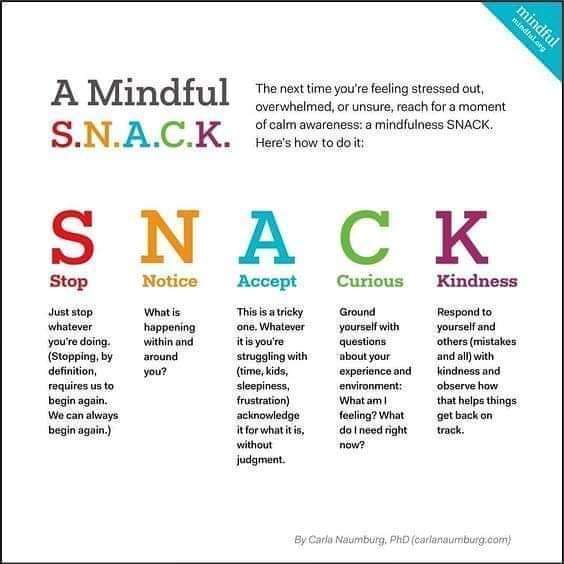
If you find doing exercises like the Mindful SNACK difficult, this article might help explain why. Know that it’s normal if you’ve got distressing experiences going on inside. Go gently with yourself. Many people find it helpful to start practising for very short times, with things that are outside of them like the view, an object or a piece of music, or while doing something, like walking, eating, drinking a cuppa, or stretching.

Mental Health Foundation Launches Mindfulness Posters

The Mental Health Foundation’s graphic designer Amy Mackinnon has created a series of posters that share the basic practices behind mindfulness. The A2 posters are available in a set of three from the Mental Health Foundation’s new webstore for $39 including postage and packaging.

Each sale is equivalent to the cost of one child in a low decile NZ school attending the Mental Health Foundation’s Pause, Breathe, Smile  eight-week mindfulness course. By purchasing these posters, you’re supporting the Mental Health Foundation to deliver mindfulness training to primary and intermediate students in their school classrooms nationwide.

Pilot Study Puts Mindfulness in NZ Schools

A November 16th article from Stuff.co.nz highlights the results of a pilot study by the Mental Health Foundation of New Zealand showing a mindfulness in primary schools programme may have “improved students’ self-control, attentiveness, respect for other classmates and enhanced the school’s mood.”

The eight-week programme includes:

  • “Week One: Coming Home: Introduction to mindful breathing – and mindful movements like ‘opening the curtains’, ‘the penguin’ and ‘seaweed’.
  • Two: Happiness Here and Now: Exploring the difference in happiness – how material things offer a temporary boost, whereas actions create a sustainable sense of wellbeing. Encouraging children to foster friendships and be kind.
  • Three: Everything for the First Time: Experiencing things freshly in each moment, helping students appreciate newness and things they often take for granted rather than getting stuck in unhelpful habits.
  • Four: All things Rising and Falling: Exploring physical sensations in the body. By now, children are aware their breathing is always rising and falling. Now that’s extended to emotions and how emotional states are ‘triggered’.
  • Five: Moving Still: Using a mind-jar (a glass jar filled with water and glitter) and engaging in the ‘neuron dance’, students learn about the brain and how mindfulness can settle a scattered mind.
  • Six: Kind Heart, Happy Heart: Mindful breathing, sending kind thoughts and practising gratitude.
  • Seven: Everything is Connected to Everything Else: Seeing the different connections between things and how being isolated and alone can be harmful.
  • Eight: Touching Base, Touching stillness: Kids bring in an object that reminds them to practice mindfulness.”

Click here to read the full article.

Mindfulness champion on Take It From Us Radio | 30 Sep 2014

On Tuesday 30 September,  tune into Take it From Us to hear from to a young psychologist who is a champion of alternative natural therapies, especially mindfulness, to manage mental health. Special guest Vikki Baird has already done some hard yards in mental health and gained some insights as a result of working in intensive residential rehabilitation.

Listen live on 104.6FM at 12.30pm or online www.planetaudio.org.nz

OR if you missed the broadcast, listen for the next seven days: www.planetaudio.org.nz/takeitfromus

And don’t forget the Facebook page @ Facebook.com and type ‘take it from us’ in the search box; contact Sheldon.brown@framework.org.nz for any feedback and comment/suggestions for shows.

Highlights from the Engage Facebook Page

Here are a few of the posts shared on the Engage Aotearoa Facebook Page in the last few weeks.

No. 150: Make a Memory Jar

This week, to attain, maintain or regain your sense of wellbeing… Coping Kete… practice holding onto good memories by making and using a Memory Jar. To make a Memory Jar, all you need to do is get a jar with a lid that you can fill with reminders of your positive, special or treasured memories throughout the year. Each day, write down at least one positive thing you want to remember later. Write down the small things like amazing views or scenery you have seen or fabulous food you have eaten or moments of laughter with friends as well as the big events and achievements that happen throughout the days and weeks of the year. Some people add objects and pictures to their memory jars too – like ticket stubs from good movies and concerts, photos of friends, shells from beach trips, dried flowers etc etc. Your Memory Jar can become a real lucky dip of treasured moments that you will be able to use as fuel for feeling good in days to come. To start with, you’ ll need to get your Memory Jar ready. Click here to see some Memory Jars made by other people. Some people decorate their memory jars – you could get really creative with this. Next schedule in some time each day for the next week, to write at least one new memory on a slip of paper and add it to the jar. If you have been feeling low, try to choose a time of the day when you usually feel the best. It is harder to notice positives when we are feeling negative, so if you find it tough to think of positive memories from the day, don’ t be hard on yourself for it. It helps to start small with just little things that have brought us a bit of pleasure. You might find it easier to write things down as they happen or to think back further than this one day or week. At the end of the week, look through your Memory Jar and practice remembering each of the good moments. Plan how to continue adding to your jar as you move through the year and then dip into it when you need some help to hold on to the good bits alongside the areas of dissatisfaction you carry or for those times you need some inspiration for how to feel better. It might help to keep it somewhere you will see it often. Reviewing your Memory Jar regularly will help you to get comfortable holding your positive memories in mind without cancelling them out with the bad stuff that has happened. This can help us to prevent the difficult things from taking over our whole view. You might find yourself having pessimistic or cynical thoughts about the activity, especially if you are in a low mood right now. Finding it hard to remember positive things doesn’ t mean that there have been no positive things. It just means you haven’ t noticed any positive things or you didn’ t count them when you did, maybe they seemed inconsequential or insignificant. Sometimes it can help to write down something you think you would find positive on a different day if you were in a better mood. By practicing the art of writing something down every day, you will practice holding onto positive memories in the face of difficulty and hardship, when it is all too easy to forget them. You’ ll also have a really neat record of your year to look back on in days to come. As you gather more and more memories in your jar, and get comfortable noticing, recording and recalling positive memories, add ‘ Use My Memory Jar’ to your Personal Coping Kete for moments of stress and distress. If you are finding things hard, take out your Memory Jar and use it to shift my thoughts to good times and moments of gratitude and find some ideas for things to do in the present to shift your mood. In times of stress and distress, as well as remembering good memories, try to add one new good memory to your Memory Jar a day. Even when everything is terrible, you will be able to find one good thing to add to your Memory Jar. Doing this during tough times might help you to balance out some of your unwanted thoughts and feelings and shift the intensity of your moods a bit.
_ _ _ _
Happy New Year from Engage Aotearoa

No. 114: List Poems

This week, to attain, maintain or regain my sense of wellbeing… Coping Kete…I will spend 10 – 15 minutes every day writing a list poem about the things I have seen, done and felt that day. Each evening, I will sit down with a notebook and write a list of five things I saw that day, five things I did that day and five things I felt or thought. I will try to make each item on each list different. Then I will rearrange or join the items on my lists into a poem. I might add words and images or change things in my lists as well. In this way I will practice regularly reflecting on my daily experience and finding a creative way to express it. While I am thinking of the words to use and working on rearranging the lines, I might get a bit of time out from worrying about things. If I get distracted by concerns of the day I will work them into the list and return my focus to the creative task at hand. By working to include a number of different experiences in the list I will practice having an expansive awareness of my day without letting one experience override everything I have been aware of. If I felt like it, I could share my poems with someone else as a way to connect with support and encouragement, but they are really something that I will do just for myself. Once I am comfortable making list poems about a typical day, I will add it to my Personal Coping Kete as a strategy for distracting myself from the moment and creatively expressing myself in times of stress and distress.Example list poem.

28/09/2012

The aluminium sky

the neighbour’ s stray cat

my own reflection in the window

outside the path littered with petals

the wind-blown tree.


I have typed so many messages

dressed myself to match

bought new socks and worn them

cooked hot food and eaten it

peeled an orange and given you half.

My small victories.


I was caring about everything

sadness for all the news

I thought I saw you flinch when I said that

worrying over the day’ s mathematics

joy in the act of nurturing something.

– M. Barr

No. 97: ABC Thought Catching

This week, to attain, maintain, or regain my sense of wellbeing...

...I will practice engaging with my thoughts and how they are affecting my mood by practicing thought-catching. Being able to catch my thoughts and follow their connection to my moods is a key step towards being able to reason myself out of stress and distress when I need to. Taking a moment to be aware of the core components of my experience will help me be able to respond with awareness.

This week, whenever I notice a slight drop in my mood, I will take a moment to ask myself (A) what just happened, (B) what it meant to me or what I might have been telling myself about that and (C) what it did to my mood.  It is not easy to notice our own thoughts, which is why I will start out by trying to catch thoughts associated with minor changes in mood. Once I'm comfortable with that, I will move on to using thought-catching as an engagement strategy in times of stress and distress.

It is often helpful at first to use a pen and paper to note these things down in three columns.

(A) Activating event: What just happened?

(B) Thoughts / Self Talk: What might I have told myself about that? What did it mean to or for me?

(C) Mood Change: What happened to my mood?

In this way, I will start to build up a picture of the kinds of thoughts that make my moods swing, and the kinds of situations that trigger those thoughts. This will prepare me to be able to recognise and catch those thoughts later when they are fueling my distress - and perhaps detach from those thoughts a bit, adopting the position of observer and getting a bit of perspective on them.

Once I have gotten good at making myself aware of what my thoughts are, I will add thought-catching to my Personal Coping Kete. In times of stress and distress, I will be able to practice catching my thoughts and observing to myself what triggered them and how the thoughts made me feel. By engaging with my thoughts and emotions before I respond, I will be better prepared to soothe, express, distract myself from or get support with them.

No. 92: The Art of Appreciation

This week, to attain, maintain or regain my sense of wellbeing… Coping KeteI will practice tuning my attention into positively charged events every day by writing down three things I appreciate, enjoy, feel grateful for, or am glad to see in the world. Later, when I need to self-soothe, I will find it easier to balance negative automatic thoughts or expectations about the world around me. During the day I will try to notice things as they happen and note them to myself for later. I might have to go searching for things to record for a while – it is quite an art to see the good stuff sometimes! Each evening I will write down the date and the list of three things for that day. Once I have been doing it for a while and have a good list, when I find myself feeling negative about the world around me I will be able to read through the list and balance it out with some of the things I appreciate and feel good about. As I read the list, I will remember to myself what it was about each thing that I liked, what I saw in it. Eventually I’ ll get good at just remembering these positive balancing points by themselves. When times are tough I will be able to shine the light of my attention onto a bit proof that it’ s not all bad out there. I let the wanted and unwanted parts of the world exist side by side without letting one cancel the other out. If/when I find a good way to make this work for me, I will note a reminder down about it on a piece of paper and add it to my Personal Coping Kete.

No. 82: Valuing My Values

This week, to attain, maintain or regain my sense of wellness… Coping Kete…I will practice using self-talk to remind myself of the things I value and care about. In this way I will give myself regular reassurance that despite how things might sometimes turn out, I ultimately have positive intentions. I can relax and let my values guide me. To prepare myself to self-soothe like this when I am distressed by negative thoughts about myself, I will first spend some time, maybe with a pen and paper, to think about what my values are. I will ask myself, “what is it that I think is most important in life?” I will then practice regularly reminding myself “I am the kind of person who values…xyz… so no matter what happens out there, I am all right in here.” If I find that my distress stems from my doing things that don’ t sit well with what I value, then I will be able to move on to a more problem-solving based strategy to discover what I could change or how I could respond. This week, I will practice seeing the evidence of my self-worth in the values that I hold, the things I believe in and strive for. Once I am comfortable being aware of my values and trusting them to guide me, I will add this strategy to my Personal Coping Kete as a way of soothing feelings of distress.