Engage Aotearoa

Alternative Activity Programme for Children

How much time does your child spend watching TV or playing video games?

Would you like some alternative activities for your family?

Are you concerned about your child’s TV and/or computer use?

Do you want to be part of a cool new study called SWITCH?

The Switch programme at the University of Auckland are looking for children aged 9–12,

who live in Auckland and watch TV/play video games/use computer for 2.5 hours per day.

This is the first study of its kind in New Zealand.

If you would like to take part in this exciting study (SWITCH),

please call 0800 SWITCH or email your enquiry to switch@ctru.auckland.ac.nz

No. 64: Me Time

This week to attain, maintain, or regain my sense of wellbeing... 

I will give myself two moments of 'me time' every day - once in the morning (perhaps the first 15 minutes I am awake) and once in the evening (maybe the last 15 minutes before going to bed). During these times I will find a way of taking some time to myself to do something centering or that connects me with myself. This might involve using the time to just quietly sip a cuppa and read a magazine or write in my journal or take a slow shower or go for a peaceful walk or doodle on a notepad or whatever it is that I find gives me a break from the demands of the day and allows me to simply 'be' for a moment.

As needed, I will use this as valuable time for sorting through my thoughts or goals or whatever else might be cluttering up my mind at the moment. Giving myself regular moments to myself will allow me mental space in each day to process what I need to process. I might even use this dedicated to time to try other coping strategies I have been wanting to learn. The point is that I take 15 minutes, two times a day to do whatever I want, just for me: I am worth it. 

If I'm out of practice of giving myself 'me time' it can take a while to get into the habit. I'll be sure to be understanding of myself if I find it hard to put this strategy into action. It is often helpful to plan in advance what I will do each day, rather than expecting myself to spontaneously think of something when the time comes.

Modern life can become very busy, this week I will set myself up to cope with stress by giving myself these two regular breathers that are just for me. This is about practicing the art of valuing myself.

Once I've figured out the art of spending time valuing myself, I will add 'Me Time' to my Personal Coping Kete. In times of stress and distress, I will try a bit of me time to shift my mood.

No. 63: Taking Comfort in the Inevitability of Change

This week to attain, maintain or regain my sense of wellbeing… "" …I will practice taking a couple of deep breaths and keeping a sense of perspective by reminding myself about the inevitability of change and how the current moment will shift. It might take a minute, an hour, a day or even weeks or months, but things will be different. Nothing ever stays the same. I will tell myself this in the moment and I will think about how I would like it to be different and what could be done to move myself closer to that picture of things. If it is hard to focus on this without counteracting it with negative automatic thoughts, I will try writing it down. I will then turn my attention to something else in my environment to involve my attention in something else. I am practicing allowing myself to let go of each moment and get a different experience. Once I am familiar with taking comfort in the possibility of change and redirecting my attention in everyday situations, I will add it to my Personal Coping Kete as a way of coping with stressful and distressing moments.

No. 62: Easing the burden

This week, to attain, maintain or regain my sense of wellbeing… ""I will remember the words of Ingrid Bacci, ‎”Inner growth is a slow and incremental process that accomplishes extraordinary results through what often look like minute daily changes” As I move through my daily life, this week, I will recall this quote and remind myself that all that is required are “minute changes” – and minute changes or minute actions are usually pretty manageable. I will observe how thinking about things in this way affects me. There’ s real wisdom in the old saying that the longest journey, begins with the smallest step. I will take comfort in my smallest steps. In each moment of distress, I will ask myself, what’ s the smallest step I could take to shift my experience right now? What’ s smaller than that? When I’ ve got to the minutest change, I’ ll think about giving that a go. The act of thinking through this exercise is a minute change in itself, whether it leads to anything else or not. When I manage to do it, I will be sure to acknowledge the achievement to myself. Once I am used to lowering my expectations for myself in everyday situations, I will add it to my Personal Coping Kete for times of heightened stress of distress. When I feel impatient or frustrated with myself about something or feel overwhelmed by a situation, I will remember that growth and survival comes from minute actions. I will think of minute actions I can take in the moment and remember how they have affected me recently.

Cross-Country Conversations…

More info here:    http://www.curious.org.nz/blogs/list/cross_country_conversations/

Blow the Whistle on Domestic Violence

Watch the Blow the Whistle Campaign Video here.

The ‘Blow The Whistle‘ campaign is a Mental Health Foundation initiative highlighting the Rugby World Cup event as a way of drawing attention to domestic violence, one of the main causes of mental health trauma in our society today.

It is also widespread.  One in three women said they had experienced family violence in their lifetimes as part of a 2004 study interviewing over 2000 women in Auckland and the Waikato (1).

Another more recent US study (August 2011) showed that if a woman was exposed to 3 or 4 types of violence (like  rape, sexual assault and stalking), the rate of mental disorders went up by 77.3%: for anxiety it went up by 52.5%, for mood disorder 56.2%, and suicide attempts went up 34.7%

When it comes to big sports events like the Rugby World Cup, the amount of violence against women and children goes up! A recent report from the United Kingdom states that incidents of family violence increase by as much as 30% on the days of England’s fixtures during the 2006 FIFA World Cup (3). A recent NZ paper states ‘…for some women and children, the Rugby World Cup may bring increased risks of violence, abuse and neglect’.(4)

So the risk to mental health issue is big and it’s likely to get bigger once the Cup is underway!

What can we do?

  • Talk about it where you work or within groups you run.
  • Put up posters: order them free from info@blowthewhistle.org.nz . There are also some whistles and coasters available at a cost.
  • Write a letter to the local newspaper
  • Support the campaign at any matches you attend.

Go to  www.blowthewhistle.co.nz for more information.

References:

  1. Fanslow J, Robinson E. Violence against women in New Zealand: prevalence and health consequences. N Z Med J. 2004;117(1206).
  2. Rees S Silove D et al. (2011) Lifetime Prevalence of Gender-based Violence in Women and Relationship with Mental Disorders and Psychosocial Function JAMA  August 3 2011– Volume 306, No 5
  3. Palmer C (2011) Violence Against Women and Sport: A Literature Review Trust for London
  4. Hager D. Woolson Neville D (2011) ‘Mitigating the risk of men’s violence against women increasing during the Rugby World Cup ‘ retrieved from http://www.2shine.org.nz/sports-and-domestic-abuse

Equipping Communities: Thriving Lives for Supporters

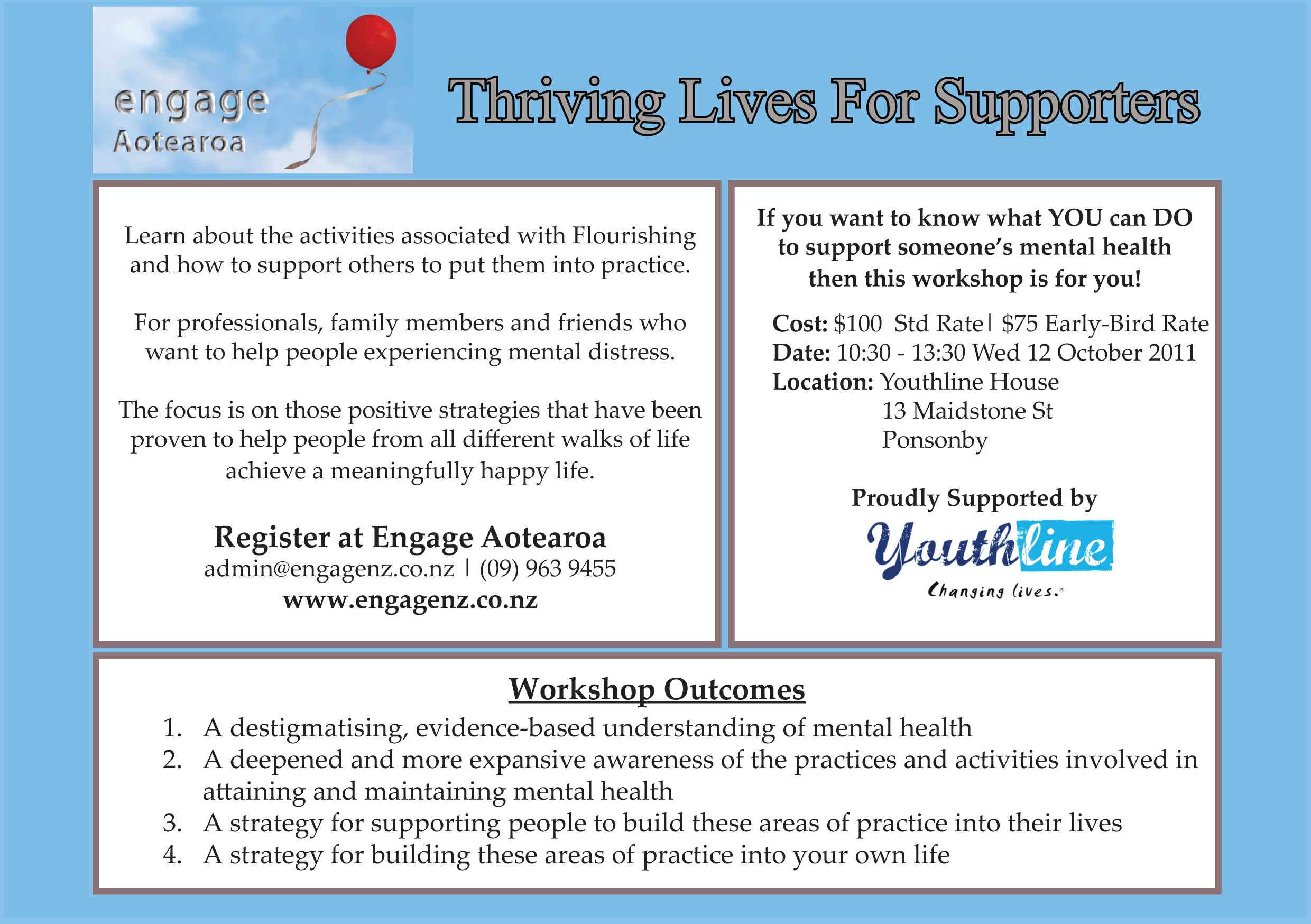
Today is World Suicide Prevention Day and we just wanted to take a moment to send a wee reminder out about our upcoming Thriving Lives for Supporters Workshop. We think one of the reasons we have such a high rate of suicide is because we don’t have enough tools for talking about or building wellbeing and happiness and the other positive experiences associated with mental health.

Thriving Lives is a worksheet tool to help people understand how they practice mental health in their own lives and what they could add to their picture. Thriving Lives Workshops teach people to use this tool to improve their wellbeing.

Feedback on the Thriving Lives Workshop shows this approach helps people to:

  • feel less alone
  • acknowledge their strengths
  • recharge their sense of hope
  • form new understandings
  • develop practical strategies for improvements

We’ll be running a repeat session on October 11th. More information about that is on our website. It doesn’t stop there though. People need supportive, informed communities to help them on their way. Our next step is about training the wider community to support people to put this approach into action.

Thriving Lives for Supporters equips supporters of all kinds to use this approach in their own lives and with the people they support. Whether you are a family-member of someone who is dealing with stress or mental unwellness, a friend, a colleague or a professional who works in the mental-health sector, this workshop is for you.

You’ll be pleased to know we’ve extended the early-bird enrolment period to September 16th, so there’s a few days left to take advantage of the discounted rate.


Any questions, please don’t hesitate to get in touch – we’re happy to offer a group discount if there are a few people enrolling together. 

Click here to open a copy of the information sheet.

Contact us to enrol. 

No. 61: Changing the Scene

This week, to attain, maintain or regain my sense of wellbeing… ""I will practice getting a change of scene to shift my mood, even just for a moment. Sometimes we need to get out of where we are to be able to shift our thinking and feeling. This week, when I notice slight drops in my mood or energy level, I will get a change of scene by moving my attention to a different aspect of my current environment or by physically moving myself somewhere new. It could be as simple as going for a walk down a nearby street I’ ve never walked down. Or spending a moment looking closely at a plant I’ ve never studied closely. Giving myself a range of different experiences throughout the week will help me to connect with more positive emotion. I will search out opportunities to give myself these out-of-the-moment experiences, taking the time I need to make considered responses where I am able to find and savour insights rather than act only out of feeling. I will observe how I am affected by these changes of scene. Once I am comfortable changing the scene, I will add it to my Personal Coping Kete as a way of shifting my mood in times of stress and distress.

No. 60: The Good Mood Diet

This week, to attain, maintain or regain my sense of wellbeing…

Coping KeteI am going to practice The Good Mood Diet. It’ s not a food diet, though food will be part of it. The good mood diet is about creating opportunities for positive moods. This will strengthen my resilience to stress and distress, because it will become easier to counter dark thoughts when I have been experiencing some positive things.

The Good Mood Diet is about finding small activities that can be fitted into everyday life on a regular basis. It’ s not about trying to only experience good moods, but about making sure that good moods are part of my experience.

I will start by making my own Good Mood Diet plan, which involves first making a series of lists:

    • FUN: A list of things I have enjoyed doing alone or with others
    • TIME-OUT: A list of things that I have found relaxing or peaceful or freeing – we all need time to do just as we please, to chill.
    • NOURISHMENT: A list of things that I found nurturing for my body
    • ACHIEVEMENT: A list of small everyday things that have given me a sense of accomplishment or strength utilisation.

Once I have built my four lists, I will take out my diary or day-planner and I will plan in one item from each list for every day of my week. That means that every day, among my usual activities, I will do one thing I find fun, one thing that gives me time out from expectations, one thing that strengthens my body and one thing that shows me my capabilities and skills.

No matter what is happening in my life, I value myself enough to gift myself the opportunity to experience the good bits.

To help myself along I will make sure that the items on my lists are specific and small enough to be achievable. I will keep my schedule in mind and ensure that the ideas I generate will fit with that. For example, planning full-day activities when I don’ t have full-days available will set myself up to be unsuccessful. It would be more useful to find little elements of the larger activity that I could implement given my particular context and situation.

If I find it difficult to think of items to try out, I will use the comments feature below to seek help or talk to some friends about what things they might try. Sometimes bad days and distressing moments come about because we become disconnected from these activities. But when we are stressed and distressed, it is extra hard to do these things. As much as possible, I will try to practice them in advance when I am feeling okay or during higher energy times of the day.

Once I have gotten comfortable putting a good mood diet in place, I will add it to my Personal Coping Kete as something to return to in times of stress and distress.

NEW Online NZ Resources for Bullying

Two innovative new bully-focused resources now available for school, community and professional use from Skylight.

With bullying causing deep and ongoing concerns in our New Zealand and Australian communities and schools, Skylight want to let you and your colleagues know that they have  just launched 2 new support resources to assist bullying prevention in both countries.

The new booklet WHO ME? (for 10-17 yr olds) focuses on the bully, giving them better understanding about what bullying is, insights into its effects on themselves as a bully and those bullied, and key steps to help them to stop their bullying behaviour.

When the Bully is Your Child is an 8 page booklet for parents and carers who aren’t sure how best to respond to their own child’s bullying.

These resources are best-evidence and best-practise based, as culturally inclusive as possible and easy to read. Both will be useful for those whose who teach or work with young people and all who work towards bullying prevention in schools, communities and families in any way.

Skylight bullying support resources can be found here. http://www.skylight.org.nz/Shop/Bullying

As a national, not for profit charity, Skylight produce high quality NZ resource tools to support children, teens, adults and their families through life’s tough times welcome partnerships with others to ensure our community is well resourced with the information tools they need the most.(www.skylight.org.nz )

Contact

Tricia Irving Hendry | Skylight | Deputy Chief Executive
PO Box 7309
Wellington 6242
NEW ZEALAND

04 909 7396 (DD)
021 987 995 (Cell)

0800 299 100

www.skylight.org.nz

BECAUSE GRIEF HAPPENS – AND SUPPORT MATTERS!