Engage Aotearoa

No. 101: Stretching Distraction

This week, to attain, maintain or regain my sense of wellbeing… Coping Kete…I will practice stretching to distract myself from the present moment and lift my energy. Once a day I will spend a few minutes doing some basic yoga stretches. As I do them I will practice mindfully focusing my attention on the movements I am making and the way they feel in my body. I will practice letting thoughts of the day pass through my mind as I observe them and bring my mind back to my stretches.\r

    \r

  1. Neck Roll: Standing up, relax your shoulders, drop your head forward to rest your chin on your chest. Slowly roll your head to rest your right ear on your right shoulder, pause, return to centre then slowly roll your head to rest your left ear on your left shoulder, pause, return to centre. Repeat.
  2. \r

  3. Shoulder and Arm Rotation: Stretch your arms out to the side and imagine you are pushing apart two walls. Repeat three times. Keeping the arms at shoulder level, rotate the shoulders forwards and then backwards. Repeat three times. Slowly drop arms to the side and observe the sensation produced in your body.
  4. \r

  5. Swaying Tree pose: Standing with your feet at hip-width, reach your arms above your head, clasp your hands together, exhale and lean gently to the left. Inhale and come back to centre. Then exhale and lean to the right. Repeat.
  6. \r

  7. Cat Pose: Kneel on all fours with hands shoulder distance apart and your knees the same distance apart. Exhale while arching your back up and looking down at your belly. Hold for a few seconds. Inhale as you arch your back down and lift your head.
  8. \r

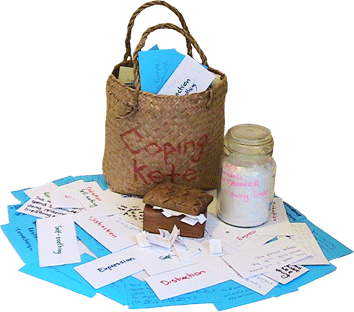
\r Once I am familiar with doing stretches as part of my ordinary day, I will add them to my Personal Coping Kete as a way of distracting myself from distressing moments and times of stress and tension. When I notice I am feeling tense, I can take myself away from present company for a moment and practice my stretches.
Mental health promotion and prevention services to gay, lesbian, bisexual, transgender and intersex populations in New Zealand: Needs assessment report

Te Pou has released a report on the results of an assessment of the mental-health promotion and prevention needs of people who identify as gay, lesbian, bi-sexual, transgender and intersex.

You can read a summary and download the full report here.

Transition Times 3: Changes to Benefit Structure

For your information from New Zealand Council of Social Services.

‘Transition Times’ #3 forwarded on behalf of Ros Rice, CEO, NZCOSS

Please note you can access NZCOSS Facebook where Ros posts information and commentary almost daily. https://www.facebook.com/pages/New-Zealand-Council-of-Social-Services/148340588547487. There is also a link on the front page of the website.

TRANSITION TIMES

Tracking changes to the NZ Government’s funding and administration of social services in our communities.

(NZCOSS is not offering opinion or critique on the information that we are providing in this mailout.)

PLEASE CIRCULATE THIS TO ALL YOUR MEMBERS

Date: 07.6.2012

BRIEF SUMMARY OF THE GOVERNMENT’S PLANNED WELFARE REFORMS

FIVE MAIN AREAS OF CHANGE

  • Changes in structure of benefits
  • Introduction of a fiscal liability-based ‘Investment Approach’
  • A ‘Youth Package’ – for 16-17 year old youth and 16 -18 year old teen parents on benefit
  • Changes affecting parents and sole parents on benefit
  • Changes affecting people with long-term illness or disability

CHANGES TO BENEFIT STRUCTURE

Three new main benefits:

  • Jobseeker Support – replaces current UB, SB (those who are temporarily unable to work due to illness will have a temporary work-test waiver) and DPB for those with youngest child aged 14+ years
  • Sole Parent Support – replaces DPB-Sole Parent for those with youngest child under 14
  • Supported Living Payment – replaces IB and DPB-Caring for Sick and Infirm

Also: Youth Payment & Young Parent Payment (see Youth Package)

THE “INVESTMENT APPROACH”

  • Significant change to method of measuring performance and accountability for Work and Income’s activities
  • Annual (or biannual) actuarial assessment of long-term future liability of current (and future?) beneficiary population (ie, sum of all future benefit costs for current beneficiary population. Current estimate: approximately $45b).
  • A primary expectation on MSD/Work and Income will be to reduce the long-term fiscal liability number.
  • Amount of assistance provided to a person to be guided by the estimated liability they represent (and therefore the reduction in the long-term fiscal liability estimate if they leave benefit)
  • A new Board to oversee this – reports direct to Ministers of Social Development and Finance
  • In future, MSD funding may include performance rewards/penalties according to performance against change in LTFL estimate.

THE YOUTH PACKAGE

  • Applies (broadly) to 16-17 yr old youth and 16-18 yr old parents (single or couples) not supported by family or parents (ie mainly those previously eligible for the Independent Youth Benefit or Emergency Maintenance Allowance ). Commences in July 2012.
  • Intensive ‘wrap-around’ assistance – main focus being to achieve NCEA Level 2, also parenting and budgeting courses and other obligations (and incentives)
  • Heavy emphasis on money management – rent and bills paid directly, remainder on payment card for groceries, up to $50 cash as ‘In-hand Allowance
  • Services will be provided by contracted providers (private, NGO or Iwi)
  • Sanctions: based on recommendation of contracted providers: up to 100% (youth), 50% (young parents)

PARENTS AND SOLE PARENTS ON BENEFIT

  • Part-time work test (15 hours) when youngest is 5 yrs; work preparation expectations when youngest is 3 yrs;
  • When youngest reaches 14, sole parents move from SPP to JSS with 30 hour work test and (presumably) JSS abatement regime

‘Subsequent child’ policy: if woman has child when on benefit:

  • Child’s age is disregarded for work-test obligation once s/he reaches 12 months old
  • Applies to couples on benefit as well as sole parents.
  • Applies at W&I discretion on ‘underlying principles’ of the policy, and can include wider circumstances if W&I believes a woman is seeking to get around the intention of the policy

Medical costs paid for contraceptive advice and for long-acting contraception for mothers on benefit and for their teenage daughters

DISABILITY AND LONG TERM ILLNESS

  • Full details are yet to be announced.
  • Work capacity assessment procedures to be introduced
  • Presumably to apply to all applicants for the new Supported Living Payment and to all those currently on IB (and possibly some SBs)

Ros Rice, Executive Officer NZCOSS

(With thanks to Michael Fletcher; Senior Lecturer, Institute of Public Policy, AUT University.)

Blueprint II Launched 13 June 2012

Launch of Blueprint II

Blueprint II was to be launched at Parliament on 13 June 2012. Blueprint II is a ten year plan to make sure that future users of mental health and addiction services, their families and whānau are getting the services they need, when they need them and where they need them.

It has been developed by the Mental Health Commission in close consultation with the wider mental health and addiction sector. The implementation of Blueprint II will be monitored by the Office of the Health and Disability Commissioner.

Have Your Say on the Gambling Harm Reduction Amendment Bill

A new gambling bill is currently before Parliament. The Gambling (Gambling Harm Reduction) Amendment Bill is a private member’s bill in the name of Te Ururoa Flavell.

Have your say in creating better gambling laws by making a written submission or make an online submission here – www.haveyoursayonpokies.co.nz/ to the Select Committee. This can be as short or as long as you like. You can submit for or against parts of the bill or the entire bill. If you make a written submission, you can also make an oral presentation. You can be as creative as you like. This is your chance to tell your story about the impact of gambling on you, your family and your community and to tell politicians about the changes that you want to see.

p.s. Some info, current editorial from the Herald

www.nzherald.co.nz/nz/news/article.cfm?c_id=1&objectid=10812126

Current facts on gambling

www.pgfnz.org.nz/Fact-Sheets-/0,2731,13132,00.html

Is gambling a concern in NZ?

http://choicenotchance.org.nz/gambling-in-nz/is-gambling-really-a-problem-new-zealand

5 year distribution of Pokie funds under the current system in Auckland– see PDF attached (as requested by some local organisations)

Study Looks at Experiences with Antidepressants in NZ

Have your say on your experience of taking antidepressants

Have you been prescribed an antidepressant in the past five years?

A team of university researchers is keen to see what you have to say about a number of things related to your experiences with these types of medications.

The researchers, from The University of Auckland’s Department of Psychology, are for the first time surveying New Zealanders on their antidepressant use.

Anyone who has been prescribed antidepressant medication in the last five years is eligible to take part in the survey, even if they are no longer taking them. And, if you have been prescribed antidepressants but decided not to take them, you are also encouraged to take part.

The research team hopes that at least 1,000 people will take part in the anonymous online survey, which they have called: Views and Experiences of Antidepressants in New Zealand

A parallel survey of GPs is being conducted by a PhD student associated with the research team, seeking doctors’ views about depression and antidepressants.

No. 100: Use Energy Lifting Words

This week, to attain, maintain or regain my sense of wellbeing… Coping Kete… I will practice using positive, inspiring words in my self-talk and my communications with others to help shift the mood of things. This week, I will become aware of the kinds of words I am using with myself and with others. Each time I notice what I am thinking, I will find a way to reframe it that allows me to use more positive words. Each time I notice the kinds of words I am using/want to use when talking to others, I will think of a way of inserting more positive words. It might help to first make a list of the kinds of energy-raising words I could use, such as inspired, peaceful, harmonious, content and enjoyment. So for example, instead of thinking or saying ‘ I feel awful right now,’ I might reframe things so I think or say ‘ I want to do something to inspire me’ instead. Sometimes just thinking about the positive concept can lift our energy. Using these words in our communication can help lift the energy of those around us and make the way we communicate our problems more effective. Once I am comfortable doing this as part of my regular day, I will add ‘ Reframe to use positively charged words’ into my Personal Coping Kete as a strategy for self-soothing and/or expressing myself when I am stressed or distressed.

100 Coping Strategies in The Coping Kete

The Coping Kete on the Engage Aotearoa website reached a milestone on the 9th of June with the publication of the One Hundredth Weekly Coping Strategy in the online kete.

Use The Coping Kete to learn new strategies online and then add them to your Personal Coping Kete for use when the going gets tough.

Engage Aotearoa have been posting a new strategy every week for the past 100 weeks. That’s nearly two years worth of new coping strategies for people who are wanting to improve their mental health and wellbeing. There are still many more to come.

Also on the horizons is The Coping Kete Handbook, a paperback collection of the first 100 strategies with some extra background information and reflection exercises.


Chatters Newsletter for May-June 2012

The latest newsletter from Crossroads Clubhouse is out.

Click here to read a copy. 

Power Relations in Communication Reading Resource

Ruth De Souza recently had a chapter on Power Relations published in a book called Communication Across the Lifespan. She very kindly emailed this out amongst the community, as it is valuable reading for any mental-health or health practitioner.

“Introduction

Many practitioners see themselves as apolitical and powerless, particularly with regard to their relationships with the structures of medicine and management. However, in reality practitioners are powerful both as individuals and as members of the groups with which they identify. The structures and cultures within which most health and disability practitioners exist and work are based on beliefs and practices that constrain autonomy. These constraints are at work through a number of mechanisms, such as the market, the infusion of targets and performance measures and quality programmes (Newman & Vidler, 2006). In addition, the changing role of consumers or service users from passive recipients of care in the past to people who may be informed, empowered, articulate and ‘demanding’ poses a threat to the ‘knowledge–power knot’ on which professional power rests.

When practitioners view themselves as people who are doing good, they tend to lack awareness of their complicity and embeddedness in relations of power that structure inequality. Yet, power is embedded in everyday practices and interactions (Bradbury Jones, Sambrook & Irvine, 2008). Practitioners within the wider health and disability sectors contribute to social regulation through their roles as employees of the state. They enact government policies for the benefit of the health of the citizens of the state; so they are both governed and governing. Members of recognised professional groups are provided with a moral authority by their capacity to define problems and pose solutions, and their role in defining and evaluating good or normal behaviour and health practices through surveillance of the population and the criteria for interventions on behalf of the state (Gilbert, 2001, p. 201).

These ambivalent relationships with power that are evident among health professionals require exploration. This can be done by considering the various ways in which power is conceptualised and the micro and macro definitions of empowerment. Some shifts in power have occurred in the last few decades, largely influenced by various social movements. Maternity and mental health are two particular examples of professional practice and service delivery in which power can be recognised and ideas of empowerment can be translated meaningful engagement between service delivery and those who engage with the service.”

Click here to read the full chapter.

Ruth DeSouza, Senior Lecturer (Wed/Thurs and Fri am), Division of Health Care Practice, AUT University, Private Bag 92006, Auckland 1142