Engage Aotearoa

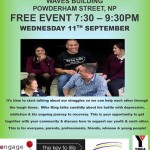
Mike King Korero Heads to Taranaki Region in September

Mike King and Tai Tupou are hitting the road again in September to encourage schools and communities to make it cool to korero about the tough stuff, so we all make it through.

  • 10 September, 1 pm, Cool to Korero, Francis Douglas College, New Plymouth
  • 10 September, 7:30 pm, Community Korero, War Memorial Hall, Stratford
  • 11 September, 7:30 pm, Community Korero, Waves Building, New Plymouth
  • 11 September, 12:30 am, Cool to Korero for Hawera High and Patea Area School, The Hub, Hawera
  • 12 September, 11:30 am, Combined Community Cool to Korero, Opunake College, Opunake

While the team at Key to Life are getting ready to hit the road, the team at Engage Aotearoa will be adding recovery resources from each of these towns to The Community Resources Directory, so they can be delivered to those who need them when the team hits the ground in each of their locations across Taranaki. If you know of any services in the Taranaki region you think others would find useful, email them in.

Study on Social Inclusion and People Living with Schizophrenia

PatientView is seeking respondents for a new study aimed at people living with schizophrenia and their carers.

The study aims to identify some of the challenges faced by people who are affected by schizophrenia- particularly the challenge of being socially included in society. The intention is to identify how healthcare policy can improve and present this information to policy makers.

If you are interested in talking part, follow these links: 6Patients  Carers and families 

This survey will close on Monday 19 August

Another Issue of Chatters from Crossroads Clubhouse

The July-August issue of Chatters for 2013 is out from Crossroads Clubhouse.

Click here to open a PDF copy of Chatters July-August 2013

August e-Bulletin from Te Pou

The August e-Bulletin is out from Te Pou.

Read it online here.

Inside the August e-Bulletin

  • Developing an outcomes culture
  • Te Pou news
  • Sector notices
  • Job vacancies
  • In the news
  • Events

The 1000 Hours Project

DRAFT FCB ARE DONATING 1000 HOURS TO HELP STOP CHILD ABUSE

The people working at DraftFCB feel very strongly about the disturbing levels of child abuse in New Zealand. But strong feelings alone don’t create change, so they’ve decided to do something. It’s a very big and complex problem, and they know that one advertising agency won’t achieve much on its own. But if they can give a boost to an existing, dedicated, long-term organisation, and help that organisation act as an inspiring example to others, then they believe Draft FCB can make a difference. That’s why they’re donating 1000 hours of their communications expertise to the organisation (or organisations) that can best show Draft FCB how they can use it to help protect New Zealand’s children.

Find out more here.

No. 141: Observing Physical Connections

This week, to attain, maintain or regain your sense of wellbeing...

...practice mindfully observing your physical connection to your surroundings. At regular intervals throughout the day, pause and take a minute to notice each of the places your body connects to the environment and what that feels like.

Notice the feeling of your feet on the ground or your back leaning on your chair, the air on your skin, the sun or wind, the sensation of your clothing on your body, and other physical sensations that anchor you to the here and now. Notice that you are connected to the environment around you. Test out shifting your weight on your feet or in your chair, or stretching your body and notice how that feels. Reach out and touch something - a leaf on a tree, or the fabric on a cushion, for example. Notice that you can move your body when you want to, no matter how you are feeling.

Once you are comfortable with this practice, add Observing Physical Connections to your Personal Coping Kete for times of stress and distress, when you need to ground yourself and get present. This is often really useful for dissociation.

Rupene Mare’s Story On Waka Huia: Watch Online

74 year old Rupene Mare is a tough man and he has the ‘guns’ to prove it, but he is a long time sufferer of mental illness. In a TV One Waka Huia episode that screened on Sunday the 28th of July he talks intimately about his remarkable life.

Click here to watch the documentary online.

Updates from the International Initiative for Mental Health Leadership

IIMHL Features – England

Whole-person care: from rhetoric to reality in achieving parity between mental and physical health

A new Report from England argues more should be done to ensure mental health treatments are on the same level as treatments for physical health and more promotion of good mental health and improved funding into research into mental illness are all also crucial for ensuring parity of esteem between­­­ the two aspects of healthcare.

The report, developed by the Royal College of Psychiatrists in conjunction with other mental health organisations, highlights the significant inequalities that still exist between physical and mental health care, including preventable premature deaths, lower treatment rates for mental health conditions and an underfunding of mental healthcare relative to the scale and impact of it. It also highlights the strong relationship between mental and physical health. Poor mental health is associated with a greater risk of physical health problems, and poor physical health is associated with a greater risk of mental health problems.

The report makes a series of key recommendations for Government, policy-makers and health professionals, as well as the new NHS structures which came into force on April 1 including the NHS England, Clinical Commissioning Groups and Public Health England.

Professor Sue Bailey, president of the Royal College of Psychiatrists, said: “Much has been done to improve mental health in the last 10 years but it still does not receive the same attention as physical health, and the consequences can be serious. People with severe mental illness have a reduced life expectancy of 15-20 years, yet the majority of reasons for this are avoidable. Achieving parity of esteem for mental health is everybody’s business and responsibility. We therefore urge the Government, policy-makers, service commissioners and providers, professionals and the public to always think in terms of the whole person – body and mind – and to apply a ‘parity test’ to all their activities and to their attitudes.

Improving Personalised Care and Support for People with Mental Health Problems

From the UK this new guide aims to increase the number of people with mental health problems experiencing the full benefits of personalised care and support. Currently, only 9% of people with mental health problems of working-age have a personal budget, compared to 29% of older people and 41% of adults with a learning disability. Paths to Personalisation, published by the National Development Team for Inclusion (NDTi), offers examples of what needs to be in place to make personalisation work in mental health. It provides examples drawn from latest practice and policy and up-to-date sources of advice for people. Coproduced with people who use mental health services and service professionals, the guide will help organisations meet government priorities to increase people’s choice and control over the care and support they experience.

Additional Features from Scotland

The British Journal of Psychiatry – Special issue focussing on campaign and attitudes

This special issue focuses on stigma and discrimination in England. It describes evaluations of the ‘Time to Change’ campaign conducted in England. It also looks at employment and role of the media.

There are seven articles followed by comments by leading mental health people.
Content Page April 2013, Volume 202, Issue s55 – all open access.

Adult Mental Health Benchmarking Toolkit: Year ending 31st March 2012
(2013). Scotland: National Health Services.
Annual publication of the Mental Health Benchmarking Toolkit comprising data up to 31st March 2010. The toolkit provides information on a range of indicators to compare key aspects of the Adult Mental Health Service in Scotland.

For general enquiries about this update or for other IIMHL information please contact Erin Geaney at erin@iimhl.com


Funding Cuts to Talking Therapies Hits the News

The NZ Herald has reported growing community concern over increasingly restricted funding for talking therapies across the country. Click the headline below to read the full story.

VoiceBoxMEgaphone

Alarm Over Depression Therapy Cuts – NZ Herald, 29 July 2013

Major insurance providers, Sovereign, have disclosed they will only fund medication and exercise as treatments for depression in future, given the cost associated with talking therapies and the number of people who need them.

In the article, Mike King of The Nutters Club and Key to Life Charitable Trust comments “I can say from experience that talk therapy absolutely works. But few people can afford it. We don’t need less talk therapy. We need to be working with the Government and insurance companies to find ways for more people to get affordable or free therapy.”

A representative from Sovereign insurance states that antidepressants are “proven to work” and uses an example of a person who is only mildly depressed following a period of unemployment as a time when talking therapy would be considered unnecessary and antidepressants considered sufficient. “This shows a misunderstanding of the research,” says Engage Aotearoa service director, Miriam Larsen-Barr, “antidepressants have been shown to be effective only at the severe end of the spectrum. People with mild to moderate symptoms can most definitely be helped with talking therapy and are much more likely to respond positively to that than antidepressant medication. People tend to have these experiences for a reason. Talking therapies help people address those reasons in ways that medication alone cannot, for all that it has its place and uses.” 

One might argue that restricting treatment choices to medication or exercise alone limits service-users’ ability to make the best recovery choices for them or freely give their informed consent – choice is considered a fundamental part of consent and choice requires multiple options. This is reflected in the Health and Disability Commissioner’s Code of Consumer Rights. In the recent Partnership Report from Changing Minds, service-users specifically call for a greater range of choice when it comes to their recovery. The NZ Herald article has already inspired much debate.

Comments on Facebook posts sharing the article are calling for some kind of action to address the issue of funding for talking therapies. Funding for therapy has been an issue for quite some time. Improved access to talking therapies was one of the requests made in the Petition for Better Mental-Healthcare Choices that was delivered to parliament in June. The Health Select Committee will be meeting to discuss the petition in the next month or two, but have yet to release the date of their meeting. If you are passionate about this issue and want to add your voice to those calling for better access to the things that work, email your submission to the chairperson of the Health Select Committee Paul Hutchison at  paul.hutchison@parliament.govt.nz or contact your local MP.