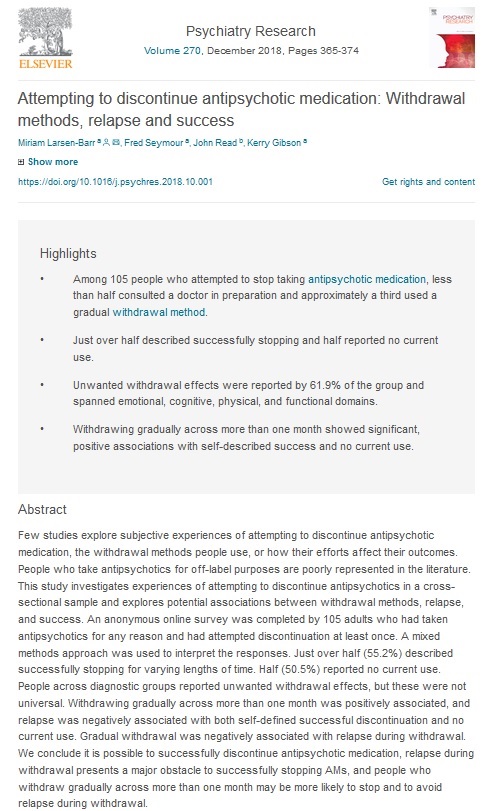
or request a copy of the full-text on Research Gate

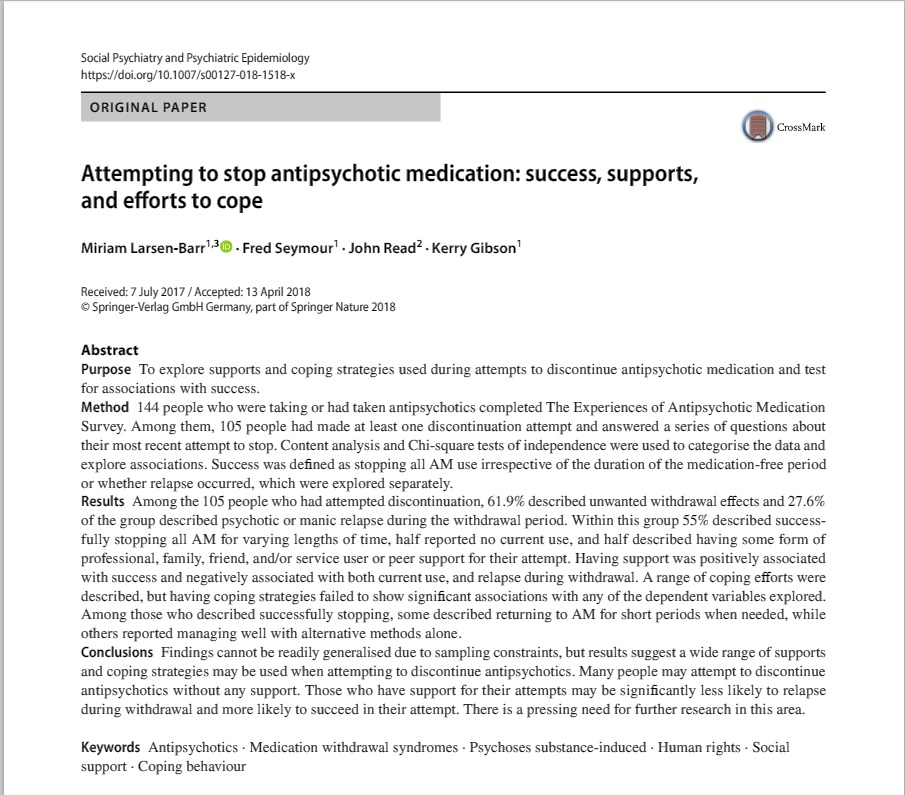
An important part of my doctoral research and some further analysis has just been published in Social Psychiatry and Psychiatric Epidemiology. You can follow this link to view a copy of the full text online, but will need a subscription to download a pdf copy to keep: https://rdcu.be/MpKs
Here’s a screenshot of the abstract for quick reference…
Robert Whitaker has written a critical review of the antidepressant literature for the Mad in America website.
The review has three parts.
This broader review of the research literature does then lead to a dichotomous question for society. Do antidepressants, as they are being prescribed now, “work” for society? Do they produce a public health benefit?”
Read the full article Do Antidepressants Work: A People’s Review of the Evidence here.
In light of the recent media attention on Peer Support Work, the team at Engage Aotearoa thought it timely to share some research on peer support, should members of the community want to get some more information on the topic.
In a review published last year researchers cite a meta-analysis of 11 studies evaluating peer support against case management and clinical professionals in support roles, which concluded “No significant differences in symptoms, hospital admissions, service use, psychosocial functioning or client satisfaction were found. In a second category, six trials compared usual care with services with PSWs in adjunct roles, four with PSWs in mentoring or advocacy roles. There were no significant differences in quality of life, social relations, client satisfaction, hospital admissions, but a small reduction in emergency service use and a larger number of met needs. With these small benefits and no adverse effects found for PSW, Pitt et al. conclude in their review that PSW’s support was noninferior to support by mental health professionals” (emphasis added).
Reference: Mahlke C, Krämer UM, Becker T, Bock T, (2014). Peer support in mental health services. Current Opinion in Psychiatry, 27/4, 276-81. doi: 10.1097/YCO.0000000000000074
In a 2011 review researchers noted that “it seems prudent to mention that a result of no difference demonstrates that people in recovery are able to offer support that maintains admission rates (relapse rates) at a comparable level to professionally trained staff” (emphasis added). They also point to several studies that reported improvements in empowerment, sense of independence, self-esteem, hope and community integration along with reduced internalised stigma. Authors outline several challenges that face peer support workers in the execution of their roles, which require training and organisational support and go on to conclude that peer support workers “have the potential to drive through recovery-focused changes in mental-health services.”
Reference: Repper, J., & Carter, C., (2011). A review of the literature on peer support in mental health services. Journal of Mental Health, 20/4, 392-411.
A 2012 study of peer support worker perspectives of their work, showed that peer support workers are aware of the many challenges they face and highlight the value of their training in enabling them to deal with such challenging issues as self-disclosure and managing boundaries.
Reference: Kemp, V., & Henderson, A.R., (2012). Challenges faced by mental health peer support workers: peer support from the peer supporter’s point of view. Psychiatric rehabilitation journal, 35/4, 337-40.
Find out more about Peer Support in NZ at Kites Trust, the Peer Workers Association or Mind and Body Learning and Development.
Routledge Journals is offering free access to a collection of over 55 articles on the topic of Diversity & Cultural Psychiatry. You can now view and download each of these articles for free, but the offer is only open for a limited time.
For more information visit the Free Article Collection at Taylor and Francis Online here.
Expires July 31, 2015.
Think Differently, led by the Ministry of Social Development, is a social change campaign that seeks to encourage and support a fundamental shift in attitudes and behaviours towards disabled people.
It works across community and national level activities to mobilise personal and community action, to change social attitudes and beliefs that lead to disabled people being excluded, and to increase people’s knowledge and understanding of disability and the benefits of inclusive communities. To support this work, Think Differently commissioned a review of the published and grey literature to understand the factors that cause disabled people to be socially excluded. The review is designed to inform the further development of the Think Differently Campaign. This summary focuses on understanding social exclusion and its key drivers. The methods and a more detailed analysis of the key concepts are provided in the main body of this report.
The following is a press release from Te Pou, from their website:
The resource Competencies for the mental health and addiction service user, consumer and peer workforce were launched on November 11 at Te Pou in Auckland.
Dr John Crawshaw, director of mental health, gave an opening address to the mental health and addiction sector people from across the North Island. He acknowledged the pivotal role the service user, consumer and peer workforce has in informing service development and working alongside clinical services, supporting people to self manage and drive their own recovery.
Dr Crawshaw was followed by two peer support workers who spoke about their experience and what peer work meant for them. Elton Hakopa, addiction peer support worker from the drug court, gave a stirring and entertaining outline of his experiences. Elton gave the quote of the day, or even the year when he said “these competencies are the sandstone I will sharpen my practice on”.
Ahmad Al-Ali, mental health peer worker from Mind and Body, also entertained the crowd with his self-deprecating wit and story of courage. Both exemplified the state of gratitude they were in to be able to use their powerful experiences to support other people’s self-determination and wellbeing.
Robyn Shearer, Te Pou chief executive, talked about the power of people from across mental health and addiction co-designing and co-developing the competencies.
Two documents created to support the competency framework were also launched: The Service user, consumer and peer workforce guide for managers and employers and the Service user, consumer and peer workforce guide for planners and funders. These are available to download alongside the competencies. These documents provide information and sound direction for people managing and employing peer workforce members and for planners and funders investing in this exciting growth area in the mental health and addiction workforce.
To contact Te Pou or for further information:
Email: info@tepou.co.nz
Te Pou phone numbers online here.
The following are some highlights from the latest Taylor and Francis “Psychosis” online releases.
Overcoming distressing voices
Katherine Berry
Understanding the development of narrative insight in early psychosis: A qualitative approach
Eric Macnaughton, Sam Sheps, Jim Frankish & Dave Irwin
Is the content of persecutory delusions relevant to self-esteem?
Johanna Sundag, Tania M. Lincoln, Maike M. Hartmann & Steffen Moritz
Childhood sexual abuse moderates the relationship of self-reflectivity with increased emotional distress in schizophrenia
Bethany L. Leonhardt, Jay A. Hamm, Elizabeth A. Belanger & Paul H. Lysaker
Opinion piece: “Hearing the voices of young people!” Do we require more personal accounts from young people who have psychotic-like experiences?
Patrick Welsh & Roz Oates
For the Psychosis list of issues click here.