
|
The following new articles have just been published in BMC Psychiatry |
|||
| Research article Common stressful life events and difficulties are associated with mental health symptoms and substance use in young adolescents Low NC, Dugas E, O’Loughlin E, Rodriguez D, Contreras G, Chaiton M, O’Loughlin J BMC Psychiatry 2012, 12:116 (17 August 2012) |
|||
| Research article Mental health of asylum seekers: a cross-sectional study of psychiatric disorders Heeren M, Mueller J, Ehlert U, Schnyder U, Copiery N, Maier T BMC Psychiatry 2012, 12:114 (17 August 2012) |
|||
| Research article Patient-reported outcome data generated in a clinical intervention in community mental health care – psychometric properties Priebe S, Golden E, McCabe R, Reininghaus U BMC Psychiatry 2012, 12:113 (17 August 2012) |
|||
| Research article Cannabis use and depression: a longitudinal study of a national cohort of Swedish conscripts Manrique-Garcia E, Zammit S, Dalman C, Hemmingsson T, Allebeck P BMC Psychiatry 2012, 12:112 (16 August 2012) |
Category Archives: Research
New Open-Access Research Online in BMC Psychiatry
Report Shows Excluded Youth Left Unsupported
Excluded Students are ‘Out of School, Out of Mind’
A report released on the 1st of August by YouthLaw Tino Rangatiratanga Taitamariki shows that students are regularly being suspended, excluded, and expelled without proper safeguards and that an Independent Education Review Tribunal is urgently required to provide an inclusive, timely, and accessible means by which school disciplinary decisions can be challenged.
The report, ‘Out of School, Out of Mind: The Need for an Independent Education Review Tribunal,’ is based upon current research literature and data obtained from the Ministry of Education under the Official Information Act.
Vanushi Walters, Managing Solicitor for YouthLaw, says that the Ministry needs to do more to ensure that decisions by principals to stand-down or suspend students, or boards of trustees to exclude or expel are correctly decided, both on their facts and the law.
The report found that 39 percent of students excluded from school were out of the formal education system for at least three months, with a further 13 percent being out for more than nine months. Those from lower-socioeconomic regions were most adversely impacted, with students from low-decile schools being nearly five times more likely to be excluded and twice as likely to be expelled as those from high-decile schools.
“Research shows us that students who are excluded from school are less likely to succeed in life than other young people, and are more prone to anti-social behaviour. We cannot condemn our most vulnerable to a life of failure,” she says. “Yet despite this, principals and boards are judge, jury and executioner over many of these children’s futures. Any decision is effectively final, with no accessible right of appeal or challenge.”
The report recommends the creation of an Independent Education Review Tribunal, based upon the Independent Appeal Panel process currently implemented in England. The Tribunal would provide an affordable, accessible means by which parents and students could challenge school decision-making, and would have the power to reverse unfair decisions.
Both the Report and Summary Document are available on the YouthLaw website.
Send queries to:
- Vanushi Walters, Managing Solicitor, (09) 306 7594, vanushi@youthlaw.co.nz
- Joanna Maskell, Solicitor, (09) 306 7596, joanna@youthlaw.co.nz
- Ben Mills, Legal Education Coordinator, (09) 306 7951, ben@youthlaw.co.nz
Acclaim Otago Launches Independent ACC survey
As a support group for injured people, Acclaim Otago is concerned that there is very little in the way of current and independent data available that accurately describes aspects of an injured person’s experience with ACC.
Acclaim Otago’s president, Dr Denise Powell says, “This is especially obvious when talking about rehabilitation and Vocational Independence. We are hearing anecdotally, that people are being exited from ACC without first receiving meaningful rehabilitation”.
ACC has recently said that “rehabilitation always comes first” but Dr Powell says “We have no simple way of finding out if this is correct or not. ACC does not currently keep data that identifies what happens once a person exits the scheme and we believe that is a huge gap. This survey aims to find out what happens to people who are clients of ACC.”
“We hope to use the survey results to make recommendations that will substantially improve the experience of injured people in New Zealand. We believe any improvements we can identify to the scheme will benefit not just the ACC and their clients, but potentially generations of New Zealanders to come” Dr Powell states.
The survey can be found at
- https://www.surveymonkey.com/s/ACCLAIMsurvey1
- Or by clicking the link on Acclaim Otago’s webpage www.acclaimotago.org
- Or from Acclaim Otago’s Facebook page
Survey About Treatment of Sexual Abuse Victims by ACC
ACC “cold blooded” to victims
by Off the Couch: Kyle MacDonald on June 18, 2012
This post appeared as an article in the Sunday Star Times on Sunday the 17th of June, 2012: click here for the original
A survey around sensitive claims and the treatment of sexual abuse victims has raised more questions about the Accident Compensation Corporation…(Click here for the rest of this blog post)
Research on Psychosis Seeks Family-Member Participants
WHAT IS YOUR EXPERIENCE OF PSYCHOSIS/SCHIZOPHRENIA?
HELP NEEDED FOR PAID RESEARCH
Research into Psychosis / Schizophrenia
Family members and caregivers of people who are treated for psychosis or schizophrenia are sought to participate in a friendly research discussion about these conditions – if you live with or have a friend or family member of someone who has psychosis or schizophrenia you may be just the kind of person the researchers would like to talk with.
All enquiries to: Jonathan Dodd Research Director jonathan.dodd@ipsos.com ph 021 538 634 09 538 0509
Study Looks at Experiences with Antidepressants in NZ
Have your say on your experience of taking antidepressants
Have you been prescribed an antidepressant in the past five years?
A team of university researchers is keen to see what you have to say about a number of things related to your experiences with these types of medications.
The researchers, from The University of Auckland’s Department of Psychology, are for the first time surveying New Zealanders on their antidepressant use.
Anyone who has been prescribed antidepressant medication in the last five years is eligible to take part in the survey, even if they are no longer taking them. And, if you have been prescribed antidepressants but decided not to take them, you are also encouraged to take part.
The research team hopes that at least 1,000 people will take part in the anonymous online survey, which they have called: Views and Experiences of Antidepressants in New Zealand
A parallel survey of GPs is being conducted by a PhD student associated with the research team, seeking doctors’ views about depression and antidepressants.
Power Relations in Communication Reading Resource
Ruth De Souza recently had a chapter on Power Relations published in a book called Communication Across the Lifespan. She very kindly emailed this out amongst the community, as it is valuable reading for any mental-health or health practitioner.
“Introduction
Many practitioners see themselves as apolitical and powerless, particularly with regard to their relationships with the structures of medicine and management. However, in reality practitioners are powerful both as individuals and as members of the groups with which they identify. The structures and cultures within which most health and disability practitioners exist and work are based on beliefs and practices that constrain autonomy. These constraints are at work through a number of mechanisms, such as the market, the infusion of targets and performance measures and quality programmes (Newman & Vidler, 2006). In addition, the changing role of consumers or service users from passive recipients of care in the past to people who may be informed, empowered, articulate and ‘demanding’ poses a threat to the ‘knowledge–power knot’ on which professional power rests.
When practitioners view themselves as people who are doing good, they tend to lack awareness of their complicity and embeddedness in relations of power that structure inequality. Yet, power is embedded in everyday practices and interactions (Bradbury Jones, Sambrook & Irvine, 2008). Practitioners within the wider health and disability sectors contribute to social regulation through their roles as employees of the state. They enact government policies for the benefit of the health of the citizens of the state; so they are both governed and governing. Members of recognised professional groups are provided with a moral authority by their capacity to define problems and pose solutions, and their role in defining and evaluating good or normal behaviour and health practices through surveillance of the population and the criteria for interventions on behalf of the state (Gilbert, 2001, p. 201).
These ambivalent relationships with power that are evident among health professionals require exploration. This can be done by considering the various ways in which power is conceptualised and the micro and macro definitions of empowerment. Some shifts in power have occurred in the last few decades, largely influenced by various social movements. Maternity and mental health are two particular examples of professional practice and service delivery in which power can be recognised and ideas of empowerment can be translated meaningful engagement between service delivery and those who engage with the service.”
Click here to read the full chapter.
Ruth DeSouza, Senior Lecturer (Wed/Thurs and Fri am), Division of Health Care Practice, AUT University, Private Bag 92006, Auckland 1142
- T: +64 9 921 9999 Ext 7770
- e: ruth.desouza@aut.ac.nz
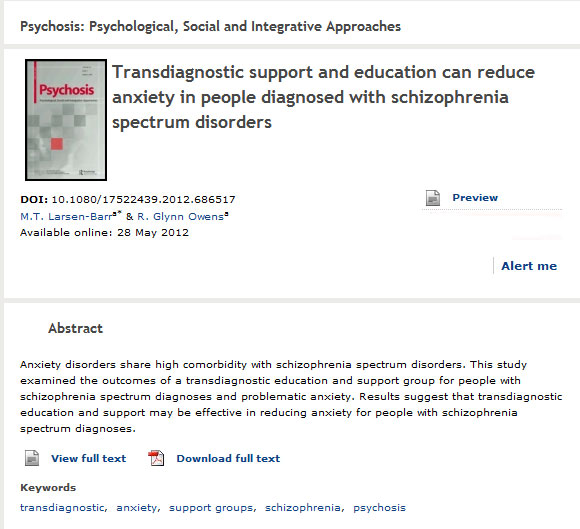
NZ Research: Transdiagnostic support and education for anxiety in schizophrenia
A peer-reviewed research article from Engage Aotearoa’s service director was advance-released online at Taylor and Francis last week and is planned for print publication in Psychosis next year.
The research was conducted for Larsen-Barr’s Master’s Degree research, supervised by Owens at the University of Auckland.
Like Minds Website Evaluation
This survey is for all users of the Like Minds website and will be compared to previous survey results to evaluate how effective the site is and what needs to be updated.
Please take a moment to fill it out.
Paper on the Complexity of a Resilience Approach with Children
Is Resilience Still a Useful Concept with Working with Children and Young People
Youth workers, health practitioners and others working in the youth sector will be interested in a paper just published by the Child Family Community Australia (CFCA) information exchange on the topic of resilience and its meanings when applied to young people. To read the article, visit this link http://arataiohi.fuzion.co.nz/sites/arataiohi.fuzion.co.nz/modules/civicrm/extern/url.php?u=2255&qid=149875