… I will use self-talk to congratulate and praise myself for each small positive thing that happens or each thing that I do well. That means that this week I will notice the little moments of strength, skill, safety and resilience. I will consciously acknowledge these moments to myself, by describing them in my head and giving myself some kind of ‘ well done’ or ‘ good one’ and actually let myself feel good about it. I will make sure that I smile each time. Once I am used to acknowledging my strengths and successes in everyday moments, I will add it to my Personal Coping Kete as a way of soothing negative automatic thoughts during times of stress and distress. Whenever I notice myself feeling stressed, pressed or distressed, I will recall these moments of self-praise to give myself some supportive evidence that I can get through this moment and work to notice the good things I am doing in this moment right now. I will bring myself back to the concept that ‘ this too shall pass‘ by building memories of myself getting through and recalling them when I need to. This starts by building my awareness of the small moments when things go well, rather than only counting the big events as meaningful.
Author Archives: Admin
No. 59: Building a Positive Memory Bank
… I will use self-talk to congratulate and praise myself for each small positive thing that happens or each thing that I do well. That means that this week I will notice the little moments of strength, skill, safety and resilience. I will consciously acknowledge these moments to myself, by describing them in my head and giving myself some kind of ‘ well done’ or ‘ good one’ and actually let myself feel good about it. I will make sure that I smile each time. Once I am used to acknowledging my strengths and successes in everyday moments, I will add it to my Personal Coping Kete as a way of soothing negative automatic thoughts during times of stress and distress. Whenever I notice myself feeling stressed, pressed or distressed, I will recall these moments of self-praise to give myself some supportive evidence that I can get through this moment and work to notice the good things I am doing in this moment right now. I will bring myself back to the concept that ‘ this too shall pass‘ by building memories of myself getting through and recalling them when I need to. This starts by building my awareness of the small moments when things go well, rather than only counting the big events as meaningful.
No. 58: Coming Back to Centre
I will be mindful of the calm, light centre I take within me everywhere I go. No matter what life layers on top of me, that centre is unchangeable. I will be aware that though my moods and thoughts and situation change, I can always return to this light place within. It is there, even when I can’ t see or feel it. Even if I am feeling really low or dark, the light place within me remains. I can touch it whenever I want to. When I notice slight shifts in my mood and frame of mind, I will remind myself that I carry this place within me. In my mind’ s eye I will visualise this calm centre inside me and I will see myself moving towards it, while I practice the standard breathing exercise. In this way, I will practice reminding myself of my own intrinsic, unchangeable worth and capacity to experience something different in a range of different situations. Once I am comfortable noticing slight shifts in my mood and coming back to centre, I will add it to my Personal Coping Kete as a way of self-soothing in the midst of distressing situations.
Chatters Newsletter
Chatters is the in-house magazine for Crossroads Clubhouse. They release this Bi-monthly and the articles reflect the experiences of our community as well as the thoughts/stories/poetry of their members.
Hosted here.
Crossroads Clubhouse is an excellent service-user led support option. Find out more in The Community Resources Directory.
No. 57: That Was Then & This Is Now
….when I notice my mind wandering over the past, I will practice bringing myself back to the present by regularly pausing to describe each of the elements of my environment in the present moment. I will use the standard breathing exercise to send my body calming messages, while I look around my current environment and observe what is happening around me right now. Once I am familiar with recalling myself to the present moment in everyday situations, I will add it to my Personal Coping Kete as a way of distracting myself from distressing memories and recollections. When my mind wanders back onto the memories, I will give myself compassion for the distress that the event originally caused and then move my awareness back to the current moment, in which I am safe. For example, I could say to myself “it’ s natural to be remembering that now. That was then, and this is now, right now I am in a room at the computer….[describe the room] … and I am safe.” I will be kind to myself with my self-talk when these remembrances occur. Especially, I will give myself the kindness of bringing myself back to the present when I need it.
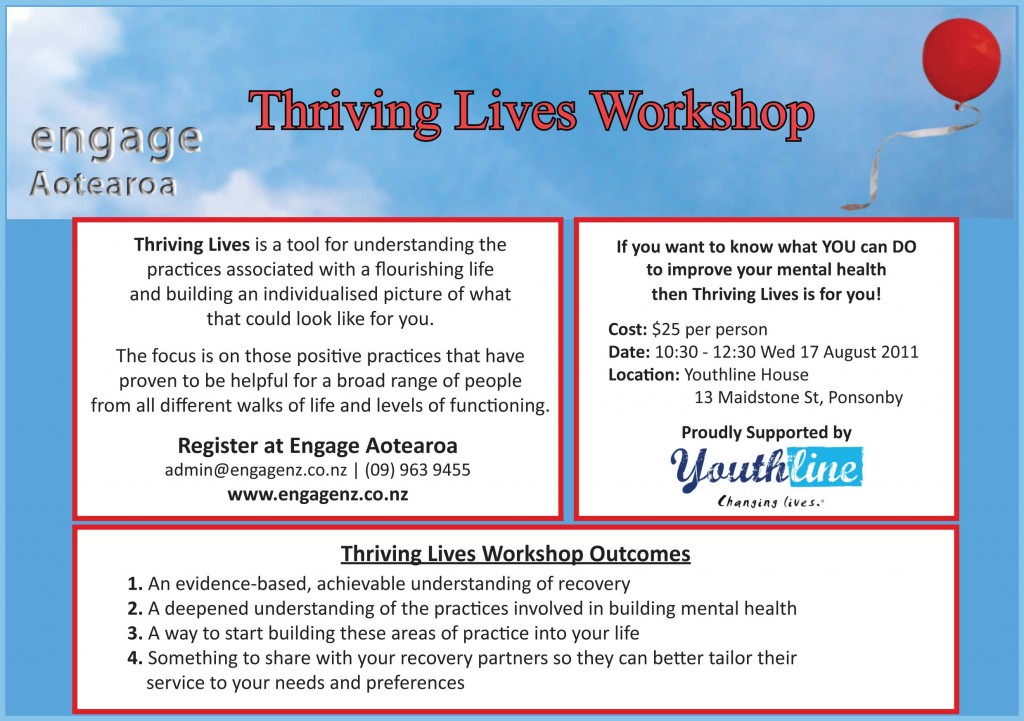
Thriving Lives Workshop on 17 August is Full
Enrolments for the August 17th session of Thriving Lives closed yesterday and we’re pleased to report an almost full session! Seventeen people are now looking forward to gathering in a week and a half to develop some new ways to improve their experience of wellbeing.
The next Thriving Lives Workshop will be on 11 October at Youthline House – so if you missed out this time, you can enrol in the October session any time until September 30th.
Contact us for an enrolment form.

No. 56: The Kind-Hearted Self-Therapist
I will practice using a self-interview technique to give myself support and get clear on what is happening for me each day. The self-interview technique involves inventing my own ideal supporter or self-therapist and then taking on the role myself by asking myself a series of gentle questions and answering them. I can do this in my head or on a piece of paper. A lot of people find it easier on paper to begin with. In preparation for practicing the technique, I will write a short list of questions down on a small piece of paper that I can easily keep handy to jog my memory. This is important because I will probably find it hard to think of useful questions to ask myself when I am in the middle of feeling stressed or distressed. Also in preparation, I will invent a whole character around this self-therapist based on the ideal form of support I would like to receive when I am distressed – then when I do the activity, it might be easier to practice talking to myself in this loving, compassionate way, especially if it is something I don’ t do very often. I will then practice using my kind-hearted self-interview about my daily experience every day. Once I am comfortable interviewing myself about my daily experiences in a compassionate way like this, I will add it to my Personal Coping Kete as a way of dealing with stress and distress. When I notice that I am feeling stressed or distressed, I will pause and use the self-interview to give myself a moment to become aware of what is driving my response and what could balance it out in a supportive, compassionate way. Some good questions to ask myself might be:\r
- \r
- What is in my mixed-bag of feelings right now?
- What thoughts have been running through my head?
- What is happening around me right now?
- What are the other possible interpretations of these events?
- What evidence do I have for these alternative interpretations?
- What interpretations take all of the evidence into account?
\r
\r
\r
\r
\r
\r
\r This exercise will allow me to practice stepping out of the moment to access a more objective state of mind that fits with my way of seeing things. When human beings are distressed our attention naturally narrows down to focus only on the things that are distressing so we can react to them – this exercise will allow me to return to a more expansive viewpoint that is able to take in all of the elements of the situation around me before I react. Often this will change the way I feel about the situation and bring the intensity of my responses down. It takes time to get familiar with techniques like this one – if we are used to being our biggest self-critic, we might find ourselves engaging in self-judgement at various times, which can sometimes make these thought-based activities distressing. I will pay special attention to giving myself encouraging self-talk and compassion during the activity, respecting the way I react to and cope with things. In this way, I will take the role of kind-hearted, self-therapist. I could give myself my ideal form of support, regardless of what kinds of support I am actually being given from the people around me.
No. 55: Progressive Muscle Relaxation
This week, to attain, maintain or regain my sense of wellbeing...
...practice progressive muscle relaxation. Find a quiet place where you can lie down comfortably and spend 10-15 minutes systematically tensing and relaxing each muscle group in your body.This is about inducing a sensations of relaxation and being really mindful of what we are doing. Thoughts will come and go, just notice whenever you are distracted and come back to the task at hand.
Start with your toes and work your way up through your body: feet, calves, thighs, stomach, chest, hands, arms, shoulders, neck, and face. For each muscle group, tense the muscles for 5-10 seconds, really focusing on what this feels like, then release and relax for 10-15 seconds, noticing the difference between tension and relaxation.
Try to keep your breathing slow and regular as in the standard breathing exercise, as you work your way through my body, tensing and releasing one muscle-group at a time.
Once you are comfortable with this practice, add Progressive Muscle Relaxation to your Personal Coping Kete for times of stress and distress.
Here is a recorded exercise you can use to guide you as you learn.Click the link below to download the MP3 file to your device.
Progressive Muscle Relaxation audio by Miriam Larsen-Barr
Case Study on Engage Aotearoa in the latest issue of MindNet
Click the link below to read the Case Study on Engage Aotearoa in the latest issue of MindNet (issue 23), the quarterly e-journal by the Mental Health Foundation of New Zealand.
www.mentalhealth.org.nz/newsletters/view/article/23/323/case-study%3A-we-are-all-connected/
In this issue, Engage Aotearoa service-director Miriam Larsen-Barr discusses how Engage Group got started, what the programme is all about and how it effects people – among other things.
No. 54: Paint
I will practice painting something on a piece of paper, wood, cloth or canvas to shift the moment. It doesn’ t matter what I paint, I will focus my attention on the sound of the brush on the surface and allow myself to get lost in the brush-strokes. I could simply colour in the surface, paint how I feel or try to copy something that is around me. Painting is great because I can start it and then come back to it later. When things get stressful or distressing, I can return to the artwork and add to it or I can start a new one if I am feeling completely different. This will give me some brief valuable ‘ me’ time in my day where I can distract myself from what’ s going in my day or a moment. This gives my unconscious mind a bit of a rest and sets me up for a moment of safety. I could get a few tubes of acrylic paint for a few dollars each from my local stationary shop. Some emporium style shops have a great range of really cheap paints, brushes, papers and canvases – but really, I can paint on anything. If I keep in mind that I can do a lot with just one colour and I’ ll be able to get started almost straight away. Once I am used to taking a few moments to paint in my everyday life, I will add it to my Personal Coping Kete as a way of shifting or expressing moments of stress and distress.\r
This week’ s strategy comes from a participant at today’ s RCNet Monthly Forum. We’ ve fleshed it out a bit.
No. 53: Regular Reflection-Points
I will spend some time reflecting on where I am and where I want to be. This week will be a period of planning what I want to work on next. As I move through my week, my distress responses and feelings of dissatisfaction will become useful indicators that give me clues on what I would like to be different in my life. I will remind myself that I am a work in progress and the messy areas are simply the bits I haven’t gotten to yet. We’ve now been posting weekly strategies for a year. Today’s post marks the beginning of the next round of strategies. This week, I will keep a notebook on me at all times. Whenever I notice something that I would like to be better at or find easier or respond differently to, I will write it down. At the end of each day I will spend a bit of time reading over my notes for that day. I will spend some time writing down what skills and strengths I will need to develop in order to transform these things for myself. At the end of the week, I will look back over my reflections and select the easiest, simplest one to work on first. In the coming weeks, I will focus on practicing techniques that will help me to develop this skill. I will add ‘A Reflect Point’ to my Personal Coping Kete and return to it from time to time to review where I am at and where I want to go.