

Author Archives: Admin
Latest RCNet Update is Live Online
Click here to read the latest update from RCNet (Soon to be Changing Minds).
Research: Mental Health practitioners’ perspectives of working with Chinese migrants in New Zealand
Jing Xu is a Master of Social Work student at the University of Auckland. She would like to invite you to take part in a study about “the mental health practitioners’ perspectives on working with Chinese migrants in relation to mental health service delivery and accessibility”.
What is the study about?
Jing Xu would like to speak with mental health practitioners individually to understand the following themes:
(1). Identification of the impediments that Chinese migrants may experience in relation to the access and use of mental health services
(2). Identification of the challenges that mental health practitioners face in delivering services to Chinese immigrants
(3). Determining strategies, solutions, and/or new approaches which would improve professional practice when working with Chinese immigrants.
Through this study, it will be possible to identify critical issues and ways that mental health practitioners can deliver culturally appropriate services to Chinese immigrants.
The focus of this study is on your professional perspectives of working with Chinese migrants in mental health settings rather than upon the specific workplace practices of your agency or organisation that you have been or are currently employed.
More Information
If you would like to participate, or you have any questions about this study, please contact Jing Xu to discuss the project further. Her email address is jxu090@aucklanduni.ac.nz
APPROVED BY THE UNIVERSITY OF AUCKLAND HUMAN PARTICIPANTS ETHICS COMMITTEE ON 05-Jul-2012 for (3) years, Reference Number 8093
It’s not OK Campaign Turns Focus to Protecting Children
New Resources from It’s not OK campaign focus on protecting children
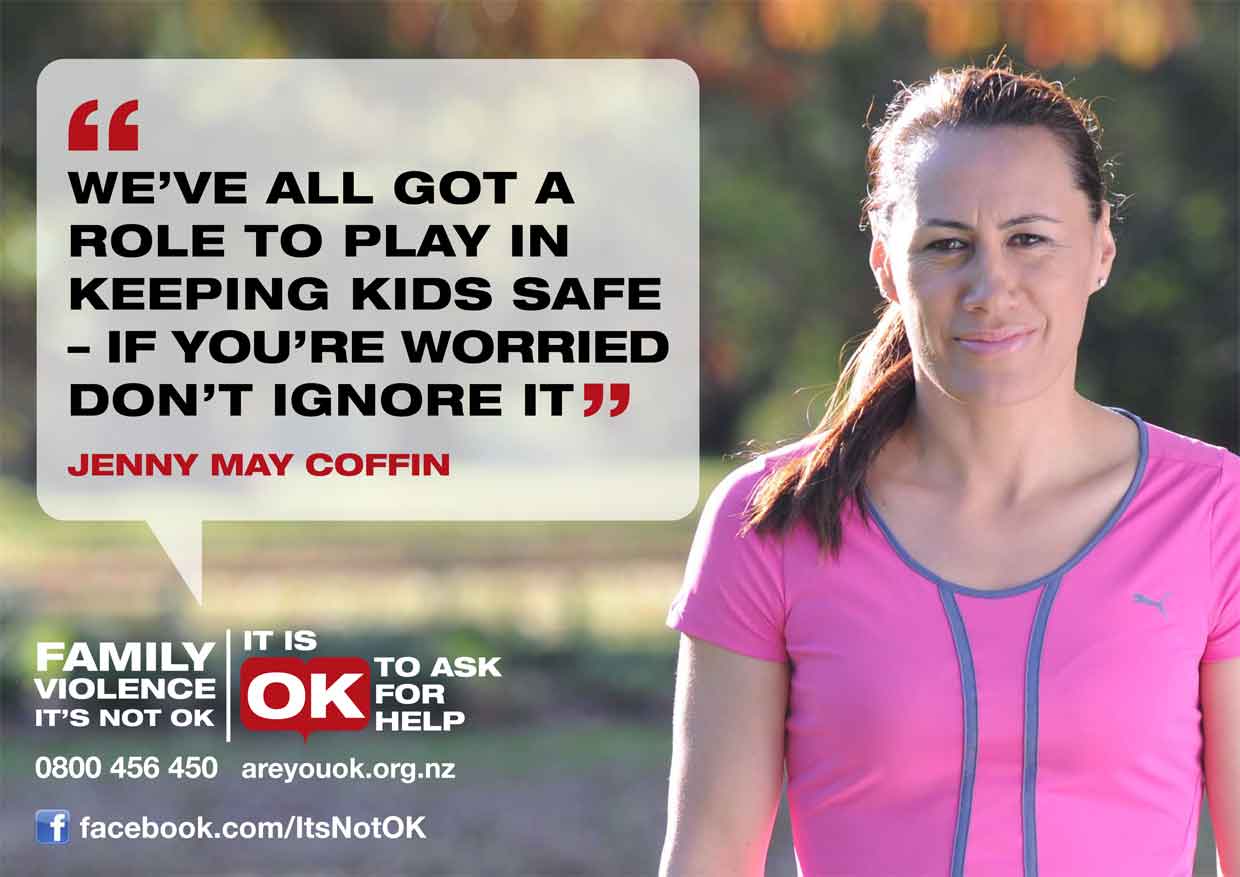 A new series of posters, postcards and stickers focus on the role we all have to play in protecting children in our families and communities.
Research shows that violence in the home affects children whether they see it, hear it or just know about it.
Child abuse is most often linked to partner abuse. In 2010 70% of child abuse cases attended by Police were family violence related and half involved children being present.
 All Black Liam Messam, Sports Broadcaster Jenny May Coffin and Comedian Ben Hurley feature on the new resources.
The new resources can be ordered from 1 August by any person or organisation from the It’s not OK website at http://www.areyouok.org.nz/.
Also, don’t forget to keep in touch with what’s happening around the country at www.facebook.com/ItsNotOK
Violence against women in NZ focus of UN Committee
Violence against women in New Zealand focus of UN Committee ‘Violence against women was a major concern for the UN Committee reviewing the status of women in New Zealand, when it met yesterday’ says Julie Radford-Poupard, one of the non-government representatives at the United Nations recently.
‘Committee members questioned whether current changes in New Zealand such as legal aid restrictions, the introduction of fees in the Family Court, the restructuring of family violence funding, and a trend towards encouraging the resolution of relationship disputes out of court, may be increasing the barriers for women seeking to leave violent relationships and risking their safety’ says Ms Radford-Poupard.
Link to Voxy Press Release: http://www.voxy.co.nz/national/violence-against-women-nz-focus-un-committee/5/129547
Stress and Technology at Work Survey
The Impact of Technostress on Job Satisfaction and Organisational Committment
This survey is being completed as part of Kelly Qiu’s Master Thesis Research at Massey University
The purpose of this questionnaire is to understand technology-related stress and its impact on employee’s job satisfaction and organizational commitment.
Employees who work full time or part time in an organisation and use computer or mobile technology at work can fill in this questionnaire.
The questionnaire will take no more than 5 minutes to complete and is completely anonymous. All results are confidential and will only be used for the purpose of this research. No individual candidate can or will be identified and participation is voluntary. Participants can withdraw from the survey anytime they prefer.
If you require more information about this survey and your involvement you can email Kelly Qiu
- Email: kellyqw0715@gmail.com
You may direct any questions or concerns you may have to research supervisor Dr Darryl Forsyth
- Email: D.Forsyth@massey.ac.nz
This research project has been evaluated by peer review and judged to be low risk. Consequently, it has not been reviewed by one of the University’s Human Ethics Committees. The researchers name above are responsible for the ethical conduct of this research.
Any questions or complaints about the ethical conduct of this research may sent to
Professor John O’Neil, Director (Research Ethics), Telephone: 06 350 5249, Email: humanethics@massey.ac.nz
New Open-Access Research Online in BMC Psychiatry
|
The following new articles have just been published in BMC Psychiatry |
|||
| Research article Common stressful life events and difficulties are associated with mental health symptoms and substance use in young adolescents Low NC, Dugas E, O’Loughlin E, Rodriguez D, Contreras G, Chaiton M, O’Loughlin J BMC Psychiatry 2012, 12:116 (17 August 2012) |
|||
| Research article Mental health of asylum seekers: a cross-sectional study of psychiatric disorders Heeren M, Mueller J, Ehlert U, Schnyder U, Copiery N, Maier T BMC Psychiatry 2012, 12:114 (17 August 2012) |
|||
| Research article Patient-reported outcome data generated in a clinical intervention in community mental health care – psychometric properties Priebe S, Golden E, McCabe R, Reininghaus U BMC Psychiatry 2012, 12:113 (17 August 2012) |
|||
| Research article Cannabis use and depression: a longitudinal study of a national cohort of Swedish conscripts Manrique-Garcia E, Zammit S, Dalman C, Hemmingsson T, Allebeck P BMC Psychiatry 2012, 12:112 (16 August 2012) |
Report Shows Excluded Youth Left Unsupported
Excluded Students are ‘Out of School, Out of Mind’
A report released on the 1st of August by YouthLaw Tino Rangatiratanga Taitamariki shows that students are regularly being suspended, excluded, and expelled without proper safeguards and that an Independent Education Review Tribunal is urgently required to provide an inclusive, timely, and accessible means by which school disciplinary decisions can be challenged.
The report, ‘Out of School, Out of Mind: The Need for an Independent Education Review Tribunal,’ is based upon current research literature and data obtained from the Ministry of Education under the Official Information Act.
Vanushi Walters, Managing Solicitor for YouthLaw, says that the Ministry needs to do more to ensure that decisions by principals to stand-down or suspend students, or boards of trustees to exclude or expel are correctly decided, both on their facts and the law.
The report found that 39 percent of students excluded from school were out of the formal education system for at least three months, with a further 13 percent being out for more than nine months. Those from lower-socioeconomic regions were most adversely impacted, with students from low-decile schools being nearly five times more likely to be excluded and twice as likely to be expelled as those from high-decile schools.
“Research shows us that students who are excluded from school are less likely to succeed in life than other young people, and are more prone to anti-social behaviour. We cannot condemn our most vulnerable to a life of failure,” she says. “Yet despite this, principals and boards are judge, jury and executioner over many of these children’s futures. Any decision is effectively final, with no accessible right of appeal or challenge.”
The report recommends the creation of an Independent Education Review Tribunal, based upon the Independent Appeal Panel process currently implemented in England. The Tribunal would provide an affordable, accessible means by which parents and students could challenge school decision-making, and would have the power to reverse unfair decisions.
Both the Report and Summary Document are available on the YouthLaw website.
Send queries to:
- Vanushi Walters, Managing Solicitor, (09) 306 7594, vanushi@youthlaw.co.nz
- Joanna Maskell, Solicitor, (09) 306 7596, joanna@youthlaw.co.nz
- Ben Mills, Legal Education Coordinator, (09) 306 7951, ben@youthlaw.co.nz
No. 110: A Sense A Day
This week, to attain, maintain or regain my sense of wellbeing…  … I will use mindfulness of my senses to practice shifting my thoughts and improving the moment. This week, I will regularly tune my attention into one of my senses each day and deliberately plan activities that will allow me to indulge it a little. I will plan in advance which sense I will do each day, and then throughout that day I will make myself aware of that sense. The next day I will practice being aware of a different one of my five senses. For example, on Monday I might pay particular attention to what I taste whenever I eat or drink, on Tuesday I might stop what I am doing for a moment throughout my day and pay attention to the different things I hear, on Wednesday I might practice being aware of the sensations I have when I touch things, on Thursday I might practice taking time to pay attention to the sights around me, on Friday I might practice taking time out to notice the smells around me. In this way, I will practice mindfully shifting my attention onto something different. Once I am comfortable practicing mindfully shifting my attention like this, I will add it to my Personal Coping Kete as a way of distracting myself from unhelpful thoughts when I am distressed or stressed.
… I will use mindfulness of my senses to practice shifting my thoughts and improving the moment. This week, I will regularly tune my attention into one of my senses each day and deliberately plan activities that will allow me to indulge it a little. I will plan in advance which sense I will do each day, and then throughout that day I will make myself aware of that sense. The next day I will practice being aware of a different one of my five senses. For example, on Monday I might pay particular attention to what I taste whenever I eat or drink, on Tuesday I might stop what I am doing for a moment throughout my day and pay attention to the different things I hear, on Wednesday I might practice being aware of the sensations I have when I touch things, on Thursday I might practice taking time to pay attention to the sights around me, on Friday I might practice taking time out to notice the smells around me. In this way, I will practice mindfully shifting my attention onto something different. Once I am comfortable practicing mindfully shifting my attention like this, I will add it to my Personal Coping Kete as a way of distracting myself from unhelpful thoughts when I am distressed or stressed.
What is Good Medical Practice to you?
Under section 118 of the Health Practitioners Competence Assurance Act 2003 the Medical Council of New Zealand (the Council) is responsible for setting “standards of clinical competence, cultural competence and ethical conduct” for doctors. In 1998 the Medical Council developed Good Medical Practice to be the foundation document for the standards they set…
Good Medical Practice aims to outline the duties of a good doctor in a simple and direct manner. It is intended to help doctors to monitor their own conduct and the conduct of their colleagues. It is also intended to serve as a source of education and reflection for medical students. The Council are also aware that it is often referred to by patients who are uncertain about the quality of care they have received. They have tried to make the resource accessible to all of these groups, and endeavoured to ensure that the standards outlined are clear and easy to follow.
Good Medical Practice also has another important function. It is often used as a standard against which professional conduct is measured. It is used by the Health Practitioners’ Disciplinary Tribunal, the Council’s Professional Conduct Committees and the Health and Disability Commissioner in determining whether a doctor has acted appropriately or not. The advice it contains therefore needs to establish a clear line in the sand against which conduct can be measured.
Good Medical Practice was last reviewed in 2006. The Council is seeking feedback from doctors, patients and other agencies engaged in the regulation and practise of medicine on this resource, and on changes that they are proposing to make.
While the Council believes that Good Medical Practice remains useful and relevant, they also think that it could be improved in a number of ways. They are seeking your comments on the proposed changes, and also your responses to a number of specific questions.
Quite a few of these changes they propose are minor, but a number outline new or different standards. The Council appreciates that your time is precious, so have tried to summarise the most important changes in a consultation paper. However, if you do have the time they would also encourage you to review both the consultation paper and a complete copy of the draft Good Medical Practice that includes details of all of the suggested changes.
Download Good Medical Practice Consultation paper
Download draft Good Medical Practice
Please send your comments to Michael Thorn, the Council’s senior policy adviser and researcher by 12 October 2012. You can either complete the questions in the consultation paper or in the complete copy of the draft Good Medical Practice and send your responses to Michael at mthorn@mcnz.org.nz or post it to:
Michael Thorn
Senior Policy Adviser and Researcher
Medical Council of New Zealand
PO Box 11-649
Willis Street
Wellington 6011
Please also feel free to send Michael any other comments or suggestions you have about Good Medical Practice.